The Maester
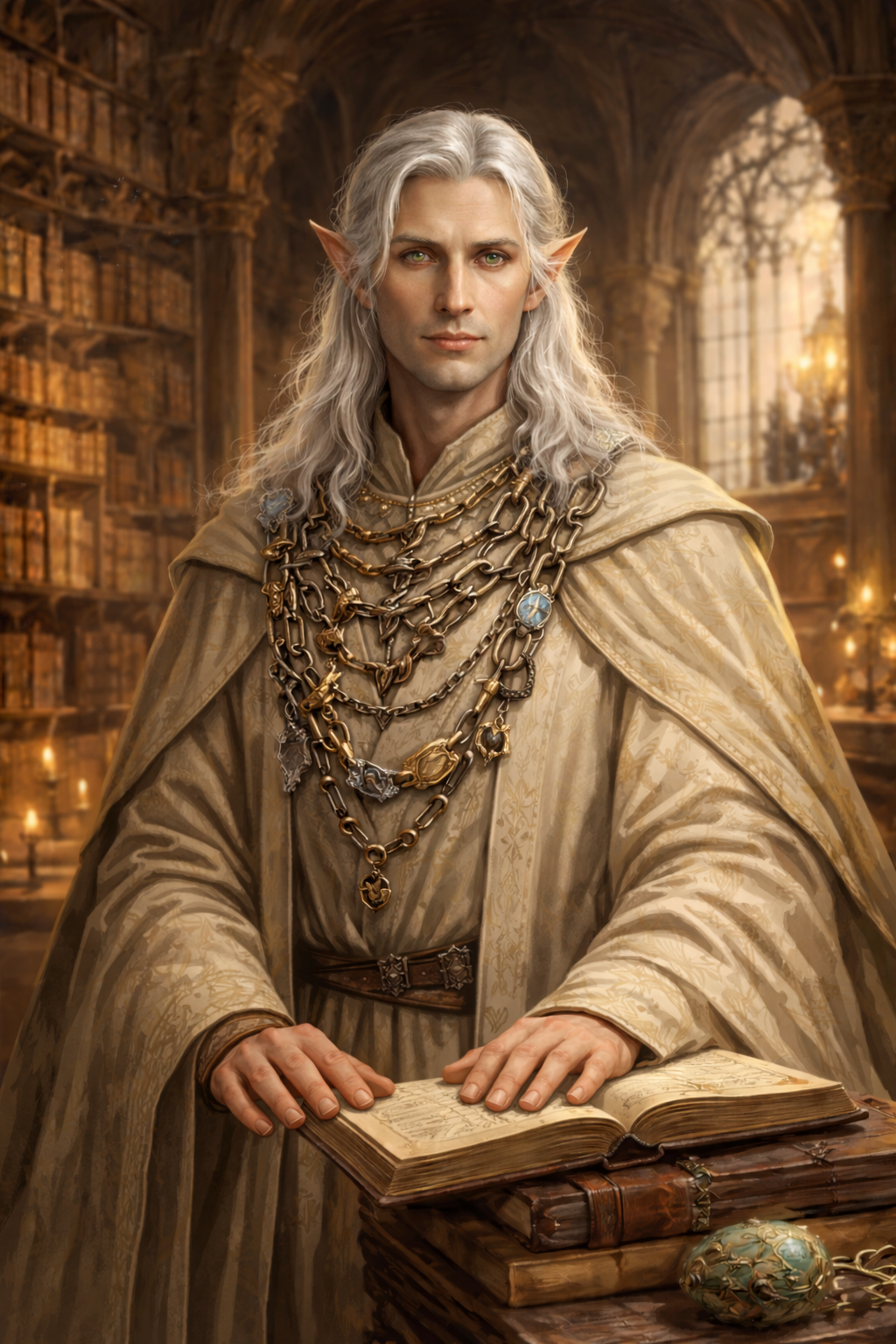 |
Maesters are often referred to as "knights of the mind," and their broad learning and experience is useful to nobles and lords across the Kingdoms. Maesters are trained in Universities and Citadels of Knowledge, in a number of different arts. They wear a chain, each link made of a different metal to signify mastery over a different art. Once a Maester dons his chain, he takes a vow of service for the rest of his life. The Maesters are the secular advisors to kings and lords just as the Priests are their spiritual advisors.
Maesters can be of any race or either sex but most are either Elven or Human males.
- Human Maesters: Humans represent the majority of Maesters, especially within Human-dominated regions. Their drive for knowledge is fueled by an inherent curiosity, practical thinking, and a deep-seated desire to understand the world in all its complexity. Human Maesters are most often found in fields that emphasize practical application, such as:
- Medicine: Human Maesters are often highly regarded as skilled healers and physicians. They are dedicated to the art of physical and magical healing, inventing remedies, and pioneering new medical treatments.
- History: The study of the past, the recording of events, and the quest to understand the roots of their civilizations are critical to Human Maesters. They may serve as historians or chroniclers, keeping detailed records of wars, politics, and cultural shifts.
- Statecraft: Many Human Maesters take on roles as advisers to monarchs, nobles, or military leaders. Their expertise in politics, diplomacy, and strategy makes them valuable assets in court and on the battlefield.
- Technology: Humans are often at the forefront of technological advancements, and Human Maesters are no exception. They may dedicate themselves to studying mechanical innovations, magical constructs, and the synthesis of magic and technology.
The Human drive to explore the physical world, combined with their relatively short lifespans, means that Human Maesters often prioritize practical applications of knowledge. They are typically hands-on and may be more interested in finding tangible solutions to immediate problems than in exploring the esoteric or abstract aspects of magic and history.
- Ancient Languages: Elven Maesters possess an unparalleled knowledge of the languages of the ancient world. They can read and decipher texts that date back to the earliest ages of the world, including languages that have been long forgotten. This makes them invaluable in uncovering lost magical knowledge or historical records.
- Magical History: Elven Maesters are often custodians of ancient magical traditions, keeping detailed accounts of lost and ancient forms of magic that have been forgotten by other races. They might even have access to powerful spells or rituals that can only be performed by those with a deep understanding of the world's magical history.
- Lost Arts: The Elven race, with its profound connection to nature and magic, often seeks to preserve ancient and sometimes obscure arts, such as the forging of powerful relics, the creation of enchanted artifacts, or the mastery of elemental magic. Elven Maesters are often called upon to teach these arts to new generations of Elves.
- Divine and Cosmic Studies: Elven Maesters frequently dedicate their lives to understanding the divine, cosmic forces, and their connection to the natural world. They may engage in meditation, commune with spirits or gods, or spend their time interpreting celestial phenomena. Elves have centuries, if not millennia, of accumulated wisdom, and the preservation of this knowledge is a central concern for many Elven Maesters. While Humans may be focused on making advancements and solving practical issues, Elves approach their role with reverence, patience, and a sense of spiritual duty. Their deep understanding of the arcane, the natural world, and the broader cosmos gives them a unique perspective that is unmatched in the realm of magical academia.
Key Differences Between Human and Elven Maesters:
- Motivation:
- Humans are driven by a desire to understand the world, solve problems, and improve society through practical applications. They are motivated by curiosity and the urge to document and systematize knowledge.
- Elves, on the other hand, are motivated by the need to preserve the ancient wisdom of their people, protect the arcane secrets of the world, and maintain harmony with the mystical forces. Their long lives allow them to take a more reflective, patient approach to knowledge.
- Focus:
- Human Maesters typically focus on practical and immediate concerns such as medicine, history, statecraft, and technology, with an eye toward making a tangible impact on their society.
- Elven Maesters focus more on ancient knowledge, magical studies, and spiritual practices. They seek to understand the larger forces of the universe, preserving knowledge that has stood the test of time.
- Lifespan and Experience:
- Humans have shorter lifespans, which drives their focus on the immediate and tangible. Their knowledge is often based on recent history and practical applications.
- Elves live for centuries, if not millennia, which allows them to accumulate vast amounts of knowledge and wisdom over their long lives. Their understanding of the world is deeply interwoven with their history, magic, and connection to nature.
Overall Role of Maesters in Society: Whether Human or Elf, Maesters hold a prestigious position as keepers of knowledge and wisdom in their respective cultures. They are the ones who preserve the past, guide the present, and shape the future. While Human Maesters tend to focus on knowledge with immediate utility, Elven Maesters look to the preservation of timeless truths, magical traditions, and ancient practices. The blend of these two perspectives often creates a vibrant exchange of ideas, ensuring that the role of the Maester remains one of great importance in both Human and Elven societies.
Personality and Role: Maesters are scholars and advisors first and foremost. The role of a Maester in any kingdom is to provide counsel based on wisdom, history, and magical knowledge. However, there are distinct differences between Human and Elven Maesters:
- Methodical and Pragmatic: Human Maesters tend to be more practical in their approach. Their studies focus on history, medicine, statecraft, and technology. They are driven by curiosity and problem-solving and approach challenges with real-world solutions.
- Military and Diplomacy Focus: Often, Human Maesters serve as military advisors, healers, and historians in royal households. They are problem-solvers, using their knowledge of heraldry, strategy, and medicine to assist the kingdom.
- Pragmatic Healers: While they do dabble in magical healing, Human Maesters are often more practical, relying on herbs, potions, and other remedies that can be replicated by others.
- Timeless Scholars: Elven Maesters approach their studies with the patience and depth of a being who may live for centuries. They focus on long-term projects, such as preserving the ancient arts of the Elves and understanding the mystical past of the world.
- Arcane and Mystical Knowledge: Elven Maesters are often drawn to the study of ancient magic, lost languages, and the forgotten histories of the Elven kingdoms. Their deep connection to the arcane and their long lives allow them to preserve knowledge in ways that Human Maesters simply cannot.
- Patience and Reflection: Elven Maesters are introspective, often preserving knowledge for future generations, waiting for the time when that knowledge will be needed again.
- Level 1-3:
- Maesters begin their journey as Scholars-in-Training or Scribes in Universities or Citadels of Learning, under the tutelage of Archmaesters. They serve as advisors to smaller houses or regions, focusing primarily on research and specializing in one area of expertise (such as history, medicine, or alchemy).
- Level 4-6:
- Maesters are called Junior Maesters and start taking on more prestigious roles in the kingdom, serving at noble houses, royal courts, or military academies. They are relied upon for their medical expertise, historical knowledge, and advice on diplomacy.
- Some may begin specializing in arcane knowledge or research into the magical arts.
- Level 7-9:
- Maesters are now well-respected advisors to kings and noble houses. They are consulted on matters of statecraft, military tactics, and mystical phenomena.
- Level 10-12:
- Maesters at this level hold significant power and influence and are considered Grand Maesters. They act as chief advisors to the ruling families, participate in the Councils, or lead major research expeditions into forgotten corners of the world. Their medical breakthroughs or arcane discoveries could shape the future of the realm.
- Level 13-15:
- These Maesters called Arch-Maesters are legendary figures, wielding considerable influence. They are consulted by kings, high lords, and adventurers for their vast knowledge. Elven Maesters at this level may influence the very course of history, seeking to restore ancient knowledge or uncover secrets of ancient Kingdoms. They may serve as mediators, archivists, or even spiritual guides.
- Medical Knowledge: Maesters are skilled in both traditional medicine and magical healing. They can perform basic surgery, herbal treatments, and alchemical remedies for ailments.
- Historical Expertise: A Maester's knowledge of history, royal lineages, and ancient cultures makes them invaluable to those seeking to understand the past. Elven Maesters, in particular, possess knowledge of Elven history, arcane practices, and the fallen civilizations.
- Research and Scholarship: Maesters are unparalleled researchers, with the ability to uncover ancient texts, artifacts, and knowledge from long-forgotten times. They are often the ones to unearth lost languages, mystical symbols, and ancient prophecies.
- Magic and the Occult: Many Maesters delve into arcane studies. Elven Maesters are more likely to study ancient spells, rituals, and mystical practices due to their longer lifespan and deep connection to magic.
- Human Maesters may focus more on practical knowledge, preserving records of technological advancements, political events, or medical breakthroughs.
- Elven Maesters, in contrast, often focus on maintaining magical knowledge, recording the rituals, spells, and wisdom of ancient Elven civilizations. Their long lifespan enables them to witness and protect knowledge across centuries, making them particularly adept at managing vast archives.
- Human Maesters are especially useful in court politics, leveraging their knowledge of history, law, and diplomacy to maintain order and advise on matters of state.
- Elven Maesters, with their understanding of magic and long-term perspectives, often serve as mediators between mortal kingdoms and the magical or divine realms, ensuring that their people remain in harmony with the mystical forces at play in the world.
- Human Maesters often focus on herbalism, surgery, and alchemy. Their knowledge of these fields allows them to craft potions, cure diseases, and treat injuries, often using cutting-edge techniques or new inventions.
- Elven Maesters may rely on magical healing methods, using their connection to nature, the elements, or divine forces to restore health. Their long lifespans also allow them to become masters of ancient, mystical healing practices passed down through generations.
- Junior Maesters typically begin their careers as apprentices, assisting senior Maesters with research, documentation, and fieldwork. They might focus on a specific discipline, such as magical studies, history, or healing, and serve under the tutelage of a more experienced scholar.
- Senior Maesters are recognized for their vast knowledge and experience. They often oversee entire institutions of learning, lead diplomatic missions, or hold positions of great influence within the ruling classes. They may also be tasked with the protection of important artifacts, historical sites, or magical relics.
- Arcane Lore: These Maesters are experts in the study of magic, focusing on its history, development, and its role in shaping societies. They might also study forbidden magic or lost spells, seeking to uncover or rediscover powerful and ancient arcane knowledge.
- Political Strategy: Maesters who specialize in the understanding of power dynamics, governance, and diplomacy. They may become the trusted advisors to kings, queens, or powerful nobles, offering insights into how to manage or manipulate political affairs.
- Divine Magic: These Maesters delve into the study of divine magic, the interaction between mortals and gods, and the manipulation of sacred energies. They may also oversee temples or shrines and provide spiritual guidance to rulers or common folk alike.
- Ancient Artifacts: Specialists who dedicate their lives to the study, preservation, and sometimes the search for ancient relics, magical items, or artifacts of great power. These Maesters may work in tandem with adventurers, scholars, and historians to uncover lost treasures of immense historical and magical value.
- A Staff: Often used both as a walking aid and a tool for magical focus. Elven Maesters may imbue their staffs with magical properties or carry them as a symbol of their wisdom.
- Books and Scrolls: The primary tools of a Maester are their books, scrolls, and writing materials. These documents may be enchanted to preserve knowledge, or they might be physical records of critical information like medical texts or magical formulas.
- Healing Kits: Especially for those Maesters who work in the medical field, healing kits may contain herbs, potions, bandages, and alchemical tools necessary for treating injuries or illnesses.
- Magical Relics: Some Maesters, particularly those with an affinity for magic, might carry or have access to enchanted items, artifacts that assist them in their studies or in performing magical feats.
- Curiosity: Whether Human or Elf, a Maester's curiosity about the world is boundless. They are driven by an innate desire to understand how things work and to uncover truths that have been long hidden.
- Neutrality: Many Maesters are neutral by nature, focusing more on the acquisition of knowledge than on taking sides in conflict. They may serve any ruler or leader, provided their pursuit of knowledge is respected.
- Wisdom: With long lifespans and years of study, Maesters often possess great wisdom. They know the value of patience, understanding, and long-term planning, particularly in how they advise others.
- Ethical Dilemmas: Some Maesters may face internal conflicts, particularly when their pursuit of knowledge leads them into dangerous or morally gray areas, such as dealing with forbidden magic or the ethics of using ancient knowledge for personal gain.
- To earn a link in such fields, the Maester must achieve 80% or higher in all related skills for the field of study.
- Multiple Skills in a Field: Some fields of mastery have multiple related skills. For example: Alchemy requires mastery in both Alchemy and Healing. Magic Lore requires Magic Lore and Arcane Lore.
- Skill Check Requirements: After the Maester reaches 80% in all related skills, they must successfully pass a skill check for each skill. This represents the testing process by an Archmaester, ensuring that the Maester’s knowledge is correct and their skills are truly mastered.
- The skill check is typically a roll against the skill's percentage to simulate the testing by the Archmaester. If the Maester passes both skill checks, they earn the link in the respective field.
- The test difficulty is based on the difficulty of the skill itself, but the base test is standard (usually a roll under the skill’s percentage). For example: For Alchemy, a successful test would require a roll of 80 or lower on a 1d100 (for an 80% skill).
The Maester must pass the skill test for both Alchemy and Healing (if they are working toward the Alchemy link) before they can earn their link.
- Alchemy field requires Alchemy (80%) and Healing (80%) skills.
- The Maester reaches 80% in both skills.
- Before earning their first link in the Alchemy field, they must pass a skill check for both skills:
- Alchemy check: The Maester rolls 1d100 and needs to roll 80 or lower to pass the test.
- Healing check: The Maester also rolls 1d100 for Healing, needing to roll 80 or lower to pass the test.
- If the Maester passes both skill checks, they earn their link in Alchemy (made of Gold). If the Maester fails either skill check, they do not earn the link and must train further in that skill before attempting the test again.
- Mastery of Skills: The Maester must achieve 80% or higher in all related skills in their chosen field.
- Skill Check Tests:
- After achieving 80% in the necessary skills, the Maester must pass a skill check for each related skill. This means making a roll under the skill’s percentage.
- If the Maester passes both skill checks, they earn their link in the corresponding field, with the corresponding metal (e.g., Gold for Alchemy, Silver for Arcane Lore).
- Link Achievement: Once both skill checks are passed, the Maester earns their link and can apply the metal bonus to the relevant skills. This includes +5% skill bonuses and special abilities related to their mastery in the field.
- Failure: If the Maester fails any of the skill checks, they must train further ( attain 85% in each skill. A second failure raises it to 90% and so on) in that skill before attempting the test again. They do not earn the link until they pass both skill checks.
- Research: +45%
- Languages: Common Tongue (native, 98%) + Two other languages (+25% each). Elven Maesters may speak Ancient Elven.
- Literacy: Native language + one other (+20% each).
- Basic Math (+25%)
- Lore: 4 of choice (+20%)
- Weapon Proficiencies: One of Choice
- Hand to Hand: Basic
- Communications: Any (+20%)
- Domestic: Any (+15%)
- Espionage: Forgery Only (+10%)
- Horsemanship: General or Exotic Only
- Labor: Any
- Medical: Any (+25%)
- Military: Any (+15%)
- Naval Skills: Any (+15%)
- Performing Arts: Any
- Physical: Any
- Rogue: Any
- Science: Any (+25%)
- Scholar/Noble/Technical: Any (+25%)
- Weapon Proficiencies: Blunt, Staff, Dagger, or short sword only
- Wilderness: Wilderness Survival only
- Two sets of formal academic robes (one ceremonial, one for daily use)
- A cloak of fine quality (A.R. 12, S.D.C. 40)
- A belt with intricate symbols representing their Maester status
- A pair of polished boots (suitable for formal settings and travel)
- A travel satchel for notes and research materials
- A set of formal gloves
- A well-crafted hat or circlet (symbolic of their academic rank)
- Parchment: 6D4 sheets of premium parchment paper
- Ink & Writing Tools: Two fine quills, 1 bottle of ink (or a set of different colored inks for special documents), and a high-quality 150-page scholar's notebook or research journal
- Research Tools: A magnifying glass, several sets of lenses (for scientific study or alchemy), and a pocket watch for keeping track of study time
- Scrolls & Books: A collection of academic texts related to their field of expertise (e.g., history, magic, medicine, etc.), usually worth a small fortune
- Magic or Alchemical Equipment: A set of tools for studying alchemy or magical components, including vials, jars, and reagents
- A small leather-bound field manual (for practical guidance in their studies or traveling)
- A map case containing regional and academic maps
- A compass or navigational tools
- A set of practical tools for emergency fieldwork, like a magnifying glass, trowel, or measuring instruments (depending on the Maester's specialty)
- A personal ledger to track research or finances
- A small ceremonial dagger (for use in symbolic rituals or ceremonies)
- A fine writing set (including a brass ink pot and sealing wax)
- A few pieces of personal correspondence sealed in the Maester's wax
- A set of delicate crystal vials for storing reagents or rare ingredients
- A personal seal (used for marking documents with their Maester status)
- Dagger (Basic S.D.C. weapon of good quality, ideal for personal defense)
- Staff (Typically a symbol of authority for Maesters, used for ceremonial purposes or self-defense)
- One additional weapon of choice (e.g., a short sword, or another practical weapon for protection during fieldwork, usually a basic S.D.C. weapon of good quality)
- Resources from their Institution: Access to a vast library or study hall for research purposes
- Maester's Rank: The Maester can summon assistance from apprentices, servants, or other lower-ranking scholars to assist with their studies or fieldwork.
- Networking: They likely have connections with influential individuals or institutions, giving them the ability to gain more equipment or resources as needed.
- Human Maesters:
- Elven Maesters:
Progression and Role in the World:
Maester Abilities:
Maester Responsibilities and Role in Society
Preservation of Knowledge: At the core of the Maester's duties is the preservation of knowledge. Whether they are Human or Elf, Maesters are dedicated to the safeguarding of historical records, magical texts, and the wisdom passed down through generations. They are the keepers of libraries, scrolls, and ancient tomes, often taking on the responsibility of translating and cataloging lost knowledge. This role makes them invaluable to their societies, ensuring that past mistakes are not forgotten, and that the lessons of history are retained for future generations.
Advisors and Diplomats: Maesters often serve as advisors to rulers, nobility, and other high-ranking individuals. Their deep understanding of history, lore, and magic makes them critical to the governance of societies. Whether providing counsel on statecraft, resolving conflicts, or advising on military strategy, Maesters are often called upon to provide unbiased, well-informed guidance.
Healers and Scholars: Maesters are also deeply involved in the healing arts, both physical and spiritual. While not necessarily healers in the traditional sense, many Maesters, particularly those of a more practical bent, are trained in medicine, surgery, and alchemy. In times of war or plague, they may act as medics, using both magical and medical techniques to heal the sick and wounded.
Maester Hierarchy and Titles
While the title of Maester is prestigious in its own right, it is also part of a broader hierarchy within both Human and Elven societies. There are often distinctions made between junior and senior Maesters, with the most accomplished being granted titles of high honor or authority.
Specializations and Advanced Training: While most Maesters are generalists in terms of knowledge, many choose to specialize in certain fields of study. The depth of their training and their area of expertise can significantly impact their role in society. Some common specializations include:
Maester's Influence in Society: The influence of a Maester within society can vary depending on their race, specialization, and social standing. In Human societies, Maesters may hold positions of power as advisors in the court, healers in cities, or scholars in libraries and universities. Their ability to influence politics, the economy, and even religion makes them pivotal figures. In Elven societies, Maesters are often deeply integrated into the fabric of the cultural and spiritual life of their people. Their connection to the divine, nature, and the arcane gives them a unique status as keepers of ancient knowledge and wisdom. They may act as mediators between different factions of Elven society or as guardians of sacred places and artifacts.ok
Maester Equipment and Tools: Maesters are often seen with certain tools and symbols that reflect their scholarly and practical nature. These might include:
Maester Personality Traits: Maesters are generally characterized by their dedication to knowledge, patience, and unbiased logic. However, depending on their alignment and background, they may exhibit different personality traits:
Maesters are among the most esteemed figures in any society, embodying the pursuit of knowledge, the preservation of history, and the exploration of magic and science. Whether they are Human or Elf, these scholars provide essential services as advisors, healers, diplomats, and keepers of forgotten lore. Their influence extends far beyond their academic role, impacting the fate of kingdoms, the progression of magic, and the course of history itself.
How the Maester Chain System Works
Example of How Skill Checks Work
Let's take the Alchemy field as an example:
Link Requirements Based on Fields with Multiple Skills: The following is a list of fields where the Maester must master multiple skills to earn a link. For each field, the Maester needs 80% in each of the related skills and must pass a skill check for each.
The Maester Chain represents the progression of knowledge and expertise across various fields. Each field of mastery corresponds to a specific metal, reflecting the Maester's growing expertise. Below is a breakdown of the fields, their metals, and the skills required to earn a link in each field.
| Field of Study | Metal Type | Skills for Mastery | Required Skill for Link |
|---|---|---|---|
| Alchemy | Gold | Alchemy, Healing | 80% in Alchemy and Healing |
| Arcane Lore | Silver | Magic Lore, Lore (Arcane) | 80% in Magic Lore and Arcane Lore |
| Art and Craft | Bronze | Art, Craft (Any type) | 80% in Craft and Art |
| Bureaucracy | Iron | Bureaucracy, Literacy, Diplomacy | 80% in Bureaucracy and Diplomacy |
| Charm/Leadership | Platinum | Charm, Leadership, Public Speaking | 80% in Charm and Leadership |
| Chemistry | Copper | Chemistry, Alchemy | 80% in Chemistry and Alchemy |
| Climbing | Steel | Climbing, Acrobatics, Survival (Wilderness) | 80% in Climbing |
| Diplomacy | Titanium | Diplomacy, Charm, Knowledge (Political) | 80% in Diplomacy |
| Heraldry | Electrum | Heraldry, Knowledge (Nobility) | 80% in Heraldry |
| History | Silver | History, Lore (General) | 80% in History |
| Lore | Obsidian | Lore (Any type), History, Magic Lore | 80% in Lore (General) and Magic Lore |
| Magic Lore | Gold | Magic Lore, Arcane Lore, Lore (Arcane) | 80% in Magic Lore |
| Medical Skills | Emerald | First Aid, Medicine, Herbalism, Alchemy | 80% in Medical Skills |
| Military Strategy | Mithril | Military Strategy, History (Wars), Tactics | 80% in Military Strategy |
| Navigation | Adamantium | Navigation, Survival (Wilderness), Mapping | 80% in Navigation |
| Raven Training | Obsidian | Animal Training (Ravens), Survival (Wilderness) | 80% in Raven Training |
| Religion | Platinum | Religion, Divine Lore, Knowledge (Sacred Texts) | 80% in Religion |
| Research | Palladium | Research, Lore (Ancient Knowledge) | 80% in Research |
| Rogue Skills | Steel | Stealth, Pickpocketing, Lockpicking, Traps | 80% in Rogue Skills |
| Science | Copper | Chemistry, Science, Physics, Mathematics | 80% in Science |
| Smithing/Crafting | Iron | Blacksmithing, Woodworking, Smithing | 80% in Smithing/Crafting |
| Survival | Bronze | Survival, Tracking, Wilderness Lore | 80% in Survival |
| Thief Skills | Steel | Stealth, Pickpocketing, Lockpicking, Traps | 80% in Thief Skills |
Process for Earning a Link:

Maester O.C.C.
Attribute Requirements: I.Q.: 13, M.E.: 12, P.E.: 12, P.B.: 10 or higher
Alignment: Any
Gender: Male or Female
Race: Human, Elf (Other races may be allowed by GM)
O.C.C. Skills:
O.C.C. Related Skills: Choose 12 skills at level 1, plus 1 per level starting at level 2. All new skills start at Level 1 proficiency.
Secondary Skills: Choose 6 at level 1, plus 1 per level starting at level 2. All new skills start at Level 1 proficiency. These are areas of knowledge that receive half the O.C.C. bonus.
Starting Equipment:
Clothing & Personal Gear:
Research & Study Materials:
Field Equipment:
Other Tools & Miscellaneous:
Armor:
Armor: Starts with a suit of Reinforced Scholar's Robes (A.R. 12, S.D.C. 40) or Hard Leather Armor (A.R. 12, S.D.C. 40), designed for mobility and protection during fieldwork, but still elegant and befitting their rank. They might also have a ceremonial set of armor (A.R. 14, S.D.C. 60) for more formal occasions.
Weapons:
Weaponry:
Money:
Starting Gold: 250 in gold (as Maesters are well-compensated for their services, their starting funds might be higher than a Rogue Scholar's, reflecting their position within the academic or political structure).
Maesters are usually supported by their institutions, so their funds would primarily be used for acquiring advanced equipment, rare texts, or funding expeditions.
Additional Benefits:
| Level | Experience |
| 1 | 0-2,200 |
| 2 | 2,201-4,400 |
| 3 | 4,401-8,800 |
| 4 | 8,801-16,500 |
| 5 | 16,501-25,000 |
| 6 | 25,001-35,000 |
| 7 | 35,001-50,000 |
| 8 | 50,001-71,000 |
| 9 | 71,001-96,500 |
| 10 | 96,501-135,500 |
| 11 | 135,501-180,500 |
| 12 | 180,501-230,500 |
| 13 | 230,501-280,500 |
| 14 | 280,501-335,500 |
| 15 | 335,501-400,500 |
Level Advancement and Role in Society: As Maesters progress in their training, they become more influential, gaining access to rare knowledge, more advanced magical abilities, and enhancing their ability to advise on diplomacy, warfare, and healing. Their vast intellect and encyclopedic knowledge make them vital assets to any kingdom, adventuring party, or scholarly institution.