|
The Half Elven Kingdom of Rhyanne
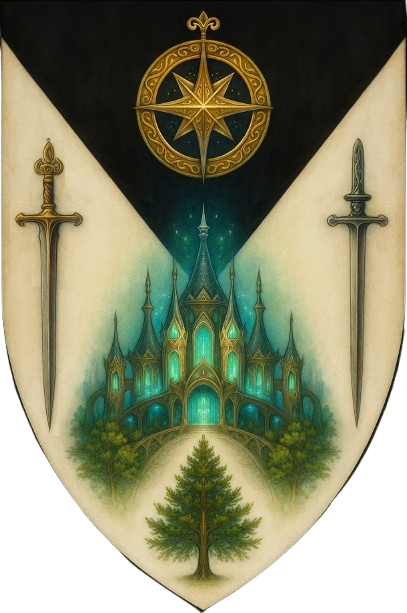
The History of Rhyanne
The Kingdom of Rhyanne, once a forested jewel of the Elven realm of Kael, stood as a testament to the grace and resilience of the Grey Elves. Nestled deep within the mainland of Otara, Rhyanne was gifted to the noble House Nar`Xiad, a lineage renowned for its wisdom, magical prowess, and unwavering devotion to the Elven cause. It was a realm of moonlit glades and enchanted towers, where the trees whispered ancient secrets and the stars danced above sacred groves. Ranger-Circles, elite guardians of the borderlands, patrolled its edges, ensuring that the sanctity of the Elven homeland remained untouched by the encroaching chaos of the world beyond.
As the golden age of Elvendom began to fracture under the weight of rising human empires, most notably the arcane-drenched dominion of Myralrech, Rhyanne’s strategic importance surged. It became the bulwark against invasion, the launch point for countless campaigns against goblinkind and the ambitious Wizard Kings of Myral. Yet even as the world darkened, Rhyanne remained steadfast, its people bound by duty and ancestral pride.
When the First Retreat began, following the catastrophic fall of Kael, the destruction of Miryth Dragkor, and the massacre at Endar’s Field, Elves across Otara fled to the island sanctuaries of Arethane, Lorien, and the Faerie Plane. But Rhyanne defied this exodus. Its people, rooted in the soil of their forebears, refused to abandon their homeland. While other provinces faded into myth, Rhyanne endured, becoming the last great Elven kingdom on the mainland. Though its borders shrank and its pureblooded Elves grew fewer, it remained a flickering ember of a dying empire, kept alive by the stubborn will of its people and the quiet rise of a new generation. About 20,000 years would pass without significant change.
Dispite the seamingly unending stalemate between the Humans and the Elves, growing tension and uncertainty, were constantly elevating. Amid this, a human warlord named Mikal Corvase emerged from the southern Duchy, Harak. Charismatic, ambitious, and fiercely determined, Mikal sought to unite the fractured human tribes of Harak. With the Elves' grip on the region weakening, Mikal recognized an opportunity for his people to cast off the yoke of Elven dominion. His rise to power was swift, and in a series of decisive battles, Mikal proved his mettle on the field of war. His greatest triumph came at the Battle of Black Fire Pass, where his human forces, vastly outnumbered, broke through the Elven lines in a stunning display of tactical genius. This victory shattered Rhyanne's hold over the human held lands and allowed Mikal to declare independence from the Elves.
With the foundation of the Kingdom of Harak and the establishment of the Corvase dynasty, Mikal Corvase forever altered the course of history. He created a kingdom where strength and might were the core values, and where kingship was earned through ritual combat rather than inherited through blood. The Rite of Dominion became the defining institution of Harak, demanding that would-be kings prove their worth in battle. This sacred tradition, overseen by the Church of Light and Dark, ensured that the throne could be claimed only by the strongest, regardless of birthright. This rite, though often deadly, became a cornerstone of Harak's identity, and it was through this tradition that the kingdom's monarchy found its legitimacy.
A new generation, born of Elven mothers and human allies, were the Half-Elves, children of two worlds, often estranged from both. As the centuries passed, their numbers grew, and with them came a subtle transformation. Rhyanne, once a bastion of Elven purity, began to evolve into something different: a realm of blended heritage, where human ambition met Elven grace.
As Harak enjoyed early prosperity, its golden age was inevitably marred by the ambitions of its rulers. Aproximately 2000 years would pass and with it the world would see the raise of Seth Corvase, a brilliant general, become one of the most infamous figures in the kingdom's history, and he hated Elvenkind with a passion that raivaled the Orcs. He hated Half ELves even moreso seeing them as an abomination.
Tragedy struck the House Nar`Xiad in the form of a brutal raid, orchestrated by Drow and monstrous mercenaries, likely under the command of General Seth Corvase. In the chaos, King Jaermeryth Nar`Xiad was slain, leaving his young son, Jaeryth, orphaned and vulnerable. To protect him, his uncle Detherynn and aunt Aglaranna spirited him away, raising him in secrecy while Lord Malarick Halfelven, the King’s most trusted advisor, assumed the mantle of Regent.
Under Malarick’s stewardship, Rhyanne endured. The Elven population aged and faded, while the Half-Elves flourished. The kingdom slowly shifted, its identity reshaped by necessity and time. By the time Jaeryth returned as an adult, the realm he had once known was no longer the proud Elven kingdom of his ancestors. The towers still stood, the forests still whispered, but the halls were quieter, and the people had changed.
It was during this time that King Rhysanus of Arethane launched the Reclamation Retreat, a final campaign to gather the remnants of Elvendom and preserve its legacy. The slaughter of twenty-five thousand Elves in Vordan under General Corvase’s watch had ignited a fire in Rhysanus’s heart, and he moved swiftly to conquer the region, renaming it Jordaine. Seeking a noble Elven figure to rule this reclaimed land, Rhysanus offered Jaeryth a principality and ducal titles for his kin, in exchange for formally ceding Rhyanne to Malarick Halfelven.
Though torn by duty and legacy, Jaeryth accepted. He saw in Rhysanus a chance to preserve what remained of his people, and in Jordaine, a new beginning. His decision, though painful, was guided by wisdom and a desire for unity. Aglaranna, however, could not accept this compromise. Proud and unyielding, she viewed Rhysanus as a usurper and plotted rebellion. Her campaign, poised to erupt, was halted by divine intervention. Moranthis, god of judgment and fate, appeared before her and declared, “Rhysanus is your lawful Valishar by My will.” Broken by the revelation, Aglaranna repented, confessing her plot and shielding her husband from blame. Jaeryth, in a moment of grace, forgave her and allowed her to return to Teradryn to seek divine justice.
With Aglaranna’s submission and Jaeryth’s departure to Jordaine, Rhyanne entered a new era. Malarick was crowned the first Half-Elven King, legitimizing the cultural shift that had quietly taken root for generations. The kingdom, no longer the heartland of Elvendom, became a realm between worlds, where Elven traditions were honored, but a new identity was forged.
Today, Rhyanne stands as a kingdom of memory and future. Its ancient towers still rise above the trees, now home to Half-Elven lords and scholars. Festivals celebrate both the Seldarine and the saints of human lore. Bardic colleges teach songs in two tongues, and Ranger-Circles still guard the groves where the Nar`Xiad once walked. Though it is no longer the glorious wood-realm of old, its spirit endures.
Rhyanne is tied to Arethane by blood and history, yet fiercely independent. Its people, neither fully Elven nor fully human, are something new, something vital. And as the world darkens and the Finale approaches, it may be this blended kingdom, born of loss and resilience, that holds the key to the future.
Religion in Rhyanne:
- The Dragonwright Faith: Rhyanne has long aligned itself with the teachings and power of Dragonwright, a pantheon centered on ancient, godlike dragons who represent forces of law, magic, conflict, and cosmic order. In Rhyanne, Dragonwright is not merely a faith, it is a foundation of society, tightly interwoven with the kingdom’s military traditions, honor codes, and rulership.
The dominant deity among the Dragonwright in Rhyanne is Moranthus, the Dragon God of Law, Vengeance, and Judgment. Revered as the ultimate arbiter, Moranthis embodies the Rhyanne ideal: stern but fair justice, strength with purpose, and absolute loyalty to order. His clergy serve as magistrates, military chaplains, judges, and advisors throughout the kingdom.
Rhyanne’s martial heritage, forged in ages of warfare, border conflicts, and later as a staging ground for the Elven Retreat, made Dragonwright a natural spiritual home. Valor, loyalty, discipline, and judgment are the core values taught from youth. Even the kingdom’s architecture and ceremonial customs reflect a reverence for strength and divine hierarchy.
Other Dragonwright deities, while honored, are seen as secondary:
Kym-Nark-Mar, Dragon of Stars and Duty, is venerated by strategists, generals, and scholars of war.
Zandragal, Dragon of Peace and Wisdom, finds a small but loyal following among healers, diplomats, and those who seek to temper Rhyanne’s rigid justice with mercy.
Former shrines to the Seldarine still dot the forests and hills of old Rhyanne, maintained by reclusive Elven druids or spirit guardians, but they are seldom visited and are often viewed as relics of a bygone age.
In truth, it is Dragonwright that shaped the soul of modern Rhyanne, giving the Half-Elven kingdom a divine structure upon which to rebuild itself, not just as a survivor of the Elven Retreat, but as a proud nation of warriors, judges, and servants of divine justice.
- The Seldarine in Rhyanne: The Seldarine were once the spiritual backbone of Rhyanne during its time as a proud Elven kingdom. Temples to Corellon Larethian, Sehanine Moonbow, and Labelas Enoreth stood in moonlit groves and atop crystalline towers, where rituals were performed under starlight and magic flowed freely. Their teachings emphasized balance, artistry, wisdom, and the eternal connection between Elves and the natural world.
Even after the fall of Kael and the First Retreat, the Seldarine remained central to Rhyanne’s identity. Ranger-Circles often invoked Sehanine’s guidance during border patrols, and arcane scholars studied the mysteries of Corellon’s creation myths. However, as the Elven population declined and Half-Elves rose to prominence, the Seldarine’s influence began to fade, not out of disrespect, but out of cultural evolution.
The Dragonwright faith emerged as the dominant religion in Rhyanne during its transformation into a Half-Elven kingdom. Unlike the Seldarine, Dragonwright is a more inclusive and dynamic belief system, centered around the worship of powerful dragon gods who embody elemental forces, fate, and cosmic balance. Chief among them is Moranthis, the Dragon God of Judgment and Fate, whose divine intervention ended Aglaranna’s rebellion and legitimized Rhysanus as Valishar.
Dragonwright appeals to the Half-Elven population because it bridges the gap between Elven mysticism and human pragmatism. Its rituals are more martial and symbolic, often involving rites of passage, oaths of loyalty, and divine trials. Temples to the dragon gods are built from stone and flame, often located near ley lines or ancient draconic ruins. The faith emphasizes personal strength, destiny, and the idea that divine favor must be earned, a stark contrast to the inherited grace of the Seldarine.
Though Dragonwright is now the main religion, the Seldarine are not forgotten. Their stories are still sung in bardic colleges, their symbols etched into ancient towers, and their names invoked during seasonal festivals. In some regions of Rhyanne, particularly the older forest enclaves, small shrines to the Seldarine remain active, tended by druids and lorekeepers who see no contradiction in honoring both pantheons.
Rhyanne’s spiritual landscape is one of layered belief, a kingdom where the old gods whisper through the leaves, and the dragon gods roar from the mountains. This duality reflects the kingdom itself: a realm between worlds, shaped by memory and rebirth.
Ruler: 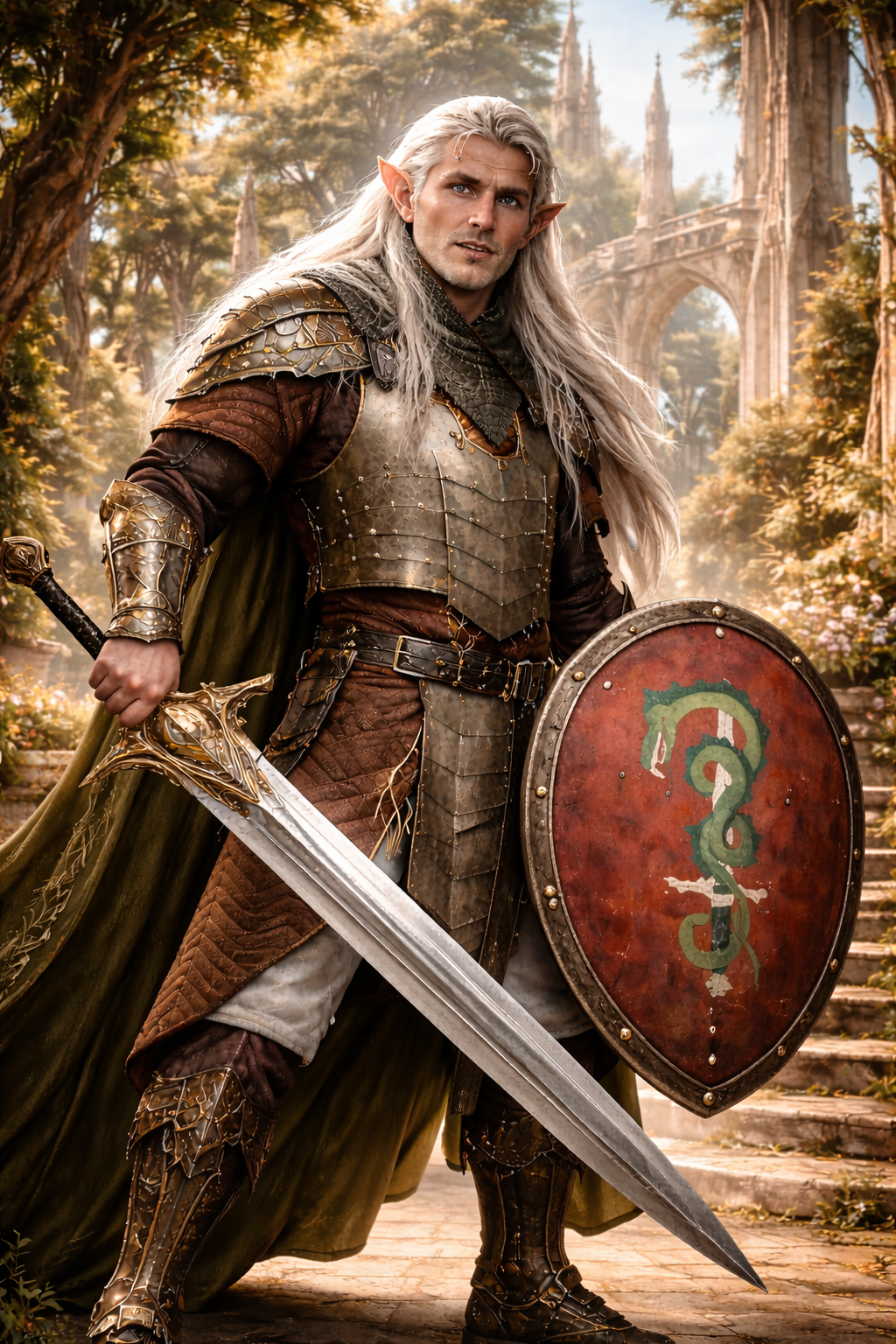
King Malarick Halfelven rules Rhyanne, with Lord Rutha`Nolis Iarven serving as both Hand of the King and designated heir. Malarick, who has neither wife nor children, is unable to sire offspring. Rutha`Nolis, a 3/4-Elf, is the son of King Rhysanus of Arethane.
Rhyanne's Population Breakdown
Total Population:
- Total Estimated Population: 10,200,000
- Pureblood Elves: 10%
- Half-Elves: 60%
- Humans: 25%
- Other Races (Dwarves, Gnomes, etc.): 5%
Rhyanne's demographic makeup has dramatically shifted since the fall of Kael. The Half-Elves have become the majority, representing the blending of Elven and human bloodlines. They hold positions of power throughout the kingdom, reflecting the new cultural and political dynamics. The Pureblood Elves, although fewer in number, continue to uphold their ancient traditions, serving as advisors, scholars, and magical practitioners. The Human population, largely concentrated in the southern regions, now enjoys greater autonomy, but still recognizes Rhyanne’s authority in some matters. Smaller populations of Dwarves and Gnomes have established settlements, particularly in the southern mining regions and trade hubs.
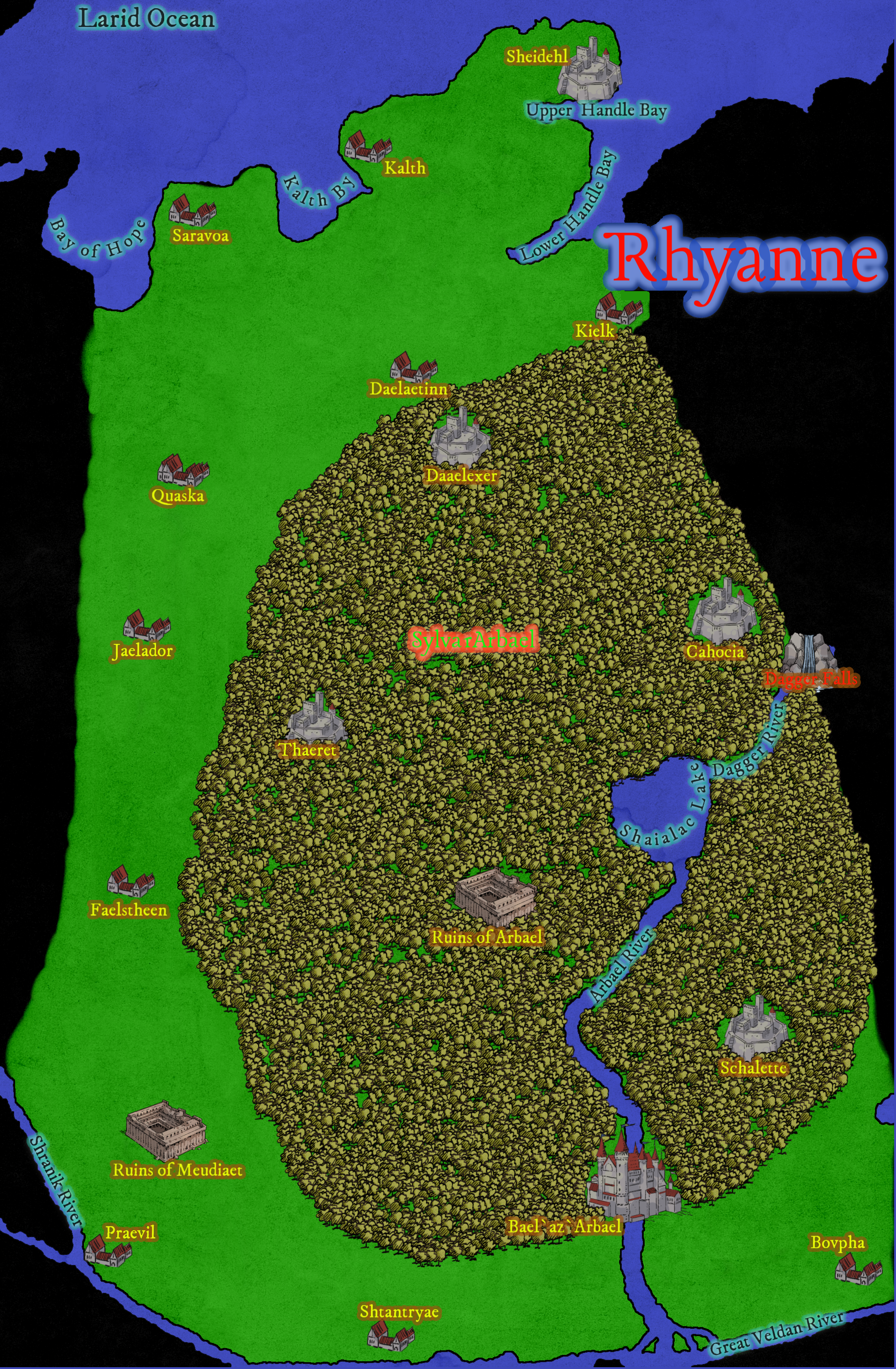
Capital: Bael`az`Arbael Bael`az`Arbael, rebuilt after the old capital Arbael was destroyed by the Drow, is the capital of Rhyanne, a city that bridges the old world and the new. It retains much of the former capitals grandeur, with its living stone architecture and arcane energy-infused structures. Over time, however, the city has taken on new characteristics, bustling marketplaces where Half-Elves and Humans trade goods, the Temple of Dragowright and the Seldarine temple are shared by both Elven and human worshipers, as well as a thriving district dedicated to magical arts and innovation. The city is both a symbol of the past and the future, where the ancient Elven legacy merges with the evolving political landscape.
Languages of Rhyanne:
- Elven (High Elven) - The language of the ancient Elven aristocracy and scholars. High Elven is still used in formal rituals, arcane practices, and diplomacy among the Elven elite. While fewer people speak it fluently, it remains a mark of status and tradition.
- Rhyanne (Common Elven) - A hybrid dialect that combines Elven and human languages, spoken by the majority of the population. Rhyanne (Common Elven) is the primary language for governance, trade, and daily life, serving as the lingua franca for all citizens, regardless of their ancestry.
- Human (Common) - The tongue of the human population, which has become widespread in the southern regions. While still influenced by Elven linguistic patterns, it is distinct and primarily used in the human communities.
- Dwarven - Spoken by Dwarven settlers, primarily in mining and crafting districts. It is a language rich in technical terms, particularly related to metallurgy, stonecraft, and engineering.
- Gnomish - A language used by the Gnome populations, especially those in the northern forested regions. The language is highly technical, used for intricate inventions, machinery, and magical studies related to the natural world.
Exports, Industry, and Resources:
Natural Resources:
- Silverleaf Ore: A rare and powerful ore found deep within Rhyanne’s mines, Silverleaf Ore is highly valued for its use in enchantments, magical weapons, and rare artifacts. Only a few kingdoms possess it in such quantities, and Rhyanne's control over its trade has granted it significant influence over the magical market.
- Moonstone: This radiant gem is harvested from the hidden caverns of Rhyanne's mountains. Known for its luminous glow and mystical properties, Moonstone is integral to powerful divination magic and is sought after by wizards and fortune tellers across the continent.
- Moonlit Wood: Rhyanne's forests are home to trees that thrive under the moonlight, producing Moonlit Wood, a material prized for its enchantable properties. This wood is used to craft staves, bows, and magical instruments.
Industries:
- Magical Artifacts: Rhyanne remains a center for magical crafting. Elven artisans still produce some of the finest enchanted items in the world, including swords imbued with elemental power, potions crafted from rare herbs, and amulets of protection that are highly sought by adventurers and royalty alike.
- Potion Brewing and Herbalism: Rhyanne’s apothecaries and herbalists are known across the continent for their expertise in creating life-saving potions, healing salves, and elixirs that promote longevity. The kingdom is a major supplier of rare herbs and potions, especially the famed Elixir of Eternal Bloom, a concoction said to extend the life of its drinker.
- Craftsmanship (Weapons and Armor): The legacy of Elven craftsmanship is alive and well in Rhyanne, especially in the forging of Elven Mithril Plate and Moonsteel weapons. The kingdom’s blacksmiths are known for crafting exceptionally light yet durable armor, as well as finely tuned bows and magical blades.
Trade:
Rhyanne has trade agreements with the Dwarves of Harak for precious metals and gems. The kingdom also has burgeoning trade routes with Arethane for political alliances and magical research exchanges.
Major Cities
- Capital:
- Bael`az`Arbael: Following the catastrophic destruction of the old capital Arbael during the drow-led assault that claimed the lives of Jaeryth NarXiad's parents, the elven court moved to Bael`az`Arbael. This city became the new political and cultural heart of Rhyanne. Bael`az`Arbael is a vibrant city, blending the ancient elven architectural traditions with renewed strength and resilience. It hosts the royal palace, important temples, especially dedicated to the Dragonwright and Moranthis, and the seat of the ruling council.
- Sheidehl: The principal port of Rhyanne, Sheidehl facilitates trade and travel between Rhyanne and neighboring human and elven realms. It is a bustling maritime city protected by strong naval forces, ensuring the security of Rhyanne’s waterways and commerce.
- Kalth: A remote settlement with skilled trackers and scouts watching the plains.
- Saravoa: A border town often caught in the tensions between elves and humans.
- Kielk: Known for its seasonal festivals and horse fairs.
- Daelaetinn: Famous for its orchards and vineyards, contributing to Rhyanne’s food diversity.
- Quaska: A hub for artisans and merchants, bridging the goods of the plains and forests.
- Daelexer: A hidden woodland city famous for its expert archers and forest rangers. Daelexer serves as a vital bastion guarding Rhyanne’s forest borders.
- Jaelodor: A cultural center with theaters, libraries, and academies.
- Cahocia: A city centered around sacred springs, known for its healing temples and spiritual retreats.
- Thaeret: Known for its elite scouts and rangers who maintain constant vigilance along the kingdom’s frontiers.
- Faelstheen: A town renowned for its horse breeding, providing mounts for Rhyanne’s cavalry.
- Schalette: A city of master artisans and enchanters who craft many of Rhyanne’s famed weapons and magical artifacts.
- Praevil: A fortified settlement guarding the borders against human encroachment
- Shtantryae: A lively trading town located at a crossroads between forest and plains routes.
- Bovpha: A prosperous farming community known for producing grain and livestock, vital for feeding the population.
- Ruins of Arbael: Arbael, once a majestic capital, lies in ruins after a devastating attack by drow and monstrous forces. This tragic assault was part of a larger campaign of terror that resulted in the death of many royal family members, including Jaeryth Nar`Xiad’s parents. The ruins now stand as a grim reminder of the kingdom’s vulnerability during those dark times. Overrun by wild growth and warded by fading magic, the site is both a place of mourning and reverence, visited by those who honor fallen heroes or seek lost knowledge.
- Ruins of Meudiaet: Located on the open plains just beyond the forest border, Meudiaet was once a thriving city and vital trade hub. It was destroyed in conflicts related to the escalating tensions between elves and humans centuries ago. Its remains now lie scattered across the plains, with occasional archaeological expeditions uncovering remnants of its elven past.
Return to Maps and Floor Plans
Return to Arethane |
|