Town of Faerlyn
|
Nestled in the north, along the banks of the Faer River, Faerlyn is a tranquil Elven village renowned for its serene beauty and its vital role in the restoration of Elven influence across the reclaimed lands of Jordaine. The waters of the Faer shimmer with a starlit glow even during midday, weaving through the village at the edge of the Moonfen Forest, a place steeped in magic and mystery. Towering trees and veils of mist mark the boundaries of the forest, where ancient whispers and the sounds of wild creatures echo through the air. Faerlyn's pastoral setting, where sheep graze peacefully amidst the verdant hills, has become an idyllic refuge for its people. The village is also known for raising large, four-horned goats that thrive nowhere else but in this unique area.
Strategic and Political Importance: Faerlyn serves as both a frontier outpost and a symbol of King Rhysanus's grand vision to restore the Elven presence across the land. Protected by the Elven crown, the village thrives under royal sponsorship, which provides it with magical aid and expert workers from Arethane. This village's enchanted wool is of unparalleled quality, refined into cloaks and vestments suitable for powerful spellcasters and prestigious priesthoods. Faerlyn's flocks are an essential resource for those seeking magical protection or arcane attire.
Though the Barony of the Vale claims nominal authority, the true governance of the village rests with the Eldergrove Council. This body of trusted ranchers, craft-masters, and druids leads the village in all matters, with ultimate authority belonging to Mayor Taleira Moonsheen, a Silver Elf shepherd-matron. Taleira commands great respect, wielding the Crown's sigil and ancient wisdom derived from the forests she has long protected.
Cultural and Magical Significance: Faerlyn's rich traditions are maintained through the weaving of magic and nature. The village hosts an annual Wool Tithe Festival, an event that draws royal barges from Arethane, bringing with them royal emissaries who collect the enchanted fleece, hear petitions, and inspect the borderlands beyond the Faer River. Among Faerlyn's most revered cultural and magical features is the Faerlooms: prophetic cloaks that hum softly under the moonlight, believed to carry the whispers of future events. Additionally, the village practices the Moon-Ewe Rite once every decade, where a white ewe is gifted to the Moonfen Forest to appease the fey spirits that inhabit it. The Riverblessed Rams born in Faerlyn are sometimes gifted with rare magical resistances or lifespans, further elevating the village's mystical aura.
Environment:
To the South: The Faer River, pure and shimmering, fed by ley-charged springs that imbue the land with magic.
To the East and North: The Moonfen Forest, a mysterious and mist-shrouded woodland home to fey spirits, ancient creatures, and shadowy beasts.
To the North and West: The looming Lasse'Amon Mountains, their jagged peaks providing a natural defense against any threats from beyond the village.
Notables of Faerlyn
- Mayor Taleira Moonsheen: The wise and respected shepherd-matron of Faerlyn, Taleira oversees the village's welfare and leads the Eldergrove Council, while ensuring that the ancient ways of the Elven people are preserved.
- Sheriff Rutheara Willowmane: Sheriff Rutheara Willowmane is the true protector and unofficial leader of the village. The middle-aged sheriff has served the people of Whitesparrow for twenty years, after serving as a soldier for fifteen years before that. She has a good heart and loves the people of the village, who always look to her when trouble arises. She typically has little patience for adventurers, seeing them as disruptive influences on the normal flow of village life, and fearing the trouble they often bring with them. Still, she understands that the threats represented by the odd events that often transpire around the village require special skills to deal with, and she looks to those with a proven ability to handle themselves to deal with those threats. The sheriff has eight guards under her employ and can call upon another twelve conscripted guards when needed.
- Eldergrove Council: Composed of ranchers, craft-masters, and druids, this council helps guide the village's decisions, with each member bringing their expertise to the governance of Faerlyn.
- Royal Emissaries: These representatives from King Rhysanus's court arrive annually to collect wool, inspect the village's progress, and engage with the local populace, lead by Lord Marlin Whitesparrow. Lord Marlin Whitesparrow is a young lord and new to the village and the lands around it. He and his staff resides in the old castle that sits on a hill above the village. Despite his young age, Lord Whitesparrow is well-respected, though he has little patience for the daily drudgery of village life. Marlin has no wife or children.
- Elovyn Sorrowsong: An elf priestess of the Temple of the Seldarine, Elovyn found herself out of political favor in Teradryn and was sent on a one hundred-year pilgrimage into the Vale. Though she still resents being sent on the pilgrimage, and the decades she has spent in Faerlyn as a result, she has come to care very much for the people of the village. She greatly enjoys the empowerment that comes with in a position of authority. Because of this, she is initially distrustful of other priests who visit the village, afraid they will take away from her mystique.
- Tannis Corweir: A former adventurer turned shopkeeper, Tannis Corweir runs Tannis & CO Outfitters alongside his wife Arianne, providing supplies for travelers and trading caravans.
- Amanda Jess: Human Owner of the Summerspring Inn and the Evershady Tavern, Amanda Jess is the dominant entrepreneur in Faerlyn. She has three sons, Kinzlow, Balaham, and Wess, who work at the tavern and inn. Amanda enjoys meeting visitors to Faerlyn, and she has an eye for people. She has a knack for knowing exactly what questions to ask in order to dig deep into newcomers' backgrounds, and always seeks a way to find opportunities for business. Some whisper that Amanda was once a spy for a powerful organization before she retired to the quiet life of Faerlyn.
- Philcock Deadcleft: The Human manager of the Summerspring Inn and a longtime employee of Amanda Jess, Deadcleft is a small, ugly rumormonger who spies on his patrons. Yet for reasons unknown, Amanda has always protected and defended him. Deadcleft wears clothes of noble cut but in poor condition, and always smells terrible.
Faerlyn, with its ancient customs, royal sponsorship, and a unique blend of magic and nature, remains a beacon of Elven culture and tradition, offering a quiet sanctuary that is both a vital part of the kingdom's northern border and a symbol of the enduring presence of Elves in Jordaine.
Town Features and Locations
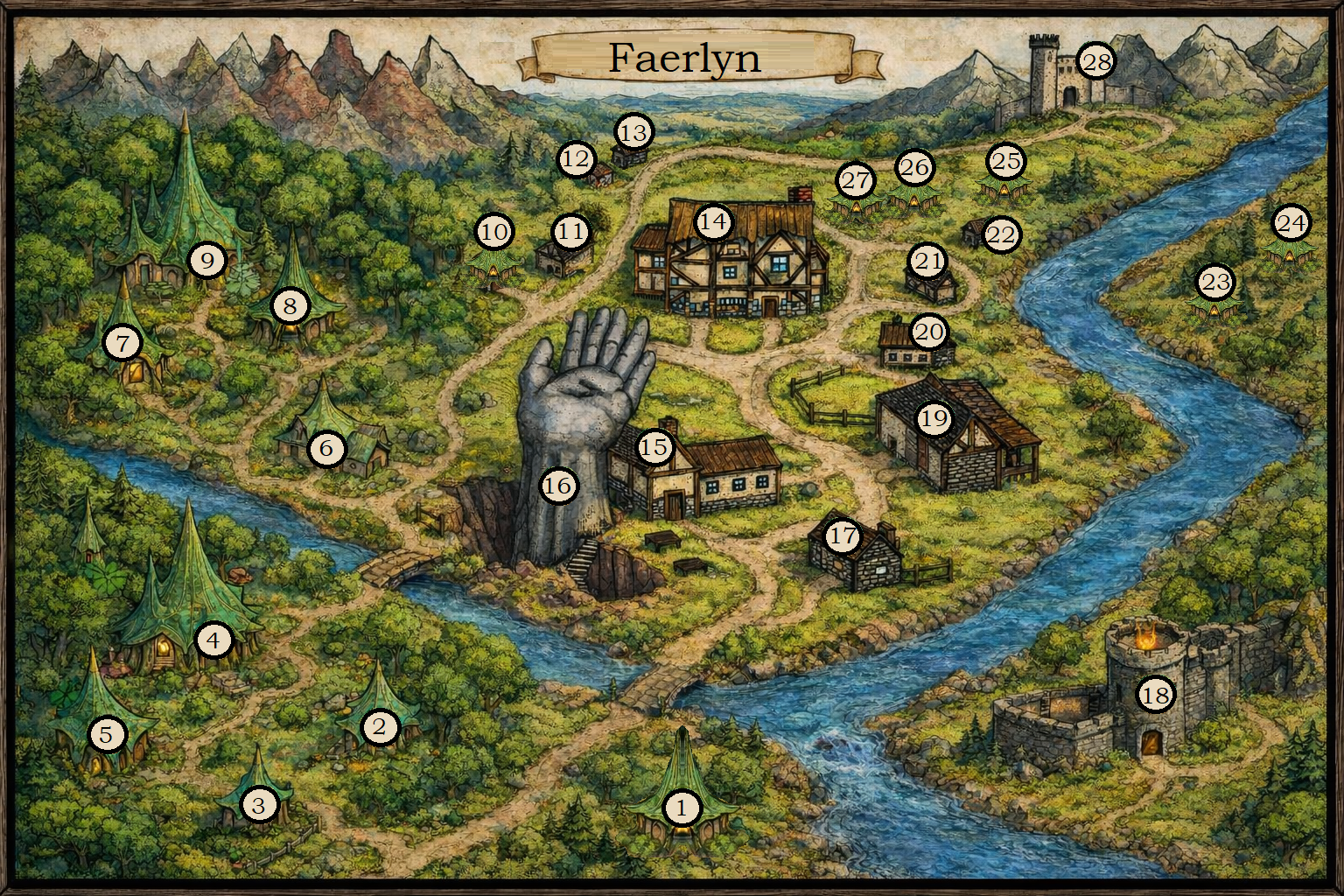
- 1. Shepherd Home: The Sol`kinae Homestead
Nestled just at the edge of town, the Sol`kinae Homestead is a small yet elegant cottage surrounded by rolling pastures that stretch towards the fringes of the river. The cottage itself is a harmonious blend of practicality and beauty, with moss-covered stone walls that seem to grow from the earth itself, blending seamlessly with the surrounding greenery. The roof is made of thatch, thick and tightly woven, with ivy creeping up its sides, adding a natural and timeless charm. The small, gracefully curved windows are adorned with wooden shutters, which are often flung open during the day to let the soft, cool breeze filter through the home. The fenced pastures surrounding the cottage are carefully tended, the fences themselves made of smooth-worn timber, their tops rounded and shaped by the hands of skilled carpenters. Within these pastures, the night-sheep graze, creatures with dusky wool that almost appears to shimmer in the moonlight, their coats blending seamlessly with the shadows. These sheep are rare, prized not only for their unusual coloration but also for their natural resistance to the cold and their ability to thrive even in the harshest of winters. The Sol`kinaes are renowned breeders of these remarkable animals, and their night-sheep have become a cornerstone of the village's economy, as well as an integral part of Elven tradition. The homestead itself is beautifully set amidst the serene landscape, surrounded by small groves of willows and oaks, with birds nesting high in the trees and the soft hum of nature ever-present. Flowering herbs grow in abundance around the cottage, adding both fragrance and medicinal value, carefully tended by Maerette Sol`kinae, who is known for her skill in herbalism and dyeing wool using the natural flora of the area.
Inhabitants: Braen and Maerette Sol`kinae
- Braen Sol`kinae is a tall, strong Elven man with dark brown hair that falls in gentle waves to his shoulders, his skin kissed by the sun from long hours spent outdoors. His eyes are a soft green, reflecting the tranquility of the lands he tends. Bran's connection to the night-sheep is almost spiritual. He speaks of them with reverence, knowing each one by name and personality. He is a man of few words, preferring the quiet of nature to the noise of the world, but when he does speak, it is with a gentle authority that commands respect. As the primary breeder of the night-sheep, Bran's work is a labor of love, spending long hours with the animals, ensuring their health and wellbeing. He has a deep understanding of animal behavior and uses a combination of natural remedies and gentle coaxing to maintain his flock. He also crafts special shepherd's crooks, each one imbued with a bit of magic to help calm the sheep and guide them through difficult terrain.
- Marta Sol`kinae, on the other hand, is a more lively and outgoing Elf with silver-blonde hair that seems to catch the light with every movement. Her sharp eyes are a vibrant amber, and her smile is as warm as the hearth that burns inside their home. Maerette is an expert herbalist and wool-dyer, using the local plants and herbs to create unique and vibrant hues in the wool. She often spends her days gathering herbs from the forest, carefully selecting plants like wild lavender, bloodroot, and moonshade blossoms, all of which add depth and magic to her dyes. The wool she creates from their flock is prized across Faerlyn, used to make cloaks and garments that are both durable and beautiful. She's known for her ability to weave magical properties into the fabric, blessing them with subtle charms of protection or enhanced warmth.
Together, Braen and Maerette have built a life in harmony with the land, creating a thriving farm that is as much a sanctuary as it is a place of work. They are not just breeders of night-sheep, but stewards of the land, guardians of the traditions passed down through the ages.
The Flock of Night-Sheep: The night-sheep are an awe-inspiring sight. Their wool, which is naturally dusky in color, seems to shift between hues of deep grey, midnight blue, and charcoal black, almost as though it absorbs the surrounding shadows. They are renowned for their ability to adapt to the cold, thriving even in the harshest winter months, and are known for their resilience to magical fatigue. When the moon rises high in the sky, the sheep's wool shimmers faintly, almost glowing, as though touched by moonlight. This mystical trait has led many to believe that the night-sheep are creatures of ancient magic, blessed by the goddess Elandur, the Shepherd God. Each year, Braen and Maerette carefully select the best of the flock to breed, ensuring that the flock remains healthy and strong. They are careful to maintain a genetic balance, working tirelessly to prevent inbreeding and ensuring the integrity of the night-sheep's mystical properties. The younglings are raised with great care, taught from an early age to be calm and obedient, making them ideal candidates for the weaving of enchanted fabrics. The elders in the flock, who are considered to be wise and full of insight, provide a sense of continuity and tradition, and are often seen as spiritual leaders in the community.
The Homestead's Features:
- Pastures & Fencing: The pastures surrounding the cottage are large and fertile, with thick, wrought-iron fences marking the boundaries of the flock's grazing grounds. The fences are strategically placed to ensure the night-sheep do not wander into the nearby woods, where danger may lurk, and to keep the sheep safe from predators such as dire wolves or goblin hunters.
- Moss-Covered Walls: The walls of the cottage itself have grown over time, with moss and ivy creeping across their surface, providing both insulation and camouflage. The moss absorbs excess moisture from the air, ensuring the cottage stays cool in the summer and warm in the winter.
- Herbal Gardens: Marta's herbal garden flourishes at the side of the house, filled with aromatic plants used for dyeing, medicinal purposes, and magical remedies. The garden is a patchwork of wildflowers, vibrant roots, and herbaceous shrubs, and Maerette spends much of her free time tending to it.
- Sheepfold: The sheepfold is a sturdy building near the back of the homestead, with a thatched roof and stone walls. It provides a safe haven for the night-sheep at night, offering protection from the cold and from potential predators. Inside, the sheep are kept in soft, straw-lined pens, with space for each sheep to stretch comfortably.
- Workshops: The homestead also includes small workshops where Braen can be found crafting his shepherd's crooks, and Maerette can be found working her loom and spinning wheel. These rooms are filled with tools, wool, and dyes, each area devoted to a specific craft.
- Firepit & Outdoor Hearth: Behind the cottage, a large stone firepit is often lit, where Braen and Maerette host gatherings with fellow shepherds and ranchers. It's a place of community, where stories are shared, and songs are sung under the stars. The firepit also serves as a space for ritual offerings, where the Sol`kinaes honor the spirits of the forest and their ancestors.
Community & Importance to Faerlyn: Braen and Maerette Sol`kinae's night-sheep play a vital role in Faerlyn's economy, providing wool for the Moonfleece Loomery and other Elven artisans. The Sol`kinaes' dedication to breeding the finest night-sheep has made them well-respected members of the village, and their influence extends beyond the cottage and pastures. They are seen as guardians of the land and often consulted on matters of herbalism, agriculture, and animal husbandry. Their home is not just a place of work, but a symbol of tradition, where the balance between nature and Elven culture is maintained. Braen and Marta's work ensures that the legacy of their ancestors lives on, and the night-sheep will continue to be an essential part of Faerlyn's magical and cultural landscape.
- 2. The Moonfleece Loomery (Textile Workshop)
Tucked away at the edge of Faerlyn, lies the Moonfleece Loomery, a beautiful whitewashed stone building renowned for its intricate Elven murals that adorn its walls. The structure stands in stark contrast to the wild surroundings, yet its quiet elegance reflects the artistry and craftsmanship that takes place inside. The loomery is known for producing the finest cloaks, tunics, and ceremonial garb in all of Jordaine, with a reputation that has reached even the distant halls of the Elven Kingdom of Arethane. The building itself is an architectural marvel. Its walls are covered in elaborate murals depicting ancient Elven legends, such as the Rise of the Seldarine, Moonlight Hunts, and the Ascension of the First Weavers. The soft, natural light filters in through tall arched windows, casting dappled shadows across the interior, where the moisture-laden air carries the scent of freshly dyed wool and the soft hum of enchanted looms. The looms are a wonder in their own right. Enchanted by the Moonmancers of old, these looms sing as they weave, the melodies rich with harmony and rhythm. The songs that emanate from the looms are not mere sounds, they are infused with magic, enhancing the quality of the fabric woven. Each piece of fabric is imbued with subtle enchantments, making them not only incredibly durable but also resistant to cold, fire, and even certain magical attacks. The looms are worked with precision and grace, their enchanted motions weaving patterns of elegance and arcane beauty into every inch of cloth. As you approach the loomery, the first thing you notice is the soothing music that drifts out into the village, a gentle, calming hum that resonates with the natural rhythm of the land. The looms hum in unison, each one vibrating with magic and talent, as if the looms themselves were alive and connected to the very soul of the forest.
Inhabitants: Velian and Rhuea Starreel: Velian and Rhuea Starreel, the two Elven weavers who run the Moonfleece Loomery, are both gifted artisans with an exceptional bond. Their skill in weaving is legendary, and their telepathic connection allows them to work together in near-perfect harmony. Though they rarely speak aloud, their mental communication flows effortlessly between them, allowing them to weave intricate, multi-layered designs without the need for words. This bond also allows them to synchronize their movements on the looms in perfect unison, creating textiles that appear seamless and are imbued with the same telepathic resonance that they share.
- Velian Starreel is the more reserved of the two, a tall, silver-haired Elf with piercing azure eyes that seem to see the very heart of the fabric he creates. His hands move with delicate precision, guiding the threads through the loom as though they were an extension of his own spirit. Velian's affinity with color and pattern has made him a master of creating magical fabrics that hold subtle protections and augmented properties, such as cloaks that shimmer like moonlight and tunics that ward off minor curses.
- Rhuea Starreel, on the other hand, is more animated and expressive. Her emerald-green eyes sparkle with an inner light, and her laughter, though rarely heard, is infectious when it does escape her lips. Rhuea is the more emotionally attuned of the two, and she often uses her telepathic link with Velian to infuse their creations with subtle emotional magic. She can weave comfort and calm into the fabric, creating garments that soothe the heart and mind, or courage and strength, imbuing them with protective properties that bolster the wearer against fear or despair. Rhuea is also deeply attuned to the spirits of the forest, often channeling their energy into her creations, allowing her garments to carry traces of the forest's ancient magic.
Together, the Starreels create garments that are more than just clothing, they are living pieces of art, each woven with a unique blend of magic and meaning. Their work is highly sought after by noble houses, mages, and priesthoods, who desire garments not only for their beauty and craftsmanship but for their enchantments and the subtle protection they offer. Many in Faerlyn believe that the cloaks and tunics crafted by the Starreels can carry the blessings of the moon and the spirits of the forest, and they are often worn during important ceremonies or rites of passage.
The Loomery's Key Features:
- The Enchanted Loons: The center of the Loomery is dominated by the ancient looms, which have been passed down through generations of weavers. These looms, crafted from glimmering wood and Moonstone threads, are alive with enchantments that make them sing as they work, creating a tapestry of melody and magic that enhances the fabric's quality. Each loom is dedicated to a specific type of textile: ceremonial garb, casual tunics, magical cloaks, and enchanted blankets. The looms hum in soft harmonies as Velian and Rhuea work, creating a serene atmosphere within the workshop.
- Dyeing Stations: To the side of the main loom room, large wooden vats are filled with natural dyes derived from the flora of Moonfen Forest. These dyes are used to create the stunning range of colors found in the Starreels' creations, earthy greens, deep blues, and shimmering silvers that seem to capture the light. The dyes are mixed with moonwater, water from the sacred springs that run beneath the village, which is said to hold the power of the moon itself. The dyeing process is a careful and meticulous ritual, with each batch of dye infused with magic to ensure that the color holds its luster and enchanted properties.
- Display Room: The Loomery has a dedicated showroom where the finest creations are displayed. The room is softly lit with enchanted lamps that emit a calming, ambient glow, enhancing the beauty of the garments. Shelves are lined with completed cloaks, tunics, vestments, and decorative tapestries, all woven with intricate designs and imbued with various magical properties. This room also serves as a gallery of the Starreels' work, where prospective buyers can examine the garments up close before making a purchase.
- Weaving Garden: Outside the Loomery, there is a small garden filled with magical plants, weave-bloom flowers, moonshade herbs, and starlight ivy, all of which contribute to the creation of the enchanted fabrics. This garden is where the Starreels gather the plants used in their dyeing process and other crafts, and it is often tended to by both twins, who are deeply attuned to the nature spirits that protect the plants.
- Moonlight Shrine: At the far corner of the Loomery, a small shrine to Elandur, the Shepherd God, sits under a canopy of ivy. It is a place where the Starreels go to offer thanks to the Moon for their talents and the forest spirits who guide their hands. This shrine is often the setting for a brief ritual of gratitude before beginning each new creation, ensuring that their work is blessed and guided by the moon's light.
Cultural Impact on Faerlyn: The Moonfleece Loomery is one of the most important cultural institutions in Faerlyn, representing the intersection of art, magic, and tradition. The textiles produced here are woven with the essence of the moon and ancient Elven craftsmanship, making them highly coveted. These garments are worn during important Elven ceremonies, such as birth rites, weddings, and funerals, as well as by magical practitioners and royalty who seek the magical properties woven into the fabric. The Loomery is also a place of learning, where young Elves are trained in the ancient art of weaving magic. Many of the village's youth learn to weave under the tutelage of the Starreels, gaining not only skills in crafting but also a deeper understanding of the mystical connection between the Moon and their art. The Loomery's reputation extends far beyond Faerlyn, making it a key part of the village's economy and a vital contributor to the preservation of Elven magical heritage.
- 3. Eira's Herbal Wash (Wool Cleaning & Dye House)
Located just a short walk from the Moonfleece Loomery, nestled against the edge of Moonfen Forest, lies Eira's Herbal Wash, a humble yet indispensable part of the wool production process in Faerlyn. This wool cleaning and dye house is a fragrant haven where freshly sheared wool undergoes a delicate transformation, becoming the soft, vibrant threads that will eventually become the finest garments in the village. The structure itself is built from weathered stone, its exterior veiled in trailing ivy and moss, giving it the appearance of being gently embraced by nature itself. The roof is thatched with reed grass, a nod to the abundant flora that surrounds the village, and the air is thick with the earthy scent of herbs and wildflowers, mingling with the occasional whiff of steaming wool. Upon entering, the first thing that strikes you is the warmth of the place. The steaming vats are positioned along the back wall, each one bubbling softly with herbal brews that work to cleanse and refresh the wool. The air is thick with the scent of lavender, chamomile, rose petals, and a medley of other magical herbs carefully chosen by Eira Fernmoss herself. The wool, freshly gathered from the night-sheep and other flocks in Faerlyn, is placed into these vats to remove the grease and dirt, before being carefully dyed using natural, plant-based colors that capture the hues of the moonlit sky, forest glades, and wildflowers. The process is a slow, meticulous one. As the wool soaks in the herbal brews, the colors begin to settle in, transforming the fibers into rich, saturated shades that seem to shimmer with an otherworldly glow. The finished product is then spread out on drying lines that stretch across the wide, open room, their threads catching the light and casting colorful shadows against the stone walls. The sight of rainbow wool swaying gently in the breeze from the open windows is a testament to Eira's craft, a visual reminder of the delicate balance between nature's magic and Elven artistry.
Inhabitants: Eira Fernmoss
- Eira Fernmoss is a quiet Moon Elf with a delicate presence, much like the plants she tends to and the wool she dyes. She has pale, silvery skin that catches the light in a way that gives her an almost ethereal quality, and her long hair, the color of moonlight, flows in soft waves to her waist. Her eyes, the color of fresh spring leaves, are large and serene, always seeming to hold a deeper knowledge than words could convey. Eira is a woman of few words, preferring the company of the plants and the rhythm of her work over conversation. Yet, despite her quiet demeanor, she is deeply attuned to the natural world, and her connection to the moon, the forest spirits, and the herbs she uses is profound. Eira is known for her exceptional skill in dyeing wool, and her secret lies in the herbal brews she creates, concoctions made from wildflowers, roots, and leaves that she personally collects from the edges of the forest. Each dye is chosen for its specific magical properties, whether it's to enhance the vibrancy of the color or to imbue the wool with a certain charm, such as resilience against fire, protection from curses, or even soothing properties for the wearer's spirit. Her most notable ability, however, is the way she hums to the vats as the wool is being dyed. The melodies she sings are not mere songs; they are an integral part of the dyeing process. These tunes resonate with the wool fibers, ensuring that the colors settle properly and that the magical properties of the plants are absorbed fully. Some villagers even claim that the colors seem to shimmer more vividly after Eira hums, though whether it's the magic of the plants or the power of her voice, it's hard to say. What is certain, however, is that her work is sought after by many, noble houses, mage guilds, and even the priests of Elandur, who have come to value Eira's magical garments for their inherent protection and blessing. Eira's hum is soft and soothing, often heard throughout the house as she works, adding a sense of peace and tranquility to the space. It is said that the spiritual harmony of her humming can even help the plants she uses grow more vibrantly, and she has cultivated an extensive herb garden behind the wash house, where moonshade blossoms and wild lavender grow in abundance, ready to be harvested for her magical brews.
The Herbal Wash's Key Features:
- Herbal Brews: The vats themselves are filled with carefully prepared herbal concoctions that cleanse and dye the wool. Eira uses a variety of local herbs, each with its own magical property: lavender for calming and protection, chamomile for healing, dandelion root for spiritual clarity, and moonshade blossoms for strengthening the wool's resilience against magical forces. The herbs are added in precise amounts, mixed with moonwater collected from the sacred springs beneath Faerlyn, which is said to carry the blessings of the moon goddess, Elandur.
- Steaming Vats: The vats themselves are made of hewn stone, their surfaces worn smooth over the years. The gentle steam that rises from the vats carries the scent of the herbs, filling the room with a soothing fragrance. Eira carefully places the wool into these vats, letting it soak in the herbal brews for a period of time before carefully rinsing and drying it. The process requires patience and finesse, as the wool must be perfectly clean before it is dyed.
- Drying Lines of Rainbow Wool: Once the wool has been dyed, it is hung on drying lines that stretch across the entire room. The wool, in its many vibrant shades, dances in the soft breeze that flows through the open windows. The colors of the wool seem to shift as the light changes, glowing with an almost magical radiance that reflects the enchantments imbued in each fiber. The drying process is essential to ensure the wool retains its magical properties.
- Herbal Garden: Behind the wash house lies a small garden where Eira grows many of the herbs she uses in her dyes. Moonshade blossoms, lavender, goldenrod, and wild marigolds are just a few of the plants that flourish in this sacred space. The garden is tended with great care, and the plants are harvested at specific times of the year to ensure they are imbued with the most potent magical properties. Eira can often be found here, humming softly as she tends to the plants, her presence helping them grow strong and healthy.
- The Herbarium: A small room off to the side of the wash house is dedicated to the storage and cataloging of Eira's herbal collection. Here, dried leaves, flowers, and roots are carefully labeled and preserved for use in future batches of dyes. Each plant is carefully chosen for its magical properties and its compatibility with the wool. The herbarium is filled with small glass jars and wooden crates, each containing plants harvested from the forest and beyond.
Cultural Importance to Faerlyn: Eira's Herbal Wash is more than just a place for cleaning wool, it is an integral part of the village's magical fabric-making process. The dyed wool created here is used by the Moonfleece Loomery to create garments that are sought after far beyond the borders of Faerlyn. Eira's dyes are not only beautiful but powerful, imbued with protection, healing, and arcane magic that adds to the garments' value. The village holds Eira in high regard, not only for her exceptional talent but also for her quiet wisdom. Many come to her for advice, not just about wool or dyeing, but also about spiritual matters and the workings of nature. Her gentle hum and affinity with nature have earned her a reputation as one of the most in-tune individuals with the forest spirits, and it is believed that she channels their power into her work. Eira's contributions to Faerlyn's economy, culture, and magic cannot be overstated, and her influence extends far beyond the walls of her wash house.
- 4. Woolwarden's Archive (Records & Ledgers)
The Woolwarden's Archive, a striking, domed structure crafted from alabaster and cedar. Its gleaming white walls seem to shimmer in the light, reflecting the subtle glow of the moonlight that often bathes the village in the evening hours. The cedar beams of the dome give the building an ancient, timeless feel, with their scent of fresh wood mingling with the soft earthiness of moss and the fragrant teas often brewed inside. The building is surrounded by a small garden filled with herbs and wildflowers, planted to honor the spirits of knowledge and memory. The air is always cool and calm here, and the occasional flutter of parchment can be heard through the windows, as if the very air of the place carries the weight of centuries of records. Inside, the space feels vast and open, with long rows of wooden shelves and ancient scrolls carefully labeled and stored. The genealogies of the village's flocks, some of them spanning generations, are meticulously cataloged here, as well as weather lore, trade agreements, and the histories of Faerlyn's magical textiles.
Inhabitants: The sole inhabitant of Woolwarden's Archive is Quenlin, an ancient Elf whose age seems impossible to guess. His silver hair flows like a river of moonlight, reaching to his waist, and his gray eyes, which seem to hold the wisdom of ages past, have never lost their sharpness. Quenlin is known for his sharp mind, which is often compared to a steel trap, he never forgets a name, a date, or a detail, no matter how small. His memory of the village's history and the genealogies of its flocks is unparalleled, and he can often be found in his cozy corner of the Archive, pouring over ancient ledgers or cross-referencing trade agreements with a precision that leaves others in awe. Despite his age, Quenlin is not one for nostalgia or reminiscing. He is a man of details and facts, with an uncanny ability to recall the smallest of details at will. His life is devoted to the careful recording and preservation of knowledge, particularly that which pertains to the village's flocks and trade practices. The genealogies of the night-sheep, moon-cows, and other rare breeds are all carefully documented here, and Quenlin is deeply respected for his contributions to the preservation of Elven heritage, especially as it relates to Faerlyn's wool trade. Quenlin is a man of few words, and those who come to the Archive seeking information often find him absorbed in his work. He speaks rarely but with great authority when he does, and it is said that his mind is as sharp as a dagger. He does not easily forget or forgive mistakes, and he takes great pride in the accuracy of his records. He is known to have a quiet fondness for moss tea, a concoction he brews himself from leaves harvested from the damp corners of Moonfen Forest. Visitors to the Archive are often greeted by the soothing aroma of the tea, which he claims helps him maintain his focus and calm his mind. While Quenlin is a keeper of facts, he is also a repository of stories. His personal memory stretches far beyond what is recorded in the Archive's shelves. Quenlin is familiar with the ancient Elven lore passed down through the generations, and though he is reluctant to share it, those who earn his trust can hear tales of lost civilizations, forgotten rituals, and the mysteries of the Moonfen Forest. Quenlin is not one to outwardly seek attention, but his presence in the Archive is regarded as vital to the village's cultural fabric, as his records hold the keys to Faerlyn's past and the guiding threads for its future.
The Archive's Key Features:
- The Domed Roof and Alabaster Walls: The Woolwarden's Archive is easily recognized by its unique architecture. The domed roof, constructed from fine cedar beams, forms a perfect circle, giving the building an air of harmony and symmetry. The alabaster walls are carved with intricate patterns, resembling delicate swirls of wind, forest vines, and moonlight, symbolizing the interconnectedness of nature and knowledge. The white stone gives the building a clean, serene aesthetic, fitting for a place of record-keeping and study.
- The Shelves of Records: Inside the Archive, rows upon rows of wooden shelves hold the village's most important records. These include the genealogies of the flocks, which are updated regularly as new sheep are born or sold. Weather lore is meticulously kept, with detailed charts recording seasonal changes, moon phases, and the shifting weather patterns in Faerlyn. There are also trade ledgers, detailing every transaction, from the sale of wool to the purchase of dye ingredients and other essential goods. These records are not merely for practical purposes, they also serve as a historical archive, preserving the very story of the village's growth and prosperity.
- The Great Archive Table: At the center of the Archive's main room, there is a large, circular table crafted from a single slab of polished moonstone. This table is often where Quenlin sits to cross-reference records, working with the village elders or visiting traders who seek to verify agreements or historical details. The surface of the table is etched with runes, which glow faintly in the dark, a magical touch added by Quenlin himself to ensure that the records are never lost to time.
- The Moss Tea Nook: At the back of the Archive, nestled against a wall of windows that open out to the moss garden, is Quenlin's tea nook. Here, he brews his moss tea, using a small, iron kettle and a collection of dried herbs he keeps in neatly labeled jars. The nook is cozy, with comfortable cushions and a low table where Quenlin sits to relax and reflect on the day's work. It's said that his tea has the power to clear the mind, which is why he takes it before or after reviewing the village's records.
- The Moonfen Garden: Surrounding the Woolwarden's Archive is a moss-filled garden where Moonfen herbs and mystical plants grow. These plants, some of which are used to dye wool or enhance its magical properties, are carefully tended to by Quenlin when he finds the time. The garden is also a quiet space for meditation and reflection, where he can connect with the natural world and renew his energies for the work ahead.
Cultural Importance to Faerlyn: The Woolwarden's Archive is far more than just a storage space for records, it is the intellectual heart of Faerlyn. The genealogies of the flocks stored here serve as a living record of the village's history, keeping track of bloodlines and ensuring that the rare night-sheep and other magical breeds remain well-maintained. The weather lore is crucial for predicting seasonal shifts, which directly affects the timing of the wool harvest and trade deals. In addition, the trade agreements stored here are vital for maintaining the economic flow of the village, especially since Faerlyn's wool is highly prized in distant lands. Quenlin himself is considered an invaluable asset to the village. He is not just the keeper of facts; he is a custodian of Faerlyn's future, ensuring that the village's past is never forgotten and its knowledge passed on. Those who seek to understand the village's history or the arcane properties of its textiles often turn to Quenlin for guidance, and many say that it is his calm wisdom and meticulous attention to detail that has made Faerlyn one of the most successful wool-producing towns in the region. The Woolwarden's Archive is a place of sacred knowledge, and the village's prosperity is inextricably tied to the records held within its walls.
- 5. The Healer's Hall
Tucked away at the edge of Faerlyn, near the edge of the Moonfen Forest, lies the Healer's Hall, a tranquil sanctuary where both physical ailments and spiritual wounds are mended with gentle hands and ancient wisdom. The structure itself is a humble yet beautiful wood-and-stone cottage, built to blend harmoniously with its surroundings. The walls are constructed from weathered cedar and smooth river stones, creating a feeling of both warmth and permanence. Vines of lavender and wild rosemary climb up the sides of the building, their fragrant blossoms releasing a soothing aroma that can be felt from the moment one steps onto the well-worn path that leads to the entrance. The Healer's Hall is surrounded by a small herb garden where the finest healing plants grow: goldenrod, yarrow, echinacea, salvia, and many other flowers, herbs, and roots that Lirael Faenwing, the Hall's sole inhabitant, uses to create her healing salves, potions, and balms. This garden is more than just a collection of useful plants, it is a sacred space, infused with the spiritual energy of the land, and Lirael tends to it with great care, treating each plant with the reverence it deserves. The soothing hum of the wind chimes that hang from the branches of nearby trees adds an air of peace and serenity to the place.
Inhabitants: Lirael Faenwing is a Moon Elf healer with a rare and profound empathy for both the wounded animals of the Moonfen Forest and the souls of those who seek her aid. Her pale silver hair is always loosely tied in a braid, and her deep blue eyes are filled with an understanding that goes beyond mere knowledge, they seem to look into the heart of a person, seeing their true pain, their grief, and their needs. Lirael's beauty is understated, a quiet elegance marked by her gentle smile and her calm demeanor. Lirael's journey into the healing arts began long ago when she lost her family in a tragic event that left her deeply scarred, both physically and emotionally. It was during her own healing process that she discovered her extraordinary ability to not only heal wounds but to understand the pain that others carried. She believes that physical injuries cannot truly heal unless the spirit is also mended. Because of this, she devotes herself not only to tending to the wounded but also to helping those who suffer mentally and emotionally, whether from grief, trauma, or despair. She has an unspoken bond with the creatures of the forest, especially those who are injured, and she often cares for wild animals, from the smallest injured birds to the most grievously wounded deer, in the Hall's rear garden or within the quietest corners of the forest. Many of Faerlyn's villagers seek her out for remedies, comfort, and even spiritual guidance. Lirael is known for being a woman of few words, preferring to listen and observe rather than speak, and when she does speak, her voice is soft and measured, full of compassion and understanding. She is known to hum softly as she works, a calming tune that she says helps her focus and connect with the healing energy of the world around her. Those who have been healed by her often report feeling a sense of deep peace after leaving her presence, a comfort that extends far beyond the physical restoration she provides.
The Healer's Hall Key Features:
- Herb Garden and Apothecary: At the heart of the Healer's Hall is the herb garden, carefully tended to by Lirael herself. The garden is a wild yet ordered collection of plants, each chosen for its healing properties. There are rows of lavender, echinacea, and st. john's wort, as well as rare herbs gathered from the depths of the Moonfen Forest, such as silverleaf, a plant said to enhance magical healing, and moonflower, whose petals are used in concoctions for spiritual clarity. Lirael uses the plants in her apothecary to create her famed healing salves, tonics, and potions. The tinctures and unguents stored in small glass bottles line shelves along the walls, each one meticulously labeled with its intended use, from curing fevers to soothing broken hearts.
- Healing Chamber: The main chamber of the Hall is simple but serene. It is here that Lirael conducts most of her work, whether it's treating an injured villager, performing a cleansing ritual, or simply offering a listening ear to those in need of emotional support. The room is furnished with a large wooden cot, draped in soft blankets made of moon-wool (a gift from Faerlyn's wool weavers), where patients can rest while Lirael attends to them. The air is always warm and filled with the faint smell of herbal teas and the soothing scent of burning sage. In one corner, a collection of crystals, each one chosen for its healing qualities, glows softly, casting gentle light across the room.
- Spirit Healing: A unique feature of the Healer's Hall is the room at the back, where Lirael performs spiritual healing. This room is dimly lit by candles made from beeswax and moonstone, and its walls are adorned with intricate carvings of Elven symbols, depicting the balance of life and the connection between all living things. Lirael uses this sacred space to perform rituals that aid in restoring emotional balance and spiritual healing. Here, she offers comfort to those who suffer from grief, trauma, or loss, guiding them through meditative journeys or engaging in dreamwork that helps them process and overcome their pain.
- Healing Waters of the Moonfen: At the far end of the garden is a small spring, fed by the Moonfen's sacred waters. This spring is considered holy, and the water that flows from it is used in various healing rituals and potions. It is said that drinking from the spring or bathing in the waters can help to soothe physical pain and promote spiritual clarity. Lirael is deeply connected to this source, and she often meditates by the spring, drawing strength from the water's connection to the moon goddess Elandur, who is said to have blessed it with healing powers.
- Animal Healing: As a healer with an affinity for animals, Lirael often cares for wounded creatures brought to her by villagers or found during her walks in the forest. The Hall includes a small animal sanctuary, where Lirael tends to injured deer, foxes, and even wild birds. These creatures are treated with the same compassion and care as any of her human patients, and many have made a full recovery under her watch. It is said that some of these animals even come back to visit her after their healing, as if they too feel the deep bond she shares with the natural world.
Cultural Importance to Faerlyn: The Healer's Hall is far more than just a place to tend to wounds, it is an emotional refuge for the people of Faerlyn. Lirael's healing arts are vital to the village, not only for the physical well-being of its people but also for their mental and emotional health. The Hall is a sanctuary where people can find both peace and comfort, whether they are physically injured or suffering from the invisible wounds of the spirit. Lirael's ability to heal not only the body but also the soul has earned her the deepest respect in Faerlyn, and her presence is a reminder that true healing requires more than just medicine, it requires a connection to the world and to one another. In times of great need, when Faerlyn faces challenges, the Healer's Hall becomes the heart of the village, offering guidance, comfort, and restoration to all who enter. It is said that Lirael's healing touch is not only a gift but also a responsibility, one she carries with grace and humility as she continues her work in the quiet, peaceful corner of the village that so many call a haven.
- 6. Faerlyn Shrine to Elandur (Shepherd-God)
Nestled in a secluded and tranquil glade, stands the Faerlyn Shrine to Elandur, the revered Shepherd-God of the Elven people. The glade is a place of quiet reverence, where the very air seems to carry an aura of peace and harmony, inviting those who enter to shed their burdens and connect with the natural world. The glade is bathed in the soft glow of filtered sunlight, as tall trees arch above, their canopies gently swaying with the breeze. The sound of distant water flowing from a nearby stream adds to the serene atmosphere, creating a space of profound stillness. At the center of the glade, carved from black obsidian, stands a striking statue of a sheep, its features sharp and delicate, the wool detailed with extraordinary craftsmanship. The statue is said to represent Elandur, the Shepherd-God who watches over the flocks and guides the shepherds in their duties. The obsidian surface of the statue gleams softly under the light, its dark hue standing in contrast to the lush greenery of the surrounding forest. This sacred statue is a symbol of protection, abundance, and the deep connection between the Elven people and the flocks they raise.
Inhabitants: Priestess Naelwyn is a serene Wood Elf who has served as the guardian and spiritual leader of the shrine for as long as anyone in Faerlyn can remember. Her gentle presence radiates calm, and her green eyes seem to reflect the very soul of the forest. Naelwyn's long, auburn hair falls in soft waves around her shoulders, often adorned with small sprigs of wildflowers or vines that she has gathered from the glade. Her robes are made from the finest moon-wool, their pale hue reflecting the soft light of the moon, and she carries a wooden staff engraved with symbols of Elandur. Naelwyn's role as priestess is deeply intertwined with her connection to the spirits of the sheep, which are considered sacred beings in Faerlyn. She is a communer with spirits, capable of understanding the whispers of the sheep and other creatures of the land. She believes that each sheep has a spirit that is linked to the soul of the village, and that these spirits guide the flocks' well-being, ensuring that their wool is of the finest quality and that they remain healthy. Naelwyn is often found walking the glade, barefoot, her feet brushing against the soft moss as she communes with the spirits in the quiet of the night. Her ability to listen to the silent voices of the sheep spirits is said to be a divine gift from Elandur himself. Naelwyn's connection to the spirit world goes beyond just the sheep; she is also deeply attuned to the rhythms of the Moonfen Forest and the natural cycles of the world around her. She can often be found speaking to the trees, the winds, and the waters, seeking guidance and balance in all things. Her serene demeanor and soft-spoken words are known to calm even the most troubled hearts, and many villagers come to her not just for spiritual guidance, but also for solace in times of grief or uncertainty.
The Shrine's Key Features:
- The Obsidian Sheep Statue: The central feature of the Faerlyn Shrine is the obsidian sheep statue, a stunning piece of art that represents Elandur in his divine role as protector of the sheep and guide to the shepherds. The statue stands tall, its sharp, angular features reflecting the strength and beauty of the sheep it represents. The wool is intricately carved, each strand of hair seemingly alive with detail, capturing the essence of Elandur's grace and wisdom. This statue is a focus of worship, where offerings are made to the Shepherd-God. Many of the village's shepherds visit the shrine regularly to give thanks, pray for their flocks, and seek guidance in the care of their animals.
- The Offering Stones: Surrounding the obsidian statue are smooth stones, carefully arranged in a circle, known as the Offering Stones. It is here that villagers come to make their offerings to Elandur. Common offerings include bundles of wool, small jars of milk, and sometimes wildflowers or fruit, all symbols of the bounty the land provides. These offerings are placed with reverence, as villagers believe that Elandur watches over the wool harvest, ensuring that the flocks remain healthy and their wool remains magically imbued with quality. It is said that the offerings, when made with pure intent, bless the flocks and the village with prosperity.
- The Glade of Reflection: Beyond the Offering Stones, there is a serene clearing known as the Glade of Reflection. This is where Naelwyn spends much of her time, meditating and seeking guidance from the sheep spirits and the natural world. The ground is covered in a soft carpet of moss, and the air is filled with the gentle sounds of nature. It is said that those who visit this part of the shrine will experience a sense of clarity and peace, as if the land itself is speaking to them. It is also here that Naelwyn performs the Moon-Ewe Rite, a sacred ceremony held once every decade to appease the spirits of the forest and ensure the continued health and vitality of the flocks.
- The Shepherd's Well: A small, crystal-clear spring flows from the edge of the glade, and it is believed to be blessed by Elandur. The Shepherd's Well is said to have healing properties, not only for the body but for the soul as well. Visitors to the shrine often drink from the well, believing that the waters will bring them clarity of purpose and strength in their work with the flocks. The water is also used in the rituals of healing that Naelwyn performs, especially when treating those who have lost their connection to the land or the sheep spirits.
- The Sacred Path of Elandur: Leading to the shrine from the village is a stone path lined with evergreen trees and soft white flowers. This path is known as the Sacred Path of Elandur, and it is believed that those who walk along it with a pure heart will be blessed by the Shepherd-God's wisdom and guidance. It is said that the path itself holds the energy of Elandur, and many villagers walk it when they seek insight into their lives or wish to offer thanks for the health of their flocks.
Cultural Importance to Faerlyn: The Faerlyn Shrine to Elandur is the spiritual heart of the village, a sacred space where the people of Faerlyn reaffirm their connection to the land, to the flocks they raise, and to the Shepherd-God who watches over them. It is a place of peace, worship, and reflection, where villagers come not only to offer their prayers and offerings but also to find guidance and comfort in times of uncertainty. Elandur is seen as the protector of the village's agricultural prosperity, and the shrine symbolizes the deep bond between the Elven people and the natural world, reminding them of the responsibility they bear to tend to the land, the animals, and each other with respect and reverence. For the shepherds, the shrine is a sacred ground, where they can connect with Elandur's spirit and seek wisdom in their work. The village itself thrives on the wool and milk of its flocks, and so the health and protection of the sheep is of utmost importance. The shrine is not just a place of prayer, it is a living testament to the vital relationship between Faerlyn's people and the animals they care for. As long as the shrine stands, the people of Faerlyn know that they will be guided by the spirit of the Shepherd-God, always leading them toward prosperity and harmony with the land.
- 7. Shepherd Home: Modest but graceful cottage with fenced pastures and mossy walls. Inhabitants: Thalior and Selaen Wyrbranch: Breeders of night-sheep with dusky wool.
- 8. Elovyn Sorrowsong Home:
- 9. The Temple of the Seldarine: The central nave of this large temple can open to the sky above and adorned by five ancient statues of elf men and women, their faces and arms held up to the sky. An orb hangs in midair in the center of the open nave, glowing with scintillating colors. Rings of stone pews face a central fountain beneath the orb, which bubbles with warm water. An elven site, the temple has stood here for centuries, and was abandoned after the elves left this region to the human settlers who came after them. The main chamber of the temple is open to the sky through a stone entryway, while the stone rooms around it are roofed of clay and slate to protect the temple's ceremonial items. A gated floor in the back of one storeroom of the temple leads into catacombs last explored centuries ago. The scintillating orb has been present in the temple for as long as anyone can remember. Four years ago, enterprising thieves tried to steal the orb armed with an exceptionally tall ladder, only to have the lead thief disappear as soon as her fingers touched the orb, never to be seen again. A nearby home is the residence of the temple's current priest, Elovyn Sorrowsong.
- 10. Shepherd Home:Modest but graceful cottages with fenced pastures and mossy walls. Inhabitants: A young Elf training his talking sheepdog, Mirth.
- 11. Shepherd Home: Modest but graceful cottages with fenced pastures and mossy walls. Inhabitants: Shanil Windmere: An elderly spinner and storyteller.
- 12. Shepherd Homes: Modest but graceful cottages with fenced pastures and mossy walls. Inhabitants: Feylin and Ruvin Caelthorn: Parents of four and operators of a small shearing cooperative.
- 13. The Sylvan Shearing Barn: A long, airy structure of woven branches and stone troughs. Used for communal shearing rituals under moonlight. Inhabitants: Shared by village families during season; supervised by Hevan Wyrleaf, a master shearer and flute player.
- 14. The Summerspring Inn: This large, two-story building seems to sit slightly askew, supported at its corners by heavy beams that keep it from collapsing completely. Whenever the wind blows, the whole building makes a deep creaking sound, like someone trying to get comfortable in a tilting chair. The Summerspring Inn's most notable feature is the hot springs on which it sits. The lower rooms of the inn include their own stone hot baths, continually fed by the slightly sulfuric smelling hot springs. Some of those springs have unexpectedly gone dry over the years, leaving a network of caverns below the inn said to contain untouched gemstone deposits, lost relics, and secret horrors. Amanda Jess owns this inn as well as the Evershady Tavern, but she relegates the inn's daily management to Philcock Deadcleft.
- 15. The Evershady Tavern: Continual shade under the cyclopean palm, indoor and outdoor tables, circular bar around the wrist Underneath the great palm rests the building and outdoor eatery that is the Evershady Tavern. A half-circle bar has been built around the wrist of the upthrust hand, and numerous tables rest beneath the shade of the palm. Ropes and nets filled with foodstuffs hang from the hand's splayed fingers. The enterprising Amanda Jess built this tavern four decades earlier, and has since turned it into an enduring and profitable business. The tavern serves travelers and workers for miles around, featuring a spiced lamb stew known far and wide as one of the best dishes in the local area. The recipe is kept secret, but some think that the proximity of the tavern's kitchens to the cyclopean palm plays some part in its potency. The vast cellars below the tavern were dug out by various expeditions seeking the secrets of the cyclopean palm, but which never uncovered anything but bankruptcy and madness.
- 16. The Cyclopean Palm: Titanic six-fingered hand rising out of the ground, unknown and indestructible substance, deep excavations, rumored staircase. A great hand carved of smooth black stone rises in the center of the village, its palm facing the sky and its thumb and five fingers splayed out. The cyclopean stonework is nearly forty feet high, tall enough that buildings have been constructed around it and a tavern sits underneath the shade of the back of the hand. Deep clefts have been dug in around the hand's wrist, confirming that it is attached to a forearm descending far beneath the ground. The age of the stone hand jutting out of the ground has never been accurately determined, and its origin remains unknown. Its stone is seemingly impervious to damage, and resembles no other type of local rock. A number of explorers and miners have tried to dig out the rest of this amazing construction over the years. However, most such attempts were abandoned when their crews began to complain of nightmares filled with strange buzzing sounds. Some of the clefts left behind by these excavation efforts still exist, with old rope ladders leading down roughly one hundred feet to the bend at the elbow of the arm. A rumor continuously floats around Whitesparrow talking of how the hand's wrist is hollow, and of a staircase carved into it that leads down below the surface. A chamber within the arm is said to be the boundary between two worlds. However, most pass this rumor off as a fantasy, spoken of by drunkards and sketched onto false maps sold for a few silver to travelers awed by the spectacle of the cyclopean palm.
- 17. Lanolin & Lace (Boutique): Sells elegant Elven wool goods: cloud-light scarves, thread-of-gold sashes, charm-stitched vests. Inhabitants: Yselda Moonspindle, enchantress-tailor with a voice like silver rain.
- 18. Watchtower of Elisar: Used to watch for wolves, dire owls, and rogue goblins. A small garrison, known as the Twilight Thread, Lead by Sheriff Rutheara Willowmane.
- 19. Tannis Outfitters & Co. General Provisions: Shop and stables, huge horns above door, clutter and mess. A pair of huge black horns protrudes out from above the heavy wooden door of this large shop. A horseshoe, a bundle of rope, and a pickaxe are carved into the sign that hangs overhead. One side of the building features a stable with twelve stalls, presently holding four wellworked draft horses and a beautiful white stallion. Tannis Corweir's shop is a cluttered mess holding all forms of tack and equipment, including both adventuring and exploration gear. Tannis reluctantly brings out arms and armor if asked, though he doesn't seem very fond of such items. If asked about the horns above the door, he says he found them out in the woods, attached to the skull of some unknown herbivore. In reality, they are the horns of the black dragon that slew Tannis's companions when he was an adventurer, in response to which he took bloody revenge by feeding the dragon a dead yak concealing six pots of alchemist's fire. The dragon's lair still holds the remains of Tannis's companions and their equipment, all of which he hopes to recover some day, were it not for the monsters that have since taken up residence within the abandoned lair. It is a humble supply shop for tools, dried fruit, travel bread, and wool-oil.
Inhabitants: Tannis Corweir, a Human merchant long adopted by the Elves, famed for his gossip and story-swapping. - 20. Faerlyn Schoolhouse: Teaches Elven history, sheep-care, and runes to Faerlyn's few children. The school bell is a wind chime. Inhabitants: Teacher Elluneth, an old Elf who trained at the capital and now tends saplings and students alike.
- 21. Eldergrove Hall (Town Hall & Gathering Place): A circular hall of living trees grown in a spiral formation, their branches woven into a vaulted roof. Meetings, festivals, and rites of shearing are held here. Inhabitants: Mayor Taleira Moonsheen, a Silver Elf matron with a shepherd's wisdom and druidic magic.
- 22. The Spindle & Stave (Tavern): A lively, lantern-lit tavern with low music and carved wooden furniture. The walls are decorated with shepherd's crooks and wool-tufted branches. Inhabitants: Soryn Elthalas, a flirtatious bard and brewer of elderflower mead.Healing Hall:
- 23. Briarthorn Inn: A cozy rest-house with a green sod roof, catering to wool merchants and seasonal shearers.
Inhabitants: Aeren Briarthorn, a jovial Elven innkeeper, and his Human wife, Milly. - 24. Hunter's Lodge: Tucked at the edge of Moonfen Forest, the Hunter's Lodge is a rustic, yet well-kept building that serves as both a sanctuary for hunters and a gathering place for those wishing to commune with nature. This sturdy wooden structure, built from timber sourced from the surrounding forests, features a high-pitched roof covered in moss and intertwined ivy. The Lodge is a central hub for those who venture into the wilds of Moonfen and Lasse'Amon Mountains, tracking elusive game, warding off predatory creatures, and ensuring the balance of the ecosystem remains undisturbed. The Lodge sits at the intersection of several forest trails and serves as both a rest stop for weary hunters and a meeting point for rangers, trackers, and those in need of their services. It is often filled with the rich smells of wood smoke, dried herbs, and freshly butchered game, with its central hearth burning perpetually to offer warmth and light.
- 25. Shepherd Home: Modest but graceful cottages with fenced pastures and mossy walls. Inhabitants: Orissa Dapplemane: Trains sheep for long-distance guiding and caravan work.
- 26. Ewe & Ember Smithy:
Primarily a toolsmith's forge for making shears, shepherd's crooks, and iron-shod boots. Has a chimney of red-glass bricks.
Inhabitants: Darniel Firemane, a Half-Elf smith with a tattooed face and a gentle heart. - 27. Thistlehitch Stables: Houses riding sheep, rams bred for defense, and a few trained mountain goats used by scouts. Inhabitants: Nymria Thistlehitch, rancher of battle-rams; her son Pell, dreams of becoming a knight.
- 28. Whitesparrow Keep: Stone three-story keep, switchback cobblestone road, enormous stone birdbath. A switchback cobblestone road leads up to the courtyard of Whitesparrow Keep, which stands majestically atop a rocky hill above the village. A large, still pool of water sits in the center of the keep's main courtyard, with a granite statue of a sparrow sitting atop a rock in the pool's center. Dozens of birds sit on perches around the pool's edge, drinking from the pool and splashing about. The keep beyond stands three stories tall, with square turrets in the front and a pitched roof in the back. Not counting the temple, Whitesparrow keep is the oldest structure in the village, having survived numerous wars and other notable catastrophes. As castles go, it is not terribly large, although numerous subbasements lead deep into the rocky hill upon which the keep is built. Local rumors talk of how most of those subbasements haven't been explored for hundreds of years.
GM Section
-Unless you are the Game Master running this Adventure, do not read any further! The following adventures are part of a set of several adventures set in the vale for a Game Master to run for his or her gaming party and to read further if not a Game Master will ruin the fun for you and your fellow players as well as your Game Master! The Adventures use the Pre-Expansion maps.
Adventure 1: The Night Blade
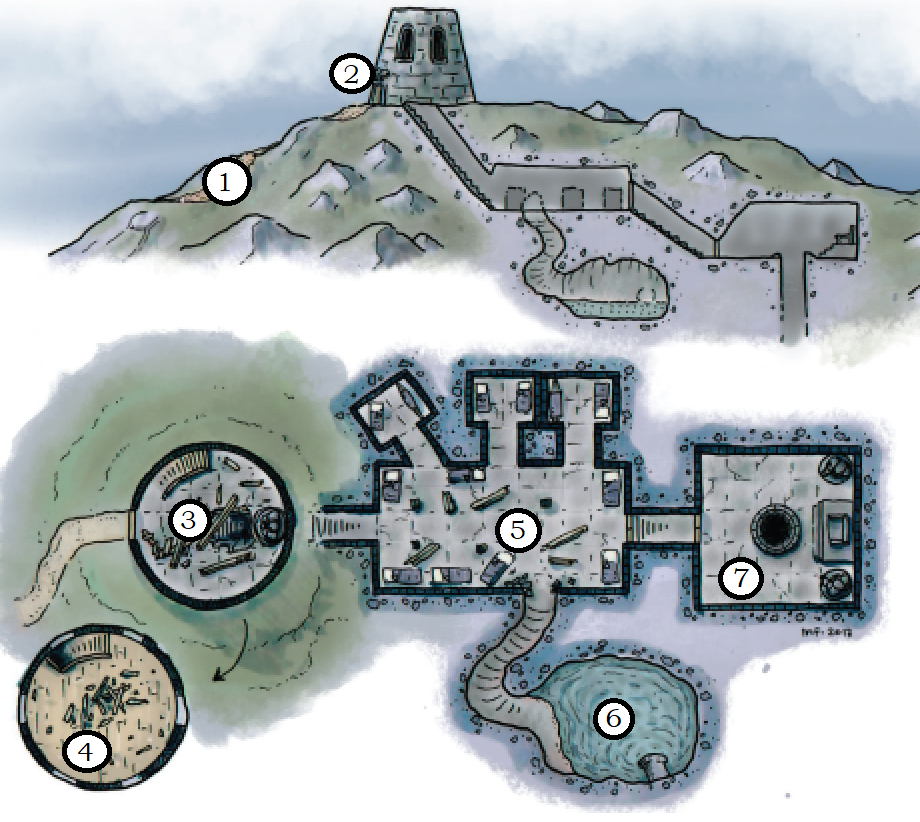
The Night Blade
Ruknar Foulbreath the Night Blade, a notorious Goblin chieftain, has been released from prison. Rumors mark him as having returned to the hideout from which he and his band once operated, a ruined watchtower where a new group of Goblins now preys upon the folk of Faerlyn and the surrounding vale.
When Ruknar Foulbreath and his younger brother Grakk Skullcrusher led the Night Blade Goblins, they were well known in the village of Faerlyn for their dastardly deeds. Grakk Skullcrusher and the rest of the Night Blades were killed when Ruknar Foulbreath was captured but later escaped and fled the Vale. But Sheriff Rutheara Willowmane believes that Ruknar Foulbreath's return means the Night Blades are back, and that attacks against wagons and travelers around the village will get worse unless the Goblin chieftain is stopped for good.
ADVENTURE SUMMARY
This adventure begins when the party is attacked by members of the new Night Blades. After the fight, the characters investigate the scene of battle to learn more about the Goblins. Sheriff Willowmane then recruits the characters to hunt down the new Night Blades and bring Ruknar Foulbreath to justice. In Faerlyn, the characters speak to the villagers to learn more of the history of Ruknar Foulbreath and the Night Blades. They then make their way through a huge expanse of tangleweed to reach the Lonely Torch, the ruined watchtower that once served the Night Blades as a headquarters. But as they explore the ruins of the tower and face off against the new group of Goblins dwelling there, the characters discover that Ruknar Foulbreath has been imprisoned by his brother Grakk Skullcrusher, disfigured but still alive. Learning that Ruknar Foulbreath has changed his ways and is now trying to turn his brother away from a life of evil, the characters must make a choice about who to save, who to kill, and who to bring back to Faerlyn to face justice.
Monsters: Goblins (6), shambling mound, guards (2), stirges (10), thugs (2), swarm of rats, Goblin captain
NOTABLE NPCS
Sheriff Rutheara Willowmane
Sheriff of the village of Faerlyn, Rutheara knows that her younger brother, Dronder Willowmane, was slain by Ruknar Foulbreath eleven years earlier, but the Goblin chieftain never paid the price for the crime.
Goblin NPCs
Ruknar Foulbreath the Night Blade (Male)
OCC: Assassin
Race: Goblin
Alignment: Diabolic
Attributes:
IQ: 12
ME: 15
MA: 10
PS: 16
PP: 18
PE: 14
PB: 6
Spd: 18
Bio: Ruknar is a feared and relentless assassin who specializes in silent kills under the cover of night. His breath is so foul it can cause nausea, a strange gift from his long exposure to the dark magic he practices. His stealth is unmatched, and he strikes with brutal efficiency, leaving no trace of his presence. Ruknar thrives on the fear of his victims and enjoys playing with his prey before delivering the killing blow. He is also a master of poisons, often coating his blades with venom before strikes.
Skills: Stealth, Assassination, Poisoning, Prowl, Melee Weapon Proficiency (Daggers and Shortsword)
Special Abilities: Night Vision, Silent Movement, Poison Resistance, Quick Reflexes
Grakk Skullcrusher (Male)
OCC: Warrior
Race: Goblin
Alignment: Diabolic
Attributes:
IQ: 10
ME: 14
MA: 9
PS: 22
PP: 12
PE: 16
PB: 5
Spd: 12
Bio: Grakk is a hulking warrior feared for his sheer physical strength and brutal combat style. He wields a massive club made from the skulls of his enemies, using it to smash through the opposition. Grakk is a terrifying presence in battle, eager to crush his foes beneath him and prove his dominance. He takes great pride in breaking his enemies' spirits before crushing their bodies, always aiming for the kill. Grakk thrives in chaos and bloodshed, showing no mercy to those who fall under his wrath.
Skills: Melee Combat (Club), Basic Math, Intimidation, Tactics
Special Abilities: Night Vision, Endurance, Iron Will, Strongman
1. Gribba Yellowriver (Male)
OCC: Warrior
Race: Goblin
Alignment: Diabolic
Attributes:
IQ: 10
ME: 12
MA: 10
PS: 18
PP: 14
PE: 16
PB: 8
Spd: 12
Bio: Gribba thrives in the chaos of battle, taking pleasure in the carnage and suffering of his enemies. He's a cruel, bloodthirsty warrior who revels in destruction and often hunts for sport. He will destroy anyone standing in his way, and his loyalty lies only with those who offer power.
Skills: Basic Mathematics, Climbing, First Aid, Land Navigation, Sword Proficiency, Wrestling
Special Abilities: Fast Reflexes, Night Vision, Strength Boost
2. Klibb the Mudstreamer (Male)
OCC: Shaman
Race: Goblin
Alignment: Diabolic
Attributes:
IQ: 16
ME: 14
MA: 10
PS: 9
PP: 13
PE: 10
PB: 6
Spd: 10
Bio: Klibb is a dark sorcerer, manipulating magic and spirits to his advantage. His rituals often involve blood sacrifices, and he's known to curse entire villages. He's an untrustworthy figure, willing to betray anyone for greater power, and often conducts his dark ceremonies near the river.
Skills: Ritual Magic, Herbalist, Wilderness Survival, Read Sensory Signals, Spellcraft
Special Abilities: Spellcasting, Spirit Channeling, Night Vision
3. Grubskull (Male)
OCC: Mercenary
Race: Goblin
Alignment: Miscreant
Attributes:
IQ: 10
ME: 14
MA: 12
PS: 16
PP: 16
PE: 14
PB: 8
Spd: 13
Bio: Grubskull is a hired killer, driven by greed and the thrill of battle. He has little regard for life, using his brutish strength to break through enemy lines and reap rewards. He will fight for anyone who offers him enough gold and promises of violence.
Skills: Hand-to-Hand Combat (Basic), Gunfighter, Intimidation, Military Strategy, Melee Weapon Proficiency (Axe)
Special Abilities: Night Vision, Fast Reflexes, Iron Will
4. Muckcrack (Male)
OCC: Bandit
Race: Goblin
Alignment: Evil
Attributes:
IQ: 12
ME: 9
MA: 8
PS: 15
PP: 14
PE: 12
PB: 5
Spd: 14
Bio: Muckcrack is a shadowy figure who thrives on thievery and ambushes. He enjoys the fear he instills in others and uses his sneaky ways to steal whatever he can. Muckcrack's ruthlessness makes him dangerous, he'll strike anyone who stands in his way and leave no survivors.
Skills: Pick Locks, Detect Ambush, Camouflage, Stealth, Trap Construction
Special Abilities: Stealth, Night Vision, Trap Sense
5. Skritch Sixfingers (Female)
OCC: Thief
Race: Goblin
Alignment: Evil
Attributes:
IQ: 14
ME: 10
MA: 8
PS: 10
PP: 15
PE: 12
PB: 10
Spd: 13
Bio: Skritch is a cunning and deceitful thief who thrives on manipulating others to get what she wants. She's an expert at picking pockets, stealing valuables, and causing chaos without leaving a trace. She enjoys watching her victims struggle, and often betrays her allies if it means she can gain the upper hand.
Skills: Prowl, Pick Pockets, Disguise, Escape Artist, Streetwise
Special Abilities: Night Vision, Silent Movement, Climbing
6. Grakshar the Stubborn (Male)
OCC: Warrior
Race: Goblin
Alignment: Evil
Attributes:
IQ: 10
ME: 15
MA: 12
PS: 20
PP: 16
PE: 18
PB: 7
Spd: 14
Bio: Grakshar is a brutal warrior who will stop at nothing to crush his enemies. His name "The Stubborn" reflects his will to fight to the death, even when it's clear he's outmatched. He believes in using overwhelming force to conquer all, often resorting to violence first and asking questions later.
Skills: Blade Proficiency, Basic Math, First Aid, Survival
Special Abilities: Night Vision, Endurance, Unyielding Willpower
7. Jukla Gritnose (Female)
OCC: Hunter
Race: Goblin
Alignment: Evil
Attributes:
IQ: 12
ME: 14
MA: 11
PS: 14
PP: 18
PE: 16
PB: 9
Spd: 12
Bio: Jukla is a ruthless hunter, using her skills to track down and kill for sport. She enjoys the fear in her prey's eyes as she closes in for the kill. She also serves as a scout for the tribe, never hesitating to eliminate any threats lurking nearby.
Skills: Archery, Tracking, Camouflage, Wilderness Survival, Fishing
Special Abilities: Night Vision, Silent Movement, Quick Reflexes
8. Skargrok Longfang (Male)
OCC: Beast Rider
Race: Goblin
Alignment: Evil
Attributes:
IQ: 10
ME: 12
MA: 10
PS: 18
PP: 13
PE: 16
PB: 8
Spd: 16
Bio: Skargrok has a deep bond with his beast, which he uses to terrorize enemy villages. He's not above using his mount to trample or devour his foes, and he relishes the chaos it brings. A brutal fighter, he's always in the thick of the action, mounted and ready to kill.
Skills: Animal Training, Beast Riding, Horsemanship, Melee Combat (Club)
Special Abilities: Animal Affinity, Night Vision, Agility
9. Krikka Mudhuffer (Female)
OCC: Healer
Race: Goblin
Alignment: Evil
Attributes:
IQ: 14
ME: 13
MA: 9
PS: 12
PP: 11
PE: 15
PB: 7
Spd: 9
Bio: Krikka uses her healing abilities in sinister ways, often poisoning her "patients" for sport or gaining favor with powerful figures. While she can heal the wounded, she is just as likely to use her skills to cause suffering or manipulate those around her. She is feared for her cold, calculating nature, and her affinity for pain and suffering only fuels her power. In her mind, healing is just another tool for control.
Skills: Herbal Medicine, First Aid, Ritual Magic, Poisoning, Survival
Special Abilities: Poison Resistance, Night Vision, Healing Touch (twisted to cause pain), Spirit Channeling
10. Tukk Cupsniffer (Male)
OCC: Scout
Race: Goblin
Alignment: Evil
Attributes:
IQ: 11
ME: 10
MA: 8
PS: 14
PP: 12
PE: 13
PB: 6
Spd: 14
Bio: Tukk is a sneaky scout, adept at tracking enemies and setting traps. He takes pleasure in watching his foes fall into his well-laid snares and is quick to betray anyone for a personal advantage. His underhanded tactics make him a skilled infiltrator, capable of slipping into enemy ranks unnoticed. He also has a cruel streak, enjoying the pain and suffering his traps inflict.
Skills: Tracking, Trap Construction, Stealth, Wilderness Survival, Prowl
Special Abilities: Night Vision, Silent Movement, Trap Sense
11. Zogthar Bitemaster (Male)
OCC: Beastmaster
Race: Goblin
Alignment: Diabolic
Attributes:
IQ: 12
ME: 14
MA: 10
PS: 17
PP: 16
PE: 14
PB: 7
Spd: 13
Bio: Zogthar is a ruthless beastmaster who uses terror and domination to control the wild creatures he commands. He loves to watch the agony of both his enemies and his beasts in battle, pushing them to their limits for his amusement. He delights in the pain and suffering that he can command from the creatures under his control. Zogthar is also known for his ability to make vicious beasts fight to the death, all for his personal gain.
Skills: Animal Training, Beast Riding, Torture, Tracking, Wilderness Survival
Special Abilities: Animal Affinity, Night Vision, Command Animal (beasts fight to the death)
12. Narkzog Teethbiter (Male)
OCC: Warrior
Race: Goblin
Alignment: Evil
Attributes:
IQ: 8
ME: 12
MA: 7
PS: 20
PP: 14
PE: 16
PB: 5
Spd: 15
Bio: Narkzog is a fearsome and relentless warrior, known for his insatiable bloodlust. He chews on the teeth of his enemies to show his strength and is often seen gnashing his teeth in excitement before battle. His savage nature makes him a terror to behold, and he is driven solely by his thirst for violence. Narkzog has no regard for the lives of others, and his enemies know to fear the sight of his gnashing, twisted grin.
Skills: Blade Proficiency, Melee Weapon Proficiency (Club), Basic Math, Tactics
Special Abilities: Night Vision, Blood Frenzy (increased strength in combat)
13. Vrukka Mudgob (Female)
OCC: Dark Priestess
Race: Goblin
Alignment: Diabolic
Attributes:
IQ: 16
ME: 13
MA: 9
PS: 10
PP: 14
PE: 12
PB: 7
Spd: 11
Bio: Vrukka is a feared dark priestess who channels forbidden magic to curse, enslave, and destroy. She uses her dark powers to manipulate others, playing her enemies against one another while slowly gaining influence over her tribe. She has no morality, and her power over dark magic is only growing as she sacrifices others to gain more strength.
Skills: Ritual Magic, Dark Arts, Occult Lore, Sorcery, Meditation
Special Abilities: Spellcasting, Dark Magic, Night Vision
14. Gritta Crankjaw (Female)
OCC: Assassin
Race: Goblin
Alignment: Evil
Attributes:
IQ: 13
ME: 12
MA: 10
PS: 15
PP: 16
PE: 14
PB: 8
Spd: 14
Bio: Gritta is a master of assassination, using stealth and poison to silently eliminate targets. She has no qualms about killing anyone, even those within her own tribe, if the price is right. Gritta is cold and calculating, preferring to observe her prey before striking swiftly and decisively. Her expertise in poisons and silent kills has made her a valued (and feared) member of the tribe.
Skills: Assassination, Poisoning, Stealth, Prowl, Melee Weapon Proficiency (Dagger)
Special Abilities: Night Vision, Silent Movement, Poison Resistance
15. Thraggar Bonepicker (Male)
OCC: Necromancer
Race: Goblin
Alignment: Diabolic
Attributes:
IQ: 18
ME: 16
MA: 9
PS: 8
PP: 13
PE: 11
PB: 5
Spd: 10
Bio: Thraggar is a twisted necromancer who uses dark magic to animate the dead and command their spirits. His experiments with the dead are gruesome and morbid, and he often uses the corpses of his fallen enemies to create his undead army. His fascination with death and decay has earned him the fear and distrust of even his fellow goblins.
Skills: Necromancy, Ritual Magic, Dark Arts, Occult Lore
Special Abilities: Undead Control, Night Vision, Death Magic
16. Snaga Redfang (Female)
OCC: Assassin
Race: Goblin
Alignment: Evil
Attributes:
IQ: 14
ME: 10
MA: 8
PS: 12
PP: 15
PE: 16
PB: 7
Spd: 15
Bio: Snaga is a sadistic assassin who enjoys torturing her victims before ending their lives. Her speed and agility make her deadly in close quarters, and she often uses her skills to eliminate rivals within the tribe. Snaga takes delight in the terror she causes and always relishes in the suffering of others.
Skills: Stealth, Assassination, Torture, Melee Weapon Proficiency (Dagger)
Special Abilities: Night Vision, Silent Movement, Quick Reflexes
SECRETS AND CLUES
- Ten years ago, Ruknar Foulbreath, Grakk Skullcrusher, and the rest of the Night Blades were trapped in a barn near the Lonely Torch. When angry villagers set the barn ablaze, only Ruknar Foulbreath made it out, with Grakk Skullcrusher and the rest of the trapped Night Blades dying in the fire.
- In former days, many young men and women who could not make a living in Faerlyn fell to evil under the flag of the Night Blades.
- The original Night Blades used the ruined watchtower known as the Lonely Torch for their headquarters. The site is overgrown with an invasive poisonous tangleweed, which covers most of the hills around the tower.
- A witness claims to have seen Night Blade Goblins pissing on their own boots before making their way up to the Lonely Torch.
- Dousing one's boots with urine protects against the worst effects of the tangleweed and allows creatures to move through it.
- When the Night Blades were destroyed, the area around Faerlyn was relatively free from Goblin attacks for many years. Over the past year, a new group of Goblins has appeared at the Lonely Torch, slowly building power by recruiting independent Goblins to their cause or slitting their throats.
- A masked figure called the Night Lord has recently been revealed as the leader of this new group of Goblins, making many see the group as a new incarnation of the Night Blades.
- The Night Lord has been seen with some sort of red bird perched on his shoulder.
- The Night Lord wears a golden mask, whose edges reveal that the skin of his neck is horribly scarred.
- A cloud of bats has been seen flying over the Lonely Torch. Witnesses have reported seeing the bats descend on a large elk that wandered too close to the tangleweed, swarming it and leaving only a bloodless, wrinkled husk behind.
- A few weeks ago, a number of villagers saw someone they swear was Ruknar Foulbreath the Night Blade returning.
CUSTOMIZING THE ADVENTURE
You can customize this adventure by replacing either Grakk Skullcrusher or Ruknar Foulbreath with NPCs from your campaign, or from the backgrounds of the characters. Grakk Skullcrusher, Ruknar Foulbreath, or both might have some relationship to one or more of the player characters, either by blood or by having crossed paths in the past. It might even be the case that, before his incarceration, Ruknar Foulbreath had murdered a character's family member, companion, or friend. The Night Blades can be customized to represent a particular faction of Goblins from your own game world. Add details to the tower and the chambers below it to highlight a previous empire or some other layer of the history of your campaign. Customize the initial story hook by switching out the quest giver to an NPC the characters have worked with in the past.
Any NPC who has reason to see the Night Blades (or the equivalent Goblin group from your own campaign) as a threat could send the characters in to cut them down.
START
Light rain falls, and a gloomy mist covers the landscape. A large tree has fallen across the road, crushing a wagon under its great weight. More fallen trees lie at the sides of the road.
Six Goblins (Artur, Dobarn, Kirci, Dorra, Rhuda and Tasty Pete) lurk at the sides of the road, hiding near the fallen trees and ready to rob passersby. If the characters approach the wagon, one of the Goblins shouts out, "Your weapons and belongings! Drop them to the ground, and in the name of the Night Blades, we'll spare your lives!"
If convinced or goaded into speaking, the Goblins reveal that they are eager to look good in the eyes of their leader the Night Lord, who waits for their return at the Lonely Torch. When the battle is over, the characters can approach local villagers in Faerlyn to learn some of the information regarding the Night Blades given in the "Secrets and Clues" section. Eventually, the party is approached by Sheriff Willowmane, who hires the characters to root out the Night Blades and bring their newly returned leader Ruknar Foulbreath to justice.
NOTABLE LOCATIONS
1/ The Tangles
A narrow path leads up a rocky slope to the broken stone walls of the Lonely Torch watchtower. A twofoot thick carpet of glistening green-and-violet weeds and thorny brambles surrounds the stony hill on which the tower sits. Statues of forgotten nobility peer out from the tangled vines.
Tangleweed is an invasive, poisonous plant that can lash out against creatures passing close by. Any creature that moves through the tangleweed without protection must succeed on a save vs. PE of 13 or take 7 (2d6) poison damage and be poisoned for 1 hour. A character with a medical background can spend 10 minutes to aid the victim and attempt a Botany or Herbology skill check. On a success, the afflicted character is no longer poisoned. Covering one's boots in urine repels the tangleweed and negates the need for a saving throw.
A shambling mound (known as Strangleberries by the Night Blades) might be seen wandering through the tangleweed, but this creature is generally not aggressive. Like the tangleweed, it can be repelled by urine.
2/ Shattered Door
The thin path rising through the tangleweed leads up to an ironbound wooden door at the front of the ruined tower. A stone gargoyle juts out from above the door, its mouth open to reveal that its tongue has been broken off. Arrow slits are cut into the rough stone walls of the tower, angled toward the path where it leads up to the door.
Two Night Blade guards (Ozgull Grubskull and Pulk Muckcrack) are meant to watch over this door by peering out the arrow slits from inside the tower. However, they are often either too drunk or too engaged in a game of knucklebones to notice anyone who doesn't make a lot of noise while approaching. The door is strong ironbound oak and is barred from the inside. The magic that once animated the door's gargoyle guardian has faded, but the residual spark of that magic allows the gargoyle to speak. The gargoyle is lonely for company, and aware of much of the activity undertaken by those inside the tower. The Goblins have long since ignored the chatty guardian.
3/ Broken Hall
Large oaken beams have collapsed from where they once supported the vaulted ceiling of this hall. One has smashed through the floor, revealing basement passages below. A large headless statue of a warrior, its greatsword clasped hilt-up in its hands, stands at the far side of the hall. A stone staircase leads up to the higher floors of the tower. In addition to the guards described above, four Night Blade Goblins (Skritch Sixfingers, Grakshar the Stubborn, Jukla Gritnose, and Skargrok Longfang) sometimes reside in this hall when preparing for an imminent attack, or when they need to get out of the stagnant air in the basement levels. They avoid the stirges above, which they call "the Night Lord's children." While in this hall, the characters might hear commotion from below but they hear nothing but silence from above.
4/ Shadowed Reaches
Sections of the walls of this upper level of the tower have collapsed from centuries of decay. Much of the stone ceiling has likewise fallen, leaving the tower open to the elements above. An old yet still beautiful fresco painting covers what remains of the ceiling, but much of it is shrouded by curtains of moss.
Ten stirges lurk behind the cover of the moss, hoping that living creatures will come close enough to feed their insatiable appetites. The Night Blades know to stay out of this chamber, since only Grakk Skullcrusher is safe from attack by these monsters.
5/ Sunken Cellars
The floor of the tower has collapsed, revealing stairs leading to a series of stone chambers below. Cracked wooden support beams hold up the crumbling stone ceiling of the main chamber, whose walls are lined with hammocks and bedrolls. A stone door, carved with an artful depiction of hooded priests, stands at the opposite end of the hall, while a natural tunnel leads off to the right. Depending on the time of day, four Night Blade Goblins (Krikka Mudhuffer, Grubnash the Mighty, Draggmash Scornscales, and Tukk Cupsniffer) and two thugs (Zogthar Bitemaster and Narkzog Teethbiter) might be sleeping here. They are generally not alert unless a significant amount of noise has been made upstairs. The carved doorway leads into the lost shrine, while the natural tunnel leads to the mud pit.
6/ Mud Pit
A narrow walkway leads to the lip of a ten-foot-deep pit filled with mud. An ancient drainpipe roughly two feet in diameter is closed off by steel bars and trickles fetid water into the pool. A knotted rope hangs from an iron hook hammered into the natural stone wall. Two Night Blade Goblins (Gribba Yellowriver and Klibb the Mudstreamer) guard this cavern while Ruknar Foulbreath languishes in the mud, imprisoned and tormented here by his brother Grakk Skullcrusher until he comes to his senses and demonstrates a willingness to return to his former life as a Raider and murderer. One of the Goblins has a large bag filled with a swarm of rats, which he uses to torment Ruknar Foulbreath. If attacked, the Goblin dumps out this bag to add to the chaos. If Ruknar Foulbreath is rescued, he reveals that he returned to the Lonely Torch after finding out that his brother Grakk Skullcrusher was alive and leading a new group of Night Blades. Ruknar Foulbreath had hoped to turn Grakk Skullcrusher away from murder and Goblinry, but his failure to do so saw him incarcerated here.
7/ Lost Throne
Two hulking statues of faceless armored knights kneel in the corners of the room, facing the center of the chamber and a well there that leads down into the shadowy depths. A stone throne sits upon a raised dais opposite the door. Grakk Skullcrusher, a Goblin captain, and four Night Blade Goblins (Vrukka Mudgob, Gritta Crankjaw, Thraggar Bonepicker, and Snaga Redfang) are usually found in this hall, sorting through recently stolen goods or planning their next attacks. Grakk Skullcrusher's pet stirge Heartspine hides in the corner and attacks any character who attacks its master. This stirge has 10 hit points and a prowl bonus of +5%. Grakk Skullcrusher wields a +1 shortsword called Nightculler a silvered weapon with a draconic pommel and a line of black onyx along the fuller of the blade. A character attuned to the sword is able to cast the darkness spell, requiring no components. Once this feature is used, it can't be used again until the next dawn. Still wracked by guilt over his previous life and feeling responsible for the behavior of his brother, Ruknar Foulbreath is willing to accept whatever punishment the characters or the folk of Faerlyn seek for him.
History of the Night Blades
The Night Blade Tribe was once a powerful and feared force in the Vale of Faerlyn, led by the two notorious goblin brothers, Ruknar Foulbreath and Grakk Skullcrusher. Their reign of terror lasted for years as they raided villages, ambushed travelers, and enslaved the weak. Their hideout, the Lonely Torch, a crumbling watchtower deep within the Tangleweed-infested hills, became their lair and symbol of their power.
The Rise of the Night Blades
In the beginning, the two brothers were unstoppable. Ruknar Foulbreath, the elder and more cunning of the two, served as the strategic mastermind behind the tribe's operations. His intellect, combined with his ruthless ambition, helped the Night Blades grow into a terror that plagued the Vale. He was a master manipulator, controlling the actions of the tribe through calculated moves and dark deals.
Grakk Skullcrusher, the younger brother, was a brute force of nature, fierce, violent, and eager to prove his strength. His combat prowess earned him respect among the tribe, and he became Ruknar's enforcer, carrying out the more violent and bloodthirsty aspects of their raids. Together, the two made the Night Blades a feared name in the Vale, and the Lonely Torch became a symbol of their dominance.
But the tribe was not just feared for their strength. They also delved into dark magic, tapping into necromantic powers to raise the dead and use them as their loyal servants. The Night Blades had a unique and terrifying advantage, dark forces guided their actions, and their power seemed limitless.
The Fall of the Night Blades
After a particularly bloody raid on Faerlyn, the Night Blades were finally cornered. The villagers, fed up with years of terror, launched a retaliatory strike, tracking the goblins to their hideout near the Lonely Torch. The goblins, assuming they were invincible, were caught off-guard. The villagers set fire to the barn where the goblins were hiding, hoping to end the terror once and for all.
The fire claimed the lives of Grakk Skullcrusher and most of the Night Blades perished. Ruknar Foulbreath, however, managed to escape, albeit severely burned and broken. He fled into the wilderness, leaving the Night Blades and their once-feared reign in ruins.
For years, the Vale of Faerlyn lived in relative peace. The Lonely Torch lay abandoned, consumed by the Tangleweed, and the legend of the Night Blades faded into the past. But not all was as it seemed. Ruknar Foulbreath was lost, wandering through the wilderness, aimless and broken by the guilt of his past actions.
Ruknar Foulbreath: Lost and Wandering
After the fall of the Night Blades, Ruknar Foulbreath wandered through the mountains and forests, broken both physically and emotionally. The fire that consumed the Night Blades had scarred him deeply. Alone, haunted by his tribe's actions, Ruknar retreated from the world, lost in the wilderness. He hoped that by distancing himself from his past, he might find some form of redemption. But the path was a difficult one, filled with guilt, pain, and self-loathing.
During his years of wandering, Ruknar found solace in solitude and began seeking a new path. He came into contact with hermits, outcasts, and other lost souls who had left the world behind. It was through these interactions that he discovered the Goddess of Light, and he began to see the possibility of atonement. He rejected his past and the dark powers that had guided him. Ruknar's heart began to soften, and he began to hope that he could atone for his sins, perhaps by one day confronting his brother, Grakk, and stopping the evil he had once helped spread.
However, Ruknar's peace would be short-lived. His brother, Grakk Skullcrusher, was still alive.
Grakk Skullcrusher: The Puppet Master
Unknown to Ruknar, Grakk Skullcrusher survived the fire, though horribly disfigured. He had been left broken by the fire, but his hatred for the villagers and his brother burned stronger than ever. Consumed by rage and vengeance, Grakk returned to the Lonely Torch. There, he began to rebuild the Night Blades, forging a new gang from the wreckage of his past.
But the Night Blades of this new era were different. Under Grakk's leadership, they were fueled not by mere greed, but by a relentless thirst for revenge. Grakk's body was a testament to the horrors of the fire; his face was scarred beyond recognition, and he now wore a golden mask to hide his disfigurement. However, it was not just his appearance that had changed, his spirit had been twisted by years of vengeance.
Despite his hatred for Ruknar, Grakk Skullcrusher was not content with merely leading the Night Blades, he desired complete control over his brother. Ruknar, once a leader, now seemed weak to Grakk. As the Night Blades grew stronger under Grakk's command, he captured Ruknar and brought him back to the Lonely Torch.
Ruknar as a Puppet Leader
Now, Ruknar was not a leader but a puppet. Grakk Skullcrusher imprisoned him in the Lonely Torch, using him as a symbol of leadership while secretly controlling his every move. Grakk kept Ruknar alive, but as little more than a figurehead. To the outside world, it seemed that Ruknar Foulbreath had returned to lead the Night Blades, but in truth, he was nothing more than a tool in his brother's hands.
Grakk, now known as the Night Lord, had plans far more sinister than simple raids. He intended to force Ruknar to make appearances, to lead the tribe into battle, all the while controlling him behind the scenes. Grakk wanted the Night Blades to reclaim their place in the shadows, but he also wanted to use Ruknar's former glory to strike terror into the hearts of Faerlyn and beyond.
The Night Blades under Grakk Skullcrusher were merciless. They carried out raids on the village, took prisoners, and looted, all while Ruknar was forced to watch, helpless to stop his brother's growing power. Ruknar, once the leader of the tribe, now faced the agony of being forced to participate in the very acts of cruelty he had once commanded.
Ruknar's Conflict: Redemption or Puppet?
Although Ruknar Foulbreath was a puppet leader, he did not lose all hope. Deep inside, the Goddess of Light still called to him, and his heart ached to free Faerlyn from his brother's influence. But his hands were tied. If he rebelled, he risked his life; if he complied, he would only perpetuate the evil that had already caused so much suffering.
As Ruknar now leads the Night Blades in his brother's shadow, he is torn between his desire to save the tribe from Grakk's vengeance and his own guilt for his past actions. Is it too late for redemption? Can Ruknar ever break free of his brother's grasp? And will the adventurers be able to help him make the impossible choice between redemption and revenge?
The Adventurers' Role
The Night Blades are back, and this time, it's not just about stopping a tribe of bloodthirsty goblins. The adventurers will have to navigate the twisted web of family, guilt, and revenge. Ruknar Foulbreath is trapped in his own personal hell, and Grakk Skullcrusher is determined to use his brother's name and reputation to reignite the terror that once defined their reign. The adventurers must decide if they can help Ruknar break free of his brother's control, or if they will have to put an end to the Night Blades once and for all.
The Lonely Torch is once again the center of a conflict, and the fate of the Night Blades, and the brothers who once led them, lies in the hands of the adventurers.