|
dwindled. Eventually, the island of Ithildin was abandoned, left empty and silent for 15,000 years, its once-great cities falling into ruin.
It was only saved from total erasure when it was recolonized and restored as a duchy of Arethane, giving the High Elves a second chance to reclaim their ancestral homeland, though many say its glory will never be what it once was.
Geography
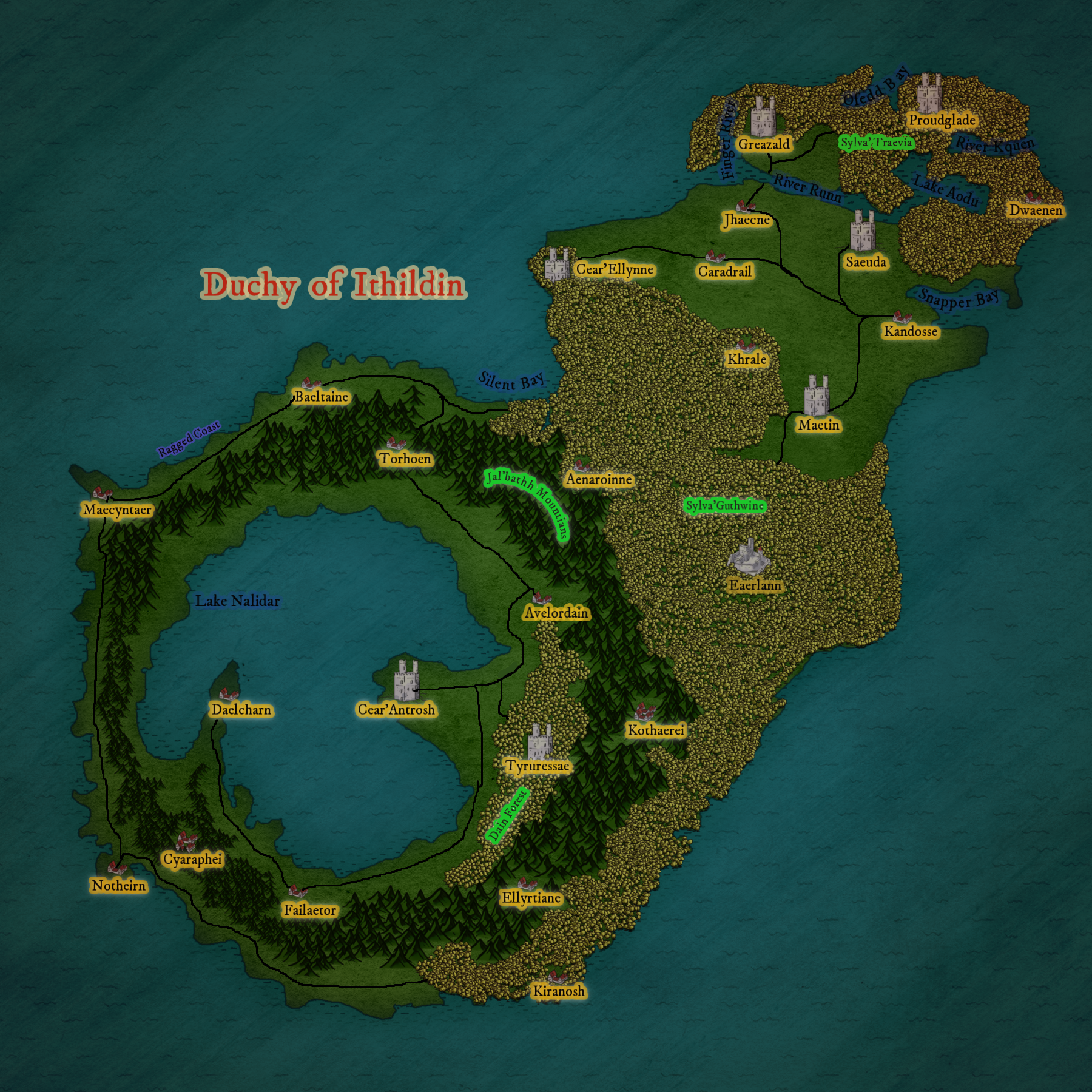
Ithildin is a large island strategically positioned to control key sea routes, making it a historic naval stronghold for the High Elves.
- Eaerlann: The ducal capital, rising amidst the southern highlands, its towers rebuilt upon ancient foundations and filled with the echoes of former grandeur.
- Sylva`Guthwine: Expansive, ancient woodlands covering much of the island's interior, filled with hidden ruins, arcane relics, and wild magic from before the wars.
- Nen'Nalidar: A vast, enigmatic crater lake nestled in the southern region, encircled by jagged, blackened mountains formed by the cataclysmic sorcery of the long-dead Mage-General Corbin Valquiss. Its unnaturally deep, eerily still waters are rumored to conceal the wreckage of ancient war machines and cursed relics.
- Coastal Fortresses & Shipyards: Remnants of a time when Ithildin's swift and mighty navy ruled the surrounding seas, now mostly abandoned but still standing as silent sentinels of the past.
History of Decline
The Golden Age of Ithildin
Ithildin was one of the the original homelands of the High Elves, a land of gleaming white towers, living forests, and thriving arts, magic, and philosophy. From here, the High Elves governed distant colonies and sea empires, their influence spreading far and wide across the seas.
The Elf-Human Wars
Then came humanity, whose rapid rise challenged elven supremacy. What began as trade skirmishes escalated into centuries of brutal conflict, the Elf-Human Wars.
Though the elves held superiority in skill, magic, and discipline, their losses were irreplaceable. For every elf slain, thousands of humans rose to take their place. Entire generations of elven warriors fell, and slowly, the High Elves diminished to shadows of their former might.
Valenkar the Exile
During this era of decline, Valenkar Ashwiend, an ambitious and charismatic High Elf noble, attempted a coup to seize power in Ithildin. After his failure, he and his followers were exiled. Consumed by bitterness and vengeance, Valenkar retreated underground and became a member of a Drow Clan.
The civil war Valenkar sparked further drained Ithildin's strength, hastening its fall and increasing its vulnerability to human advances.
The Myralretch Campaigns and the Birth of Nen'Nalidar
Nearly 20,000 years ago, the human empire of Myralretch dispatched its infamous Mage-General Corbin Valquiss to conquer Ithildin. Valquiss wielded devastating sorcery, culminating in a cataclysmic spell that shattered the southern plains, collapsing mountain ranges into a massive sinkhole.
This catastrophe formed Nen'Nalidar, the great crater lake ringed by jagged mountains, a grim reminder of the campaign's destructive power. The blackened mountain walls bear scars of searing energy, while the lake's depths conceal the ruins of drowned cities, shattered war machines, and the remains of countless fallen soldiers.
Though Valquiss was slain in the campaign, his sorcery permanently scarred the land. Exhausted and bereft, the surviving High Elves fled through arcane gates to Rhyanne, abandoning Ithildin to ruin.
15,000 Years of Silence
For millennia, Ithildin lay silent and empty. Its forests grew wild and dangerous, ruins crumbled, and humans scavenged its forgotten treasures. Nen'Nalidar became a place of dread and superstition; fishermen whispered of strange lights dancing on the water, and travelers spoke of eerie voices carried on the wind.
When the High Elves of Arethane finally returned, they found a homeland steeped in sorrow, a shadow of its ancient self.
Recolonization under Arethane
The rising Kingdom of Arethane sought to restore the legacy of the High Elves. Ithildin was recolonized as a duchy, governed by the noble Rae'Nardae Family. The ducal capital of Eaerlann was restored atop ancient ruins, new fortresses and settlements were founded, and scattered elven clans were brought back into the fold.
Despite this revival, Ithildin remains a fragile jewel, a land caught between its glorious past and uncertain future.
Government
Today, Ithildin is a duchy within the Kingdom of Arethane, its rulers, Duke Draeshard and Duchess Telandia Rae'Nardae vassals of the Elven crown.
- Duke Draeshard Rae'Nardae: Commander of the duchy's military forces, vigilant against human raiders, Drow infiltrators, and remnants of Myralretch cults.
- Duchess Telandia Rae'Nardae: Patron of arts, culture, and arcane knowledge, dedicated to restoring Ithildin's cultural heritage.
The ducal court in Eaerlann is a place of cautious hope shadowed by the memory of loss, where every small victory is tempered by the knowledge that the High Elves may never regain their former glory.
Culture
The High Elves of Ithildin remain masters of art, magic, and scholarship, but a hard edge has crept into their beauty and grace. The centuries of war and loss have left them proud yet bitter, their cultural refinements tempered by survival's harsh realities.
- They view humans as brash upstarts, responsible for the centuries of bloodshed that hollowed their lands.
- They despise the Drow, their traitorous kin who dwell in the shadows beneath the earth.
- They revere their ruined cities and ancient legacies, even as they rebuild upon their broken foundations.
Though proud, the elves of Ithildin carry the weariness of a people who have fought too long and lost too much.
Duchy of Ithildin Overview
Climate and Landscape: Ithildin is a scarred, battle-worn land, haunted by the memory of centuries-long wars with humanity. Some area's have returned to being lush and verdant, composed of approximatly 40% plains land and 60% forests of Mallorn Trees, along with Oak, Birch, Willow, Maple, and Pine. The elves have seamlessly integrated their civilization into the natural surroundings, creating a harmonious coexistence with the environment.
Climate: The weather in Ithildin is temperate and mild, influenced by the magical energies that flow through the land. The area around Nimilith has a consistent temperature all year round of 74 degrees. The rest of Ithildin has the following conditions
- Summer: Warm, with temperatures ranging from the mid-70s to low 80s.
- Spring/Fall: Gentle, with temperatures between the mid-60s and low 70s.
- Winter: Mild, rarely dropping below the mid-30s.
- Precipitation: Soft, cleansing rains occur in the early evening or just before dawn. Snow and severe storms are almost nonexistent.
The region's climate supports the thriving forests and the diverse flora and fauna within them, making it a haven for the elves and the other inhabitants of Ithildin. The magical ambiance of the land ensures a stable and nurturing environment, fostering the growth of both the natural world and the elven society.
Integration with Nature: The elves of Ithildin have mastered the art of living in harmony with their surroundings. Their homes, paths, and structures are crafted to blend seamlessly with the forests, minimizing disruption to the natural landscape. This approach not only restores the beauty of Ithildin but also enhances the magical essence that flows through the land.
Religion
The main religions worshiped in Ithildin are the Seldarine and Dragonwright.
- Seldarine: Approximately 80% of the population worships the Seldarine, the pantheon of Elven gods, which includes deities like Corellon Larethian, the primary god of the Elves.
- Dragonwright: The remaining 20% of the population worships Dragonwright, a religion that venerates ancient dragon deities.
Ithildin stands as a testament to the Elves' reverence for nature and their ability to create a sustainable, harmonious society that thrives within it. The strong spiritual presence of the Seldarine and Dragonwright further enriches the cultural and magical tapestry of the Principality.
Primary economic activities
Elven societies often blend natural resources with artisanal craftsmanship, magic, and sustainable practices. Key economic sectors include:
- Animal Husbandry: Cattle, Pigs
- Forestry and Woodcrafting:
- Sustainable harvesting of timber from various tree species, including the valuable Mallorn trees.
- Production of high-quality wooden goods, such as furniture, instruments, and architectural components.
- Magic and Enchantment:
- Crafting magical items, potions, and enchantments.
- Exporting rare and enchanted goods to other regions.
- Agriculture and Herbalism:
- Cultivation of unique plants, herbs, and fungi used in healing, alchemy, and cuisine.
- Production of fine wines, especially from magical or rare ingredients.
- Art and Craftsmanship:
- Creation of elven art, jewelry, and textiles known for their beauty and quality.
- Exporting these goods to wealthier markets.
- Fae-related Activities:
- Trade with Fae beings and other magical entities that inhabit the forests.
- Unique services and goods stemming from the interaction between Elves and the Fae.
Law and Justice in Ithildin
The Principality of Ithildin, like much of the Elven kingdom of Arethane, has a well-structured system of law and justice that reflects its deeply ingrained values of harmony, wisdom, and balance. The Elven approach to law is rooted in ancient traditions and is heavily influenced by their connection to nature, magic, and their long lifespan, which gives them a unique perspective on justice and societal order.
- Legal System:
- Council of Elders:
The highest governing body in Ithildin is the Coronal Council Lead by the Duke and is composed of the wisest and most respected Elves from various regions of the Principality. They serve as advisors to the Duke and oversee major legislative decisions.
The council meets in Eaerlann, the Principal Seat, where they deliberate on important matters, resolve disputes between communities, and ensure that the laws are in harmony with Elven values and the natural world.
- Local Governance:
Each village or town within Ithildin has a local council led by a chief or mayor. These councils handle day-to-day governance, local disputes, and the enforcement of laws.
Village councils often include representatives from various professions and social groups, ensuring a broad representation of the community's interests.
- The Code of the Seldarine:
The legal framework is heavily influenced by the teachings and principles of the Seldarine, the Elven pantheon. Laws are designed to reflect the virtues of the gods, such as justice, mercy, honor, and respect for life and nature.
The Code of the Seldarine is a living document, evolving with the times while maintaining its core principles.
- Judicial System:
- Judges and Druids: The judiciary is composed of learned judges and druids who are well-versed in Elven law, magic, and the natural world. They are responsible for interpreting the laws and presiding over trials. Judges and druids are selected based on their wisdom, fairness, and deep understanding of both the spiritual and temporal aspects of Elven life.
- Trial by Council: Trials in Ithildin are typically conducted by a council of judges rather than a single judge. This ensures a balanced and fair assessment of the case. In more serious cases, the Council of Elders may be called upon to render judgment.
- Restorative Justice: The Elven approach to justice emphasizes restoration and rehabilitation over punishment. Offenders are often required to make amends to their victims and the community, through acts of service or restitution. Imprisonment is rare and usually reserved for those who pose a significant threat to society. Instead, offenders may be banished or placed under magical constraints or in some cases executed.
- Magic in Law Enforcement:
- Magic plays a crucial role in law enforcement and investigation. Truth spells, divination, and other forms of magic are used to ascertain facts and ensure that justice is served.
- Magical protections are also in place to safeguard the legal process from manipulation or corruption.
- Crime and Punishment:
- Minor Offenses: Minor offenses, such as theft or vandalism, are typically resolved through restitution and community service. The focus is on restoring harmony and repairing any damage done.
- Major Offenses: Major offenses, such as murder or treason, are taken very seriously. Perpetrators of such crimes face severe consequences, which may include banishment, loss of magical abilities, or, in extreme cases, execution.
- Snagga System: In certain cases where a prisoner is deemed redeemable or of special value, they may be spared the death sentence and instead given over as property to serve as snagga. This practice allows offenders to serve the community under strict supervision, offering them a chance at redemption through service.
- Protection of Nature: Crimes against nature, such as the destruction of sacred trees or the pollution of waterways, are considered particularly heinous. Offenders are required to undertake extensive restoration efforts and may face additional penalties.
- Customary Practices:
- Mediation and Arbitration: Mediation and arbitration are common practices in Ithildin. Elders, druids, or respected community members often mediate disputes to reach a peaceful resolution without the need for formal trials.
- Oaths and Vows: Oaths and vows are sacred in Elven society. Breaking a sworn oath is considered a grave offense and can lead to social ostracism or legal consequences.
- Community Involvement: The community plays an active role in maintaining law and order. Public opinion and communal values heavily influence the enforcement and interpretation of laws.
Overall, the legal and judicial systems in Ithildin reflect the Elven commitment to harmony, balance, and respect for all life. Justice is not merely a matter of punishment but a path to restoring balance and ensuring the well-being of the community and the natural world. The inclusion of the snagga system adds a layer of redemption and service, highlighting the Elven belief in second chances and the potential for personal growth and change.
Social Structure
Noble Houses: Ithildin's social hierarchy is primarily structured around noble houses, each tracing its lineage back through generations of Elven and possibly Fae ancestry. These noble houses hold positions of authority and influence within the Principality, overseeing governance, military leadership, and cultural stewardship. The heads of noble houses, such as House Ariquis, play pivotal roles in shaping Ithildin's policies and representing the Principality's interests at the kingdom level.
Merchant Houses: Alongside noble houses, Ithildin also features merchant houses that contribute significantly to the Principality's economic prosperity. These merchant families engage in trade both within Arethane and with external realms, specializing in the export of magical artifacts, rare herbs, and enchanted goods derived from Ithildin's natural resources. Merchant houses often hold considerable wealth and influence, forming alliances with noble houses to bolster economic ventures and ensure mutual benefit.
Clans: - Wood Elven Clans: Wood Elves organize their society into clans, each typically centered around a large extended family. These clans are deeply connected to the forest and natural world, and their leaders are often chosen based on wisdom, experience, and their ability to communicate with nature. Unlike the noble and merchant houses, Wood Elven clans emphasize communal living and decision-making through consensus. Clan gatherings are central to their culture, where members discuss important matters, celebrate seasonal festivals, and honor their ancestors.
- Moon Elven Clans: Moon Elves also follow a clan-based structure, but their organization is more fluid compared to Wood Elves. Clans are formed around shared interests, magical pursuits, or common goals rather than strict family ties. Leadership within Moon Elven clans is often merit-based, with leaders chosen for their magical prowess, vision, and ability to inspire. These clans are known for their strong emphasis on art, music, and celestial studies, contributing to the cultural and spiritual enrichment of Ithildin
Fae Community: Integral to Ithildin's social fabric is its vibrant Fae community, which resides harmoniously alongside the Elven population. Fae individuals may be organized into their own societal structures or integrated within noble and merchant circles, contributing unique perspectives and magical expertise to the Principality's affairs. Their presence enriches Ithildin's cultural diversity and spiritual practices, intertwining with Elven traditions to create a tapestry of shared heritage.
Guilds and Artisans: Beyond noble and merchant houses, Ithildin supports guilds and artisan communities specializing in various crafts, from woodworking and herbalism to arcane enchantments and healing arts. Guilds play a crucial role in preserving traditional skills and fostering innovation, ensuring the Principality remains self-sufficient in crafting essential goods while nurturing artistic expression and cultural pride.
Magical Practices:
Integration of Magic: Magic in Ithildin is not merely a mystical force but an integral part of daily life and governance. The Principality's inhabitants, particularly those trained in arcane arts, weave magic into various aspects of society, from agricultural rituals that ensure bountiful harvests to protective enchantments safeguarding the Mallorn Trees and sacred sites.
Magical Education: Ithildin boasts esteemed academies and magical institutions where gifted individuals, both Elven and Fae, hone their talents under the guidance of skilled mentors. These institutions emphasize not only theoretical knowledge but also practical applications of magic, preparing students to serve as healers, enchanters, and guardians of ancient lore.
Rituals and Ceremonies: Throughout the year, Ithildin hosts elaborate rituals and ceremonies that honor natural cycles, ancestral spirits, and the divine essence of the land. These rituals often involve communal participation, with prayers, offerings, and spellcasting conducted to maintain harmony between the physical and spiritual realms.
Environmental Conservation:
Stewardship of Mallorn Trees: The Mallorn Trees are central to Ithildin's identity and sustainability efforts. The Principality implements strict conservation practices to preserve these ancient trees, ensuring their longevity and magical potency. Guardians appointed by noble houses oversee the health of Mallorn groves, monitoring for signs of disease or magical imbalance that could threaten the forest's equilibrium.
Sustainable Practices: Ithildin promotes sustainable use of natural resources, balancing economic demands with ecological responsibility. Harvesting of magical herbs and materials is regulated to prevent overexploitation, with guidelines set by guilds and environmental councils to maintain biodiversity and ecosystem health.
Magical Sanctuaries: Certain areas within Ithildin are designated as magical sanctuaries, where access is restricted to protect fragile ecosystems and rare flora. These sanctuaries serve as havens for endangered species and repositories of ancient magic, guarded by both natural barriers and enchanted wards.
Diplomatic Relations:
Alliances and Treaties: Ithildin maintains diplomatic ties with neighboring human settlements, and possibly non-Elven factions across Arethane. Diplomatic envoys from noble houses negotiate trade agreements, military alliances, and cultural exchanges that foster mutual cooperation and prosperity.
Cultural Diplomacy: Cultural festivals and diplomatic summits hosted in Ithildin showcase the Principality's rich heritage and commitment to peaceful relations. These gatherings promote understanding between diverse cultures, celebrating shared values and forging lasting bonds that transcend political borders.
Education and Knowledge:
Academic Pursuits: Ithildin's educational institutions prioritize the study of magic, history, and natural sciences, nurturing scholars who contribute to the Principality's intellectual legacy. Libraries stocked with ancient tomes and enchanted scrolls serve as repositories of knowledge, accessible to researchers and students alike.
Apprenticeships and Mentorship: Apprenticeships under skilled artisans and mages provide practical training in specialized fields, ensuring continuity of traditional craftsmanship and magical techniques. Mentorship programs foster innovation and creativity, empowering individuals to push the boundaries of magical understanding and application.
Cultural Festivals and Traditions:
Seasonal Celebrations: Ithildin observes seasonal festivals that coincide with natural cycles, such as the blooming of Mallorn blossoms or the solstices and equinoxes. These festivals feature feasts, performances, and ceremonial rites that honor deities, ancestors, and elemental spirits believed to influence the Principality's prosperity and well-being.
Artistic Expression: Artisan guilds and performers showcase their talents during cultural festivals, presenting music, dance, and visual arts that reflect Ithildin's mythological themes and historical narratives. These artistic expressions reinforce community bonds and inspire pride in shared cultural heritage.
Challenges and Conflicts:
Political Intrigue: Intrigue among noble houses and external powers can strain diplomatic relations and internal harmony within Ithildin. Disputes over resource allocation, succession rights, or territorial claims may require mediation by the Valishar or diplomatic intervention to prevent escalation.
Cultural Preservation: Balancing modernization with cultural preservation poses a continual challenge in Ithildin, as societal changes and external influences impact traditional practices and values. Efforts to safeguard cultural heritage while embracing innovation contribute to ongoing debates and community dialogue.
Cities and Towns of Ithildin: |