Orders and Organizations of the Kingdom of Arethane
The Shadow Council of Arethane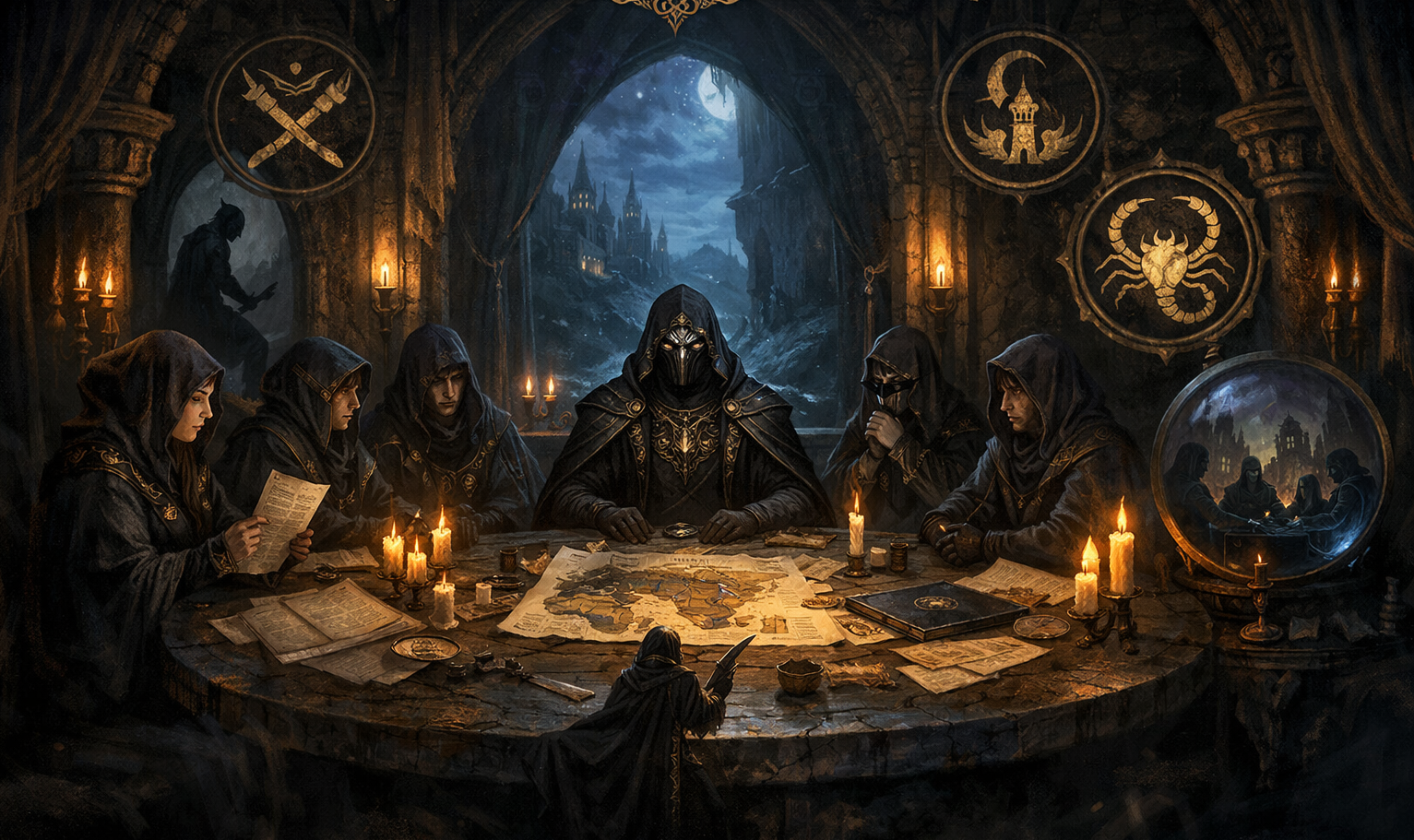
The Shadow Council is a clandestine assembly that wields unparalleled influence over the intelligence operations within the Elven Kingdom of Arethane. Operating from the shadows, the council is tasked with overseeing and coordinating all intelligence efforts, ensuring the security and stability of the realm through a range of covert activities.
Composition
The council consists of a small, elite group of individuals selected for their expertise, discretion, and unwavering loyalty to the crown. Members come from diverse backgrounds, including seasoned spies, master tacticians, skilled diplomats, and trusted advisors. Their varied expertise allows the council to address a broad spectrum of intelligence and security needs.
Leadership
Shadow Chancellor: The highest ranking member of the council, responsible for orchestrating the council's activities and liaising with key figures in the kingdom's government and military. The Shadow Chancellor directs the council's efforts and ensures the coordination of intelligence gathering operations.
Functions
The Shadow Council's primary function is to acquire and analyze vital intelligence to protect the kingdom. This includes:
- Espionage: Gathering information on potential threats.
- Surveillance: Monitoring activities of rival factions and internal dissidents.
- Counterintelligence: Preventing and neutralizing espionage activities against the kingdom.
- Covert Operations: Conducting secret missions both within and beyond the kingdom's borders.
Operations
Under the Shadow Chancellor's guidance, the council directs a network of spies, informants, and operatives. These agents work with utmost secrecy, collecting intelligence on threats, uncovering enemy plots, and monitoring rival factions. Operations are designed to be discreet, ensuring that the council's activities remain hidden from the general populace.
Secrecy and Security
Secrecy is crucial to the Shadow Council's operations. To protect their identities and activities:
- Meetings: Held in remote and heavily guarded locations.
- Communication: Channels are encrypted and closely monitored.
- Operatives: Trained to maintain discretion and avoid detection.
Impact
Though the council's existence is unknown to the public, its influence is significant. The council's efforts are critical in shaping the kingdom's security policies and safeguarding its interests. Their covert activities are essential for maintaining stability and addressing both internal and external threats.
Relations with Other Organizations
The Shadow Council maintains discreet interactions with other elven organizations such as the Order of the Black Scorpion and the Order of the Shadow Walkers. While their operations are largely independent, there are occasional collaborations or information exchanges when objectives align. The council's secrecy often limits the extent of these interactions.
Notable Achievements
- Strategic Interventions: The council has been instrumental in thwarting numerous threats to the kingdom through its intelligence network and covert operations.
- Influence: Their behind the scenes work has significantly shaped the kingdom's security policies and political landscape, ensuring the stability and safety of the Elven realm.
| |
The Guild Council of Arethane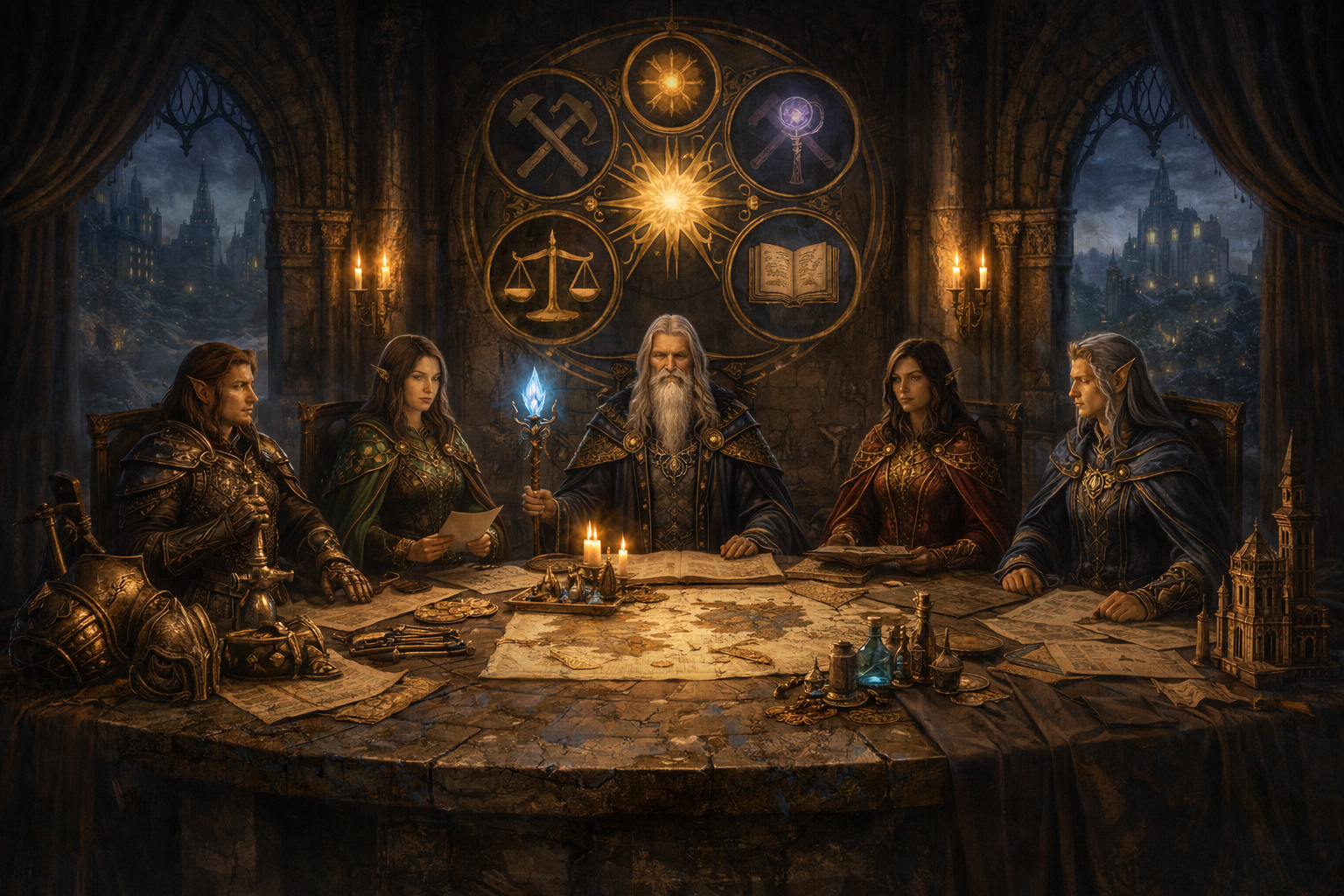
Description:
Composition
The Arethane Guild Council is an esteemed body comprised of representatives from various guilds and crafts in the Elven Kingdom of Arethane. It is a powerful, influential council that governs and regulates the guilds, ensuring that each faction within the kingdom contributes to the prosperity and protection of Arethane. The council is formed by skilled leaders from diverse backgrounds, including artisans, architects, scholars, and military strategists.
Leadership
The Arethane Guild Council is led by the Guildmaster, the highest-ranking member chosen for their exceptional leadership, wisdom, and influence. The Guildmaster is responsible for overseeing the activities of the guilds, managing relations between them, and ensuring that all operations align with the kingdom's needs. The council also includes key representatives from specialized guilds, each providing guidance and expertise in their respective domains.
Functions
The primary function of the Guild Council is to oversee and coordinate the efforts of various guilds within Arethane, ensuring that their work aligns with the broader goals of the kingdom. This includes:
- Regulating guild activities: Establishing guidelines, rules, and practices for each guild to follow.
- Resource allocation: Managing the distribution of resources and ensuring efficient use in crafting, building, and defense.
- Promoting innovation: Encouraging advancements in crafts, magical studies, and strategic defenses.
- Diplomatic functions: Coordinating between guilds and external factions or kingdoms for trade and alliances.
Operations
The Guild Council manages and supervises all guild-related activities. It ensures that guild members work in harmony, focusing on achieving the kingdom's goals through collaborative and coordinated efforts. The council supports the growth of magical arts, engineering, architecture, and trade, all crucial to Arethane's success. Additionally, special projects and large-scale operations are often directed by the council.
Secrecy and Security
- Meetings: The council meets in a grand hall concealed within the heart of Arethane's capital, shielded by powerful enchantments to ensure secrecy and privacy.
- Communications: Encrypted magical communications are used to share confidential information between guilds and officials.
- Security Measures: Elite guards are employed to protect the council's members and sensitive materials from external threats or sabotage.
Impact
The Guild Council has a profound influence on the development of Arethane. It ensures that each guild's contributions are efficiently utilized to bolster the kingdom's economy, security, and magical capabilities. The council's work has been instrumental in advancing technological and magical innovations, as well as maintaining the kingdom's prosperity and strength in times of peace and war.
Relations with Other Organizations
The Guild Council maintains strong relationships with various factions, including other elven institutions and external kingdoms. While the council primarily focuses on internal matters, it occasionally engages in diplomatic ventures and trade agreements with neighboring realms.
- Order of the Shadow Walkers: Cooperation for maintaining security within the kingdom.
- Order of the Black Scorpion: The council occasionally provides support for covert operations that align with the kingdom's interests.
- Human and Dwarven Guilds: The council engages in trade agreements and collaborative ventures with non-elven guilds to further the kingdom's influence.
| |
Healer's Hall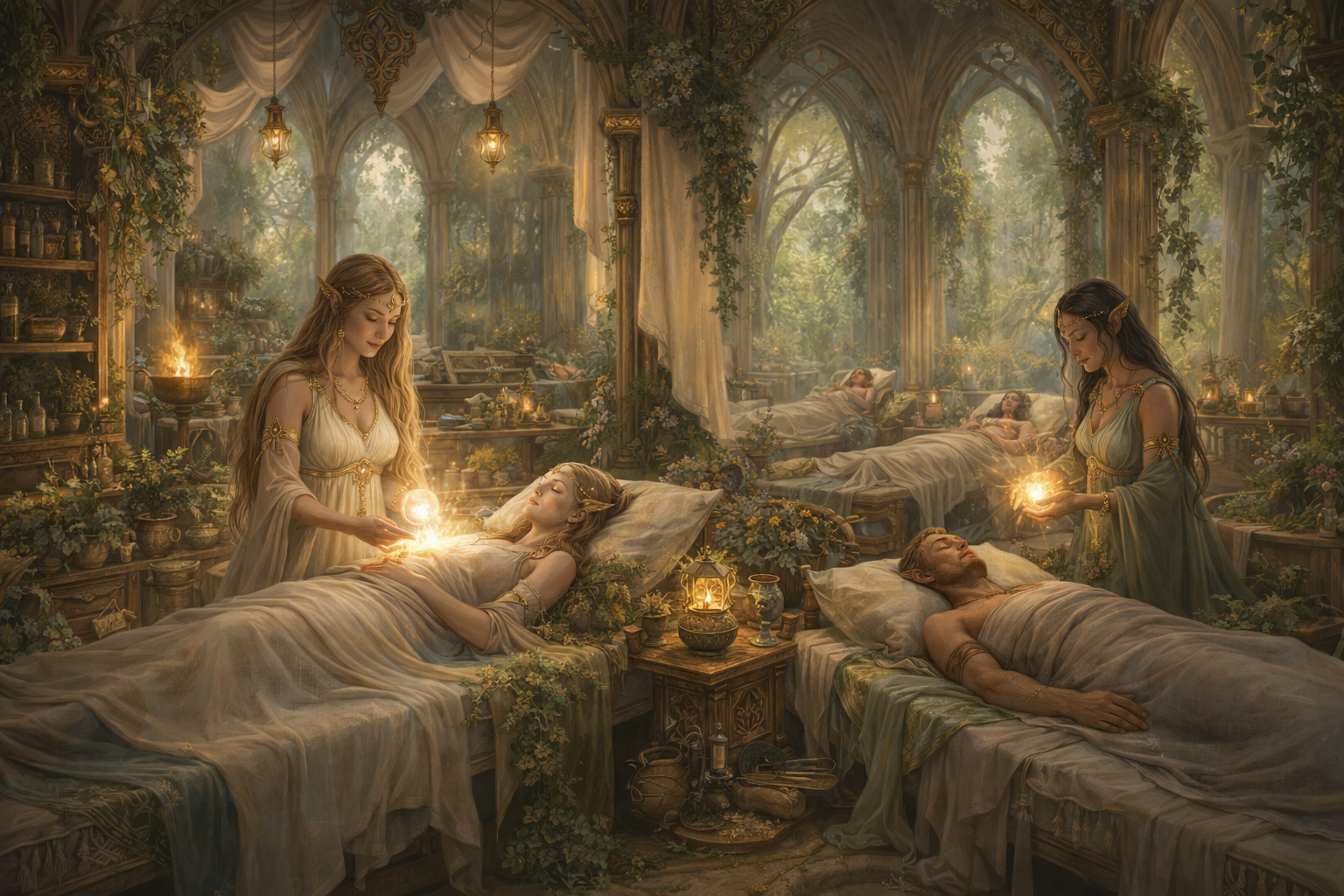
Description:
The Healer's Hall serves as a sanctuary for the skilled healers of the elven community. It is a serene, verdant place where elves with a deep connection to nature and magic gather to practice their art of healing. The Hall is built within the heart of ancient forests, where light filters through the trees, and plants and herbs are abundant. Here, both physical and magical healing is practiced, from tending to wounds to curing ailments with restorative magic and natural remedies.
Composition
The Healer's Hall consists of skilled healers, herbalists, and clerics who specialize in both magic and traditional healing methods. These practitioners come from all walks of elven society and are united by their shared commitment to the well-being of their people. The Hall also includes apprentices, students, and those seeking healing themselves. The interior is filled with medicinal plants, sacred relics, and magical artifacts that aid in the healing process.
Leadership
The Hall is led by the Archhealer, an esteemed individual chosen for their vast knowledge, experience, and wisdom. The Archhealer oversees the organization of the Hall, ensuring that healers are properly trained and that the resources are maintained. Beneath the Archhealer are a council of senior healers who manage different areas of healing and instruction.
Functions
The Healer's Hall provides several key functions to the elven community. It serves as a center for physical and magical healing, offering both emergency care and long-term treatment for various ailments. It is also a place of learning, where younger elves and those in need of training can come to study the arts of healing.
This includes:
- Emergency medical care for the injured and sick.
- Magical healing for ailments beyond mortal medicine.
- Training new healers in both magical and herbal practices.
- Providing a sanctuary for those in need of rest and recovery.
Operations
The Healer's Hall operates with a structured system where healers are assigned to various duties, including patient care, research, and training. There is a constant flow of patients, both elves and visitors from neighboring lands, requiring different levels of care. Healers are organized by specialization, with some focusing on physical ailments, others on magical healing, and others still on the study of disease and contagion.
Secrecy and Security
- The Hall maintains confidentiality, ensuring that all personal health information is kept secret.
- Although the Hall is a place of healing, there are sacred healing techniques that are only taught to those deemed worthy by the Archhealer and senior healers.
- Access to the most powerful magical healing relics is restricted and requires special authorization.
Impact
The Healer's Hall has a profound impact on the elven community, not only providing the physical and magical healing necessary to ensure the survival and prosperity of its people, but also strengthening the cultural bond between elves. It is also a symbol of the elves' deep connection with nature and their reverence for life and health. The knowledge shared and passed down through generations ensures that the practice of healing is sustained and evolves with time.
Relations with Other Organizations
- The Healer's Hall often collaborates with other elven institutions, including the Elven Circle of Magic, to ensure that healing practices remain in harmony with magic.
- It has strong ties with other elven settlements, providing aid in times of conflict, disaster, or disease.
- There are occasional interactions with non-elven groups seeking healing, though the Hall remains selective about whom it serves.
|
|
The Sajorte Hall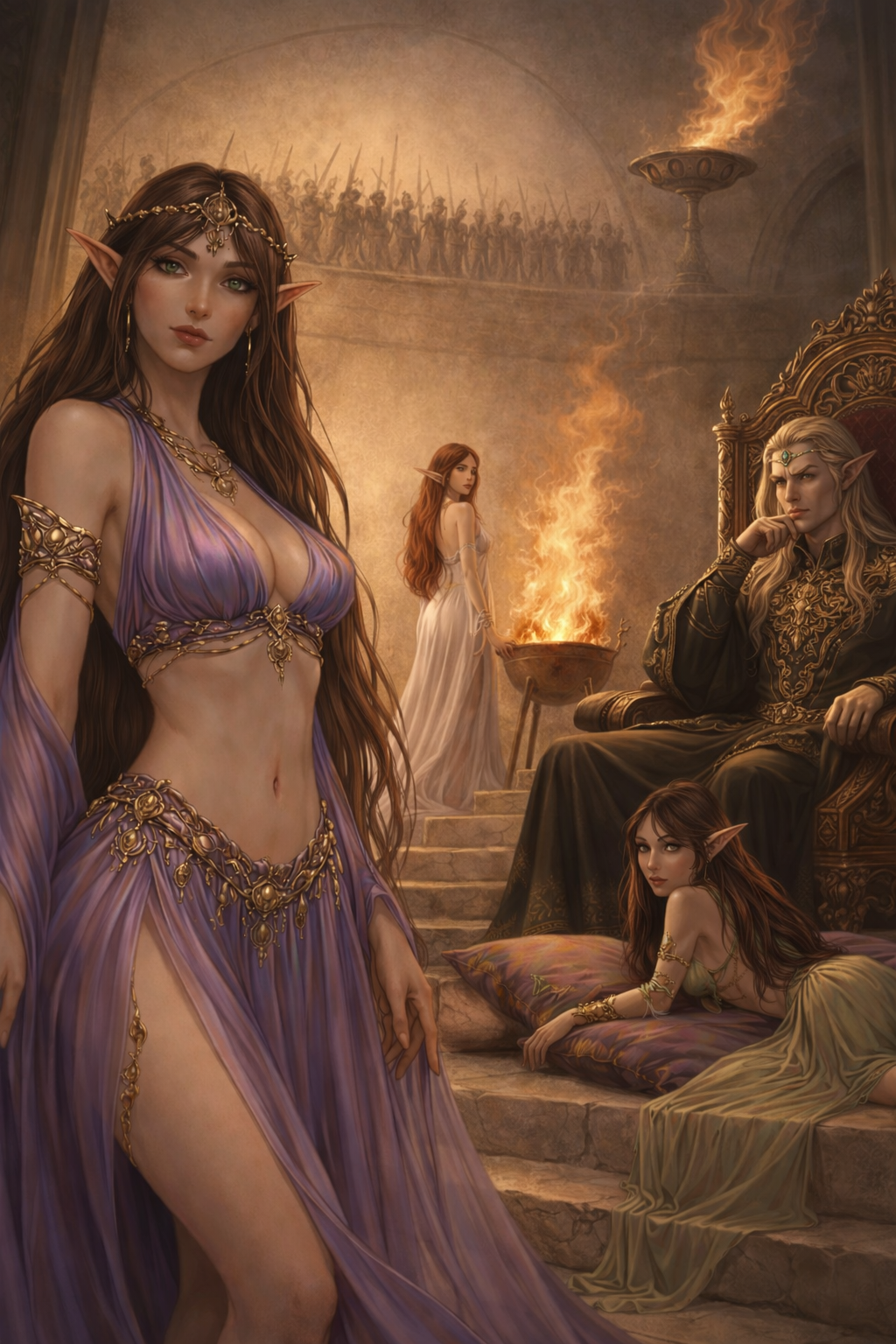
Description: The Sajorte Hall is best understood as the central institution or cultural ideal associated with sajorte, individuals who willingly devote themselves to service out of free will and spirit rather than coercion. A sajorte is distinguished from a slave ("snagga") by pride in voluntary service and loyalty of heart.
In elven culture, sajorte are respected for their self‑chosen dedication to persons, communities, or causes. Although not fully detailed in the handbook itself, "The Sajorte Hall" would function as the organizational center: both symbolic and practical, for these vows of service.
Composition
- The core of the Hall is composed of sajorte themselves, elves who have pledged service.
- Membership cuts across castes and may include multiple roles (warrior‑servants, caretakers, ritual officiants, etc.).
- Sajorte are not bound by force, and therefore their ranks are voluntary and maintained by cultural honor rather than coercion.
Leadership
Leadership of the Hall is likely a council of senior or most respected sajorte who embody the values of service, devotion, and cultural tradition. These leaders serve as:
- Custodians of Sajorte lore and protocols
- Judges or mediators in disputes involving sajorte
- Representatives of sajorte interests in broader elven politics
There is no indication it is led by a single monarch, but rather by collective or elected figures within the caste.
Functions
Operations
- Training and Initiation: Preparing new sajorte in elven protocols, rituals, and crafts of service.
- Assignment: Matching sajorte with duties ranging from personal service to community functions such as caretaking, healing, or ritual support.
- Custodianship of Protocol: Maintaining the behavioral standards, vows, and rituals associated with the role of a sajorte.
Secrecy and Security
There is no indication that the Hall is a secretive or clandestine body. Elven culture values honor and openness. However, sajorte undertaking sensitive roles (like serving noble houses or covert duties) may operate discreetly when required.
Security is cultural: upheld through reputation, oath‑keeping, and deep communal respect, not through force or isolation.
Impact
The Sajorte Hall has broad social significance:
- Promotes voluntary service as honorable, distinguishing it from slavery.
- Supports community bonds through sajorte participation in village, household, or courtly life.
- Reinforces cultural values of free‑will service, respect, and ceremonial conduct in elven society.
While not militaristic, it influences societal cohesion and tradition.
Relations with Other Organizations
Though The Sajorte Hall itself isn't described as a political power center, sajorte members interact with many key groups:
- Noble Houses: Some sajorte come from noble families or serve in those houses.
- Elven Orders: At least one covert order protecting elven interests includes sajorte as part of its membership cadre.
- Civic and Ritual Bodies: Sajorte participate in elven traditions, rites, and cultural ceremonies, making them cultural touchstones within the broader society.
Because sajorte represent service, they often act as intermediaries, bridging households, community needs, and ritual obligations.
Ranks and Castes of the Sajorte
The Sajorte Hall is an institution of service where members are organized by rank and role based on experience, honor, and duty to their chosen patron or cause. While every sajorte voluntarily joins, there are distinctions of rank that are earned and reflect the nature of their service. The Hall upholds a strict caste system, each caste representing a specific type of service, cultural role, and responsibility.
1. The Initiates
Rank: Aspirant
Description: The lowest rank within the Sajorte, Initiates are newcomers who have pledged to serve, either to prove their dedication or for personal reasons. Their service is typically light or transitional in nature, such as assisting with community tasks, learning the customs of sajorte life, or preparing for a particular discipline.
Responsibilities: The Initiates undertake menial yet vital duties to prove their dedication and learn the principles of service. They are typically assigned to low-ranking household duties or community support roles. They are under the mentorship of more senior members.
2. The Servants
Rank: Devoted
Description: Servants have proven their dedication to the vows of service and have completed their initial training. They are considered the backbone of the Sajorte Hall, handling most of the active service roles across elven society.
Responsibilities: These members are assigned specific tasks, such as caretakers for noble families, ritual attendants, healers, or warriors serving their patrons in battle or diplomacy. Their tasks are varied, ranging from domestic work to complex political service in the courts.
3. The Guardians
Rank: Protector
Description: Guardians are sajorte who have committed to protecting the interests of their patron or the community at large. This rank is reserved for those who have demonstrated exceptional loyalty, physical ability, and dedication to protecting others, whether it's the household, the Hall, or elven lands.
Responsibilities: They may serve as bodyguards, defenders in times of conflict, or even operatives in covert missions to safeguard the Hall's interests. They are responsible for the security and safety of the Hall, ensuring that no harm comes to their fellow sajorte or their patrons.
4. The Custodians
Rank: Overseer
Description: Custodians are those who have risen to positions of leadership within the Hall, overseeing the daily operations and maintaining the honor of sajorte traditions. They are responsible for managing the recruitment of new sajorte, educating them in the rituals, customs, and disciplines of service.
Responsibilities: Custodians conduct the rituals of initiation, oversee the allocation of service, and arbitrate in disputes within the Hall. They hold spiritual and ceremonial authority over the sajorte, ensuring that the vows are kept and the culture maintained.
5. The Elders
Rank: High Guardian
Description: Elders are respected veterans of service, often those who have dedicated their entire lives to the ideals of the sajorte. They are revered figures who have either served for an extended period or have made significant contributions to the Hall's preservation and growth.
Responsibilities: Their role is more advisory and ceremonial. Elders maintain the sacred archives, provide guidance to lower ranks, and serve as the voice of experience in decision-making. They are the stewards of tradition and the guardians of ancient rituals.
Rituals of the Sajorte Hall
Service within the Sajorte Hall is defined not only by duties but by sacred rituals that bond the members to their vows and patrons. These rituals ensure that each sajorte remains aligned with their cultural values and personal commitment to their chosen role.
1. The Rite of Binding
Purpose: This is the central ritual for any elf who enters the Sajorte Hall. It represents the commitment of an individual to a life of voluntary service. During this rite, the sajorte swears an oath before a sacred fire and the Council of Elders. Their hands are bound by ceremonial ropes, symbolizing their commitment to both their duty and their freedom to choose.
Process: The initiate declares their oath, and a ceremonial blessing is performed, often by an Elder or Custodian. A bond of mutual respect and loyalty is established between the sajorte and their patron or the Hall itself.
2. The Trial of the Spirit
Purpose: This trial is an important milestone for those wishing to ascend to the rank of Protector or Overseer. It tests the physical, mental, and spiritual resolve of the sajorte. It is meant to prepare them for the challenges they will face in service.
Process: The trial is performed in the wilds, or within the sacred forests of the elves. The trial often involves surviving harsh conditions, protecting an artifact, or completing a task that requires both wisdom and strength. Success brings the sajorte the right to swear an oath as a Protector or Overseer.
3. The Rite of Renewal
Purpose: This ritual is performed every five years and marks the renewal of vows. It is a solemn event where all sajorte gather to reaffirm their dedication to the Hall and their patrons.
Process: The renewal takes place around the same sacred fire used in the Rite of Binding. Each sajorte must reflect on their service and offer an item of personal significance to the flames. This offering symbolizes their ongoing commitment.
Cultural Influence and Legacy
The Sajorte Hall is integral to maintaining the social order within elven society. Its existence reinforces the notion that service, loyalty, and honor are higher values than mere power. The Hall influences not only the structure of elven politics but also shapes personal relationships, with sajorte regularly acting as advisors, caretakers, warriors, or guides to both commoners and nobles alike.
The legacy of the Hall will continue to impact future generations of elves, ensuring that sajorte remain both a cultural pillar and an enduring symbol of self-chosen duty and loyalty. While sajorte are not military warriors by design, their influence in securing alliances, preserving knowledge, and holding their society together is immeasurable.
| |
The Knight Order of the Black Rose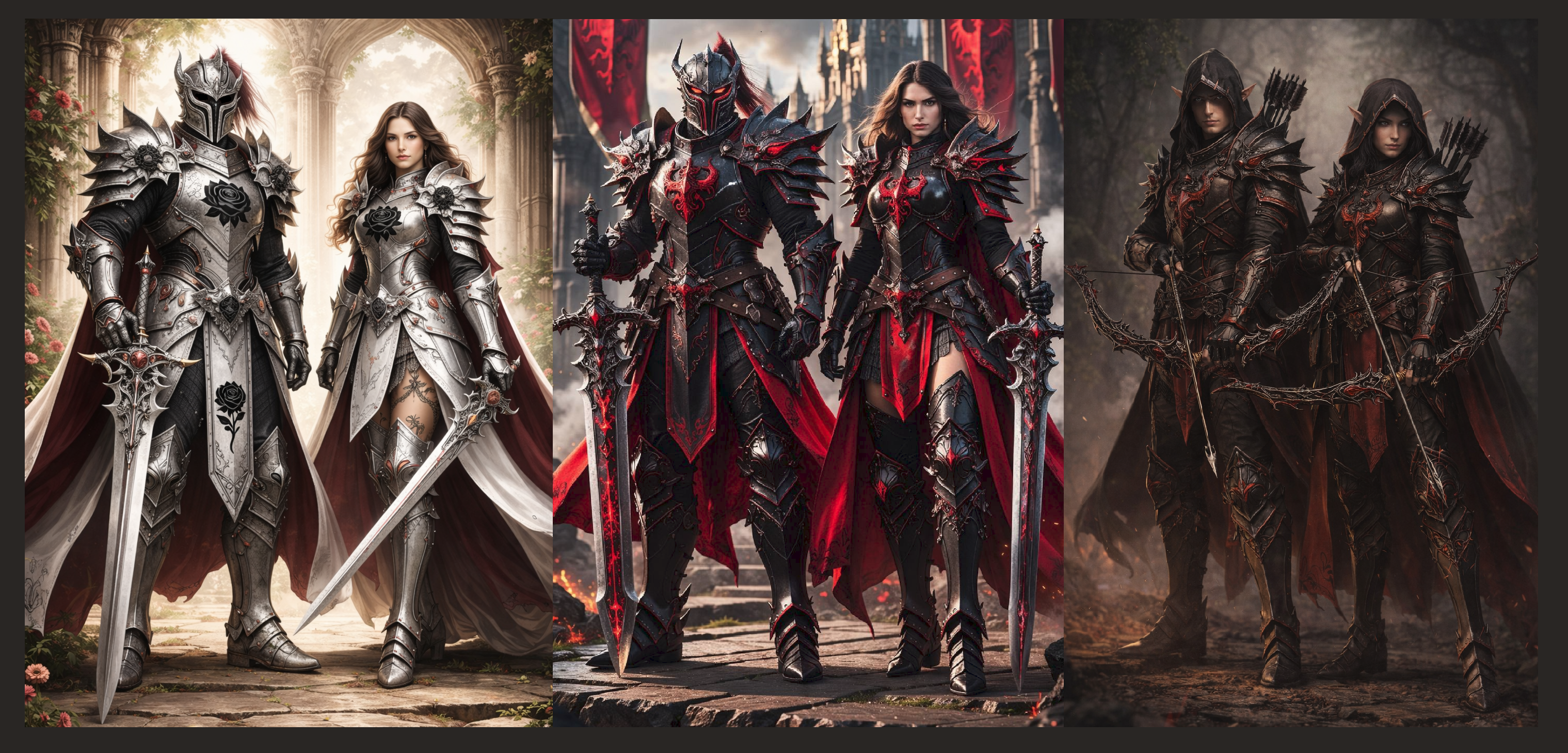
| Sub-Order of the Rose | Sub-Order of the Dragon | Sub-Order of the Thorn |
The Knight Order of the Black Rose, known as "Vell Kanoste Quarth a Vell Mor`Kellos" in the Elven tongue, is a chivalric order devoted to the highest ideals of valor, justice, and nobility. The order is both feared and respected throughout the land, known for its unyielding commitment to defending the weak, upholding honor, and seeking out wisdom from those who have come before. The Black Rose symbolizes the duality of beauty and danger, representing the order's resolve to protect and serve while being ever vigilant against the forces of darkness.
Structure and Leadership
The Council of the Knights of Mor`Kellos: At the helm of the order is the Council, a body of wise and battle hardened knights who guide the order's direction. The Council is responsible for making decisions on matters of policy, strategy, and justice within the order. Each member of the Council is chosen for their exemplary service, wisdom, and dedication to the order's principles.:
- The Sub-Order of the Rose: This suborder focuses on diplomacy, compassion, and the softer aspects of knighthood. Knights of the Rose are skilled in negotiation, healing, and are often called upon to mediate disputes and administer aid to those in need. They embody the nurturing and protective qualities of the order, ensuring that justice is tempered with mercy.
- The Sub-Order of the Thorn: The Thorn represents the order's martial prowess. Members of this suborder are the elite warriors of the Black Rose, trained in the art of war and the protection of the innocent. They are the order's first line of defense against evil and tyranny, often sent into the most dangerous situations where their combat skills and unwavering courage are needed.
- The Sub-Order of the Dragon: The Dragon is a symbol of wisdom, power, and the pursuit of knowledge. Knights of this suborder are scholars, strategists, and seekers of ancient truths. They are tasked with preserving the lore of the order and advising the Council on matters that require deep understanding of history, magic, and the divine. They are also responsible for teaching the younger knights the ways of the order.
Beliefs and Oaths
The Knight Order of the Black Rose is bound by a strict code of honor and chivalry, which guides every aspect of a knight's life. A knight is sworn to uphold the following principles:
- Valor: A knight must be courageous both in intent and deed. He avenges wrongs, defends the weak and innocent, and fights with honor. Cowardice and treachery are abhorrent to the knightly code.
- Honor: A knight's heart knows only virtue. He always keeps his word and maintains his principles. Betrayal, deception, and dishonesty have no place in the life of a knight.
- Justice: A knight's blade defends the helpless, and his might upholds the weak. He fights not for glory, but to undo the wicked and restore balance. He lives his life in a way that is worthy of respect and honor.
- Fair Play: A knight is sworn to fair conduct in battle. He will never attack an unarmed foe or strike from behind. Torture and cruelty are forbidden, as they are antithetical to the order's principles.
- Nobility: A knight must exhibit self discipline and respect for authority. He obeys the law, administers justice, and shows mercy where it is warranted. A knight respects women and all life, recognizing the sanctity of both.
- Courtesy: A knight must display impeccable manners and be polite and attentive. He shows respect to his hosts, authority figures, and women, and acts as a paragon of chivalry.
- Loyalty: A knight is loyal to his gods, sovereign, country, and the codes of chivalry. This loyalty is unwavering, and a knight will never forsake his duties or his oaths.
Rituals and Practices
- Ceremonial Oath: Upon initiation, each knight of the order swears an oath to uphold the values of valor, honor, justice, fair play, nobility, courtesy, and loyalty. This oath is taken before the Council and is considered sacred.
- Knightly Vigil: Before being fully accepted into the order, aspiring knights must undergo a nightlong vigil, where they meditate on the tenets of the order and prepare themselves for the responsibilities that come with knighthood.
- The Rose and Thorn Ceremony: This ceremony honors knights who have demonstrated exceptional bravery and compassion. During the ceremony, a black rose is placed in their armor, symbolizing the beauty of their deeds and the thorns they have faced in battle.
Role in Society
The Knight Order of the Black Rose serves as protectors of the realm, defenders of the weak, and upholders of justice. They are often called upon to resolve conflicts, lead armies, and advise rulers on matters of honor and governance. Their presence in society is both a comfort and a reminder of the ideals that all should strive to live by. The order's reputation for fairness, courage, and wisdom makes them revered figures, and their influence is felt in both the courts of kings and the homes of common folk.
Symbols and Garb
Symbol: The Black Rose, with its thorns, symbolizes the dual nature of the order, beauty and danger, protection and combat. It is worn proudly by all members of the order, often as an emblem on their armor or as a pendant.
Garb: The knights of the order are known for their distinctive black and silver armor, adorned with intricate rose and thorn motifs. When not in battle, they wear robes of deep black, with the emblem of the Black Rose embroidered in silver on their chests. This attire serves as a constant reminder of their duty and the values they are sworn to uphold.
Relations with Other Orders
The Knight Order of the Black Rose maintains alliances with other chivalric and religious orders that share similar goals of justice and protection of the innocent. They work closely with other knightly orders and religious institutions to ensure that their combined efforts are effective in combating evil and maintaining peace. While they collaborate with many, the order is also known for its independence and high standards, sometimes leading to tensions with orders or groups that do not adhere to the same strict codes of conduct. However, their dedication to their cause often bridges any divides, as their ultimate goal is the protection of all that is good and just.
Notable Achievements
The Knight Order of the Black Rose has a long history of heroic deeds and victories. They have played pivotal roles in battles against tyrants and dark forces, often turning the tide of conflict through their strategic brilliance and unwavering courage. The order has also been instrumental in the establishment of just laws and the preservation of peace in troubled regions. Their greatest legacy, however, is the moral and ethical example they set for others. Through their actions, they inspire not only their fellow knights but all who encounter them to live by the principles of honor, justice, and nobility.
| |
The Order of the Shadow Walkers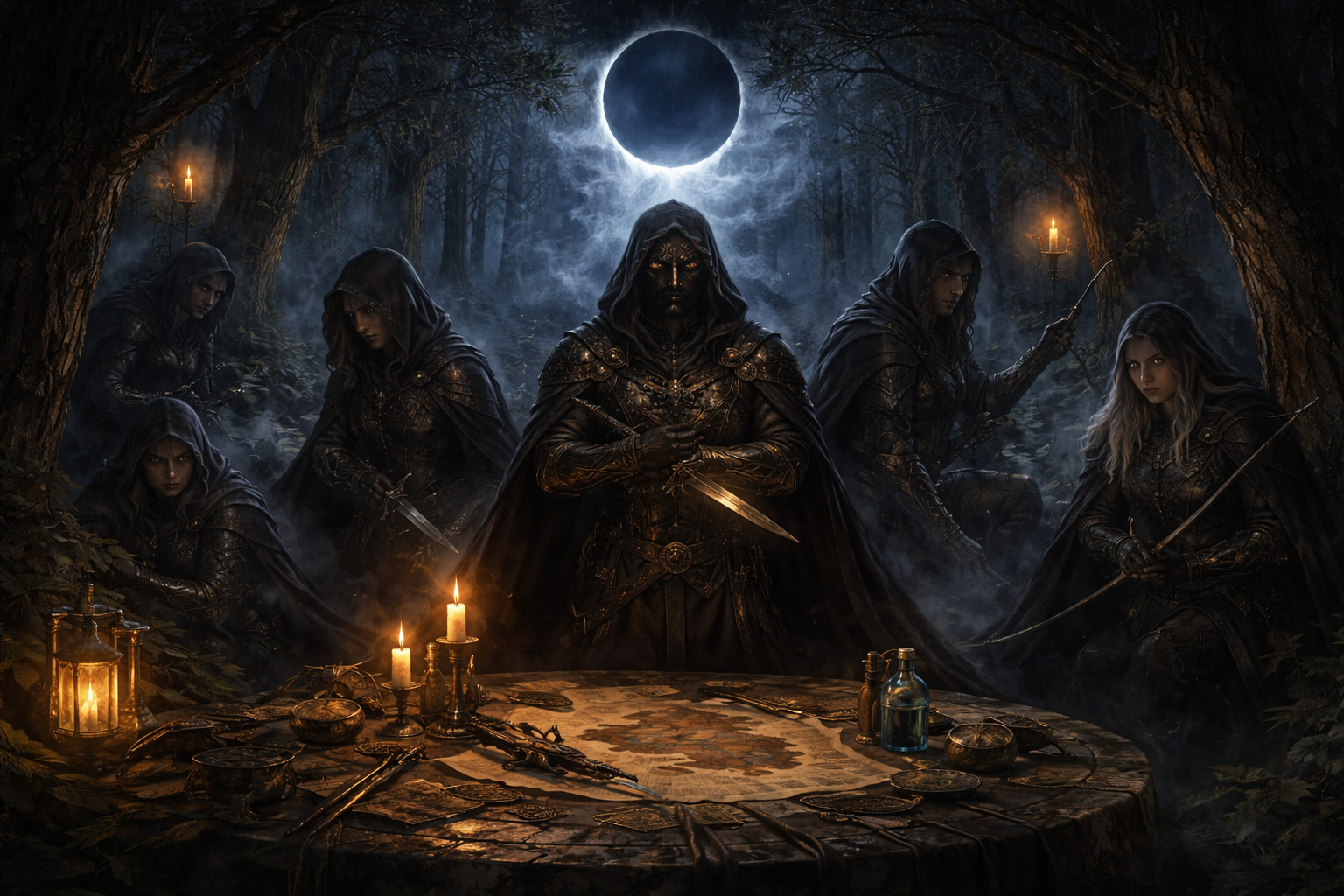
The Order of the Shadow Walkers, known as "Vell Quarth a Vell Xiad`Kyolinra" in the Elven tongue, is a secretive and elite order that operates from the shadows, protecting the elven realms from hidden threats and unseen dangers. Masters of stealth, subterfuge, and strategy, the Shadow Walkers serve as guardians of elven society, often dealing with threats that traditional forces cannot confront. They are both revered and feared for their ability to move unseen, strike with precision, and maintain the delicate balance between light and dark.
Structure and Leadership
- The High Shade: The enigmatic leader of the order, known only as the High Shade, commands the Shadow Walkers with unmatched wisdom and skill. The High Shade is chosen through a mysterious process, often involving a combination of skill, cunning, and spiritual insight. They are responsible for guiding the order's secretive operations, making decisions that affect the elven realms, and maintaining the order's sacred oaths.
- Council of Shadows: This council consists of the most skilled and trusted members of the order. Each Shadow on the council oversees a Specific aspect of the order's operations, such as intelligence gathering, covert missions, or training new recruits. The Council of Shadows serves as advisors to the High Shade and ensures the order functions smoothly and effectively.
- Shadow Blades: These are the elite operatives of the order, tasked with carrying out high-stakes missions that require stealth, precision, and discretion. Shadow Blades are trained in a wide range of skills, from assassination and espionage to sabotage and infiltration. They are the order's hands, executing the will of the High Shade and the Council of Shadows.
- Shadow Seekers: The seekers are the scouts and spies of the order, responsible for gathering intelligence and monitoring potential threats to the elven realms. They are masters of disguise and deception, often operating in hostile territories or infiltrating enemy organizations to gather critical information.
Beliefs and Oaths
The Order of the Shadow Walkers operates on a code that blends the tenets of elven honor with the pragmatic necessity of secrecy and subterfuge:
- Balance: The order believes in maintaining the balance between light and dark, life and death. They see themselves as the guardians of this balance, ensuring that no force, be it internal or external, tips the scales.
- Secrecy: A Shadow Walker understands that their work must often remain hidden, even from their fellow elves. Secrecy is a sacred oath, and betrayal of the order's secrets is the gravest of sins.
- Honor in the Shadows: Though they operate in darkness, Shadow Walkers uphold a code of honor. They do not strike without cause, and every action is taken to protect the greater good of elven society.
- Loyalty: A Shadow Walker's loyalty to the order and to the elven realms is absolute. They serve without question, trusting in the wisdom of the High Shade and the Council of Shadows.
Rituals and Practices
- Rite of Shadows: New recruits undergo the Rite of Shadows, a ceremonial induction into the order. This ritual involves a series of tests designed to prove the recruit's loyalty, skill, and ability to operate in the shadows. Only those who pass the rite are granted the title of Shadow Walker.
- Night-blade Training: The training regimen of the order is grueling and intense, focusing on the mastery of stealth, combat in darkness, and the use of unconventional tactics. Shadow Walkers are trained to be adaptable and resourceful, capable of overcoming any obstacle in their path.
- Silent Vigil: A sacred observance where Shadow Walkers meditate in complete silence, reflecting on their duties and preparing themselves for the challenges ahead. This ritual strengthens their connection to the shadows and sharpens their focus.
- The Whispered Oath: Upon completing a mission, Shadow Walkers recite a silent oath, reaffirming their dedication to the order and the elven realms. This whispered promise binds them to the shadows and to their purpose.
Role in Elven Society
Though their presence is often unseen, the Order of the Shadow Walkers plays a crucial role in safeguarding elven society. They are the unseen defenders who eliminate threats before they reach the heart of the elven realms. Their work allows other elven orders to operate without fear of hidden dangers, and their loyalty to the elven people is unwavering. While their methods may be questioned by more traditional factions, the results of their work speak for themselves. They have thwarted countless plots, neutralized dangerous enemies, and preserved the delicate balance that keeps the elven realms secure.
Symbols and Attire
- Symbol: The symbol of the Shadow Walkers is the Eclipsed Moon, representing their ability to operate in the darkness and bring light to hidden truths. This symbol is often worn discreetly, either as a small pendant or subtly embroidered into their dark attire.
- Attire: Shadow Walkers wear garments designed for stealth, typically in shades of black and deep gray. Their attire is lightweight yet durable, allowing for silent movement and quick action. Each piece of clothing is meticulously crafted to minimize noise and maximize concealment.
Relations with Other Orders
The Order of the Shadow Walkers maintains a complex relationship with other elven orders. While some view their methods with suspicion, others recognize the invaluable role they play in protecting the elven realms.
- Allies: They work closely with intelligence based orders and those who value pragmatism and results over appearances. The Shadow Walkers are often consulted by those who seek to uncover hidden threats or need assistance with covert operations.
- Tensions: More traditional or honor bound orders may find the Shadow Walkers' methods distasteful, leading to occasional friction. However, these tensions are usually set aside in times of great need, when the skills of the Shadow Walkers are indispensable.
Notable Achievements
- The Fall of the Dark Conclave: The order played a pivotal role in dismantling the Dark Conclave, a shadowy organization that threatened the stability of the elven realms. Through a series of covert operations, the Shadow Walkers eliminated key leaders and destabilized the Conclave from within.
- The Protection of the Eternal Grove: When a powerful necromancer sought to corrupt the sacred Eternal Grove, the Shadow Walkers intercepted his plans and neutralized his forces before they could desecrate the holy site.
- The Safeguarding of the Starfall Treaty: The order ensured the success of the Starfall Treaty, a critical alliance between the elven realms and neighboring kingdoms. Their covert operations protected the diplomats and exposed a plot to sabotage the negotiations.
- The Order of the Shadow Walkers remains one of the most enigmatic and respected orders in elven society, a silent but ever watchful force ensuring that the elven realms remain safe from the shadows that seek to consume them.
| |
The Order of the Black Scorpion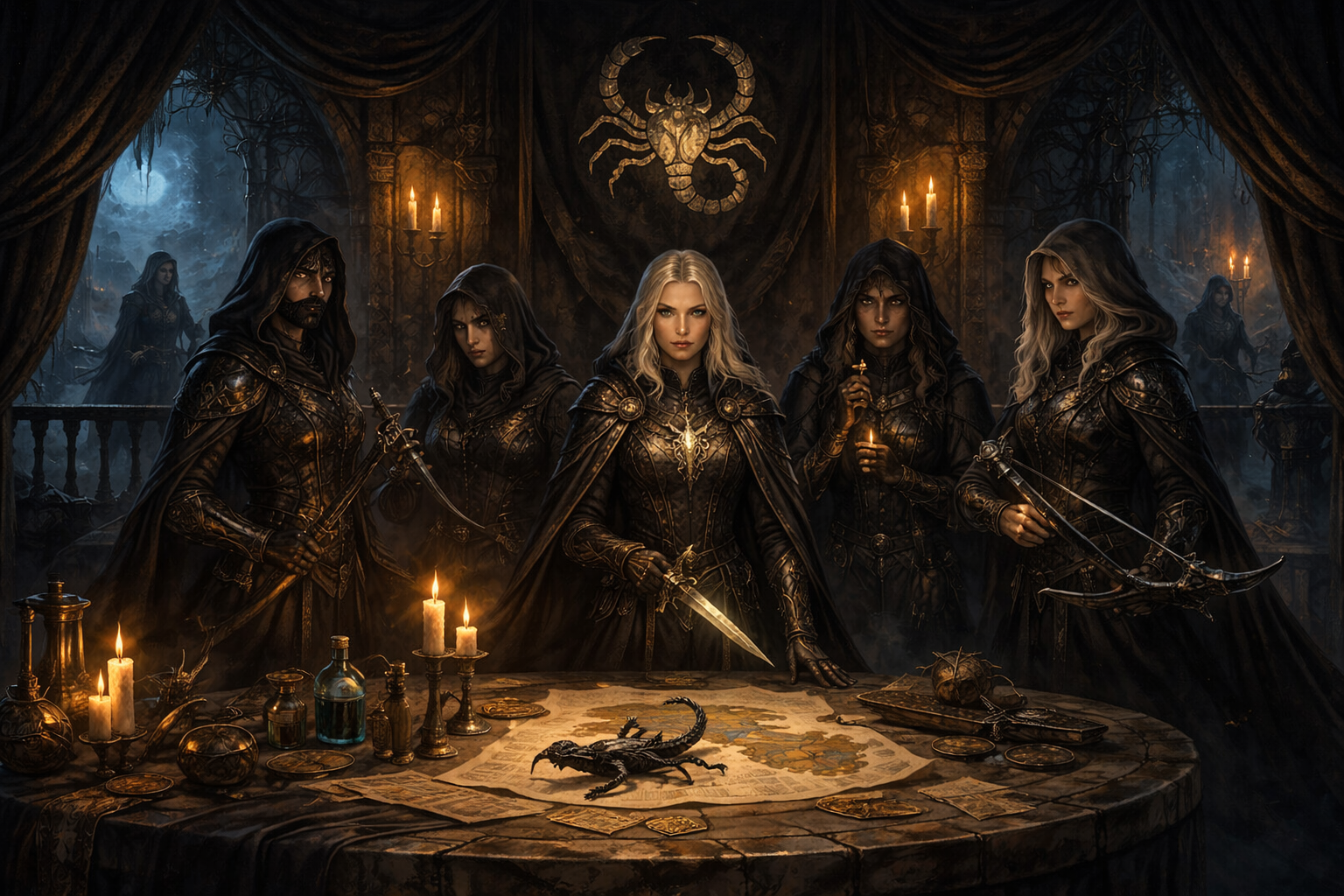
The Order of the Black Scorpion is a secretive and elite organization founded by the late Queen Gwenneth Ariquis. Comprised solely of female members from noble families or the Sajorte warrior caste, the order operates covertly to protect and advance elven interests through assassination and espionage. Its members use their noble status as a front for their true activities, executing missions with precision and discretion to safeguard the realm.
Structure and Leadership
- Founder: The order was founded by the late Queen Gwenneth Ariquis during a period of political intrigue and external threats. Her leadership established the order as a crucial element in protecting the elven realm through covert operations.
- Co-Ordinator: The Shadow Council oversees the order's operations, ensuring alignment with the crown's goals while maintaining secrecy.
Beliefs and Mission
- Core Belief: The members of the Order of the Black Scorpion believe in protecting elven society through covert means. They view their actions as necessary for safeguarding the realm from internal and external threats, upholding the interests of the elven crown while maintaining secrecy.
- Mission: The primary mission is to use their noble facade for covert operations, including intelligence gathering, assassination, and diplomacy. The order seeks to eliminate threats to the crown and advance elven agendas while operating in the shadows.
Rituals and Practices
- Training: Members undergo rigorous training in assassination, espionage, and manipulation, ensuring their skills are finely honed for covert operations.
- Secrecy: Maintaining secrecy is paramount. Members often keep their activities hidden from their families and the broader elven society, with only the highest ranking officials aware of the order's true nature.
- Ceremonies: Regular rituals involve oaths of loyalty, reaffirmation of the order's mission, and secret meetings to discuss ongoing operations and strategies.
Role in Elven Society
The Order of the Black Scorpion plays a crucial role in maintaining the stability and security of the elven realm. By operating covertly, the order addresses threats that cannot be managed through conventional means. Their work ensures the crown's interests are protected, and their presence, though shrouded in secrecy, is a key element in the elven realm's security apparatus.
Symbols and Garb
- Symbol: The Black Scorpion emblem represents the order's deadly precision and stealth. The scorpion, known for its lethal sting and adaptability, symbolizes the order's approach to their covert operations.
- Garb: Members wear dark, elegant attire suited for stealth and blending into noble circles. Their ceremonial garb often features a scorpion motif, emphasizing their allegiance to the order and their role as covert protectors of elven society.
Relations with Other Orders
The Order of the Black Scorpion maintains a discreet relationship with other elven organizations, such as the Order of the Spear of Shattered Sorrow and the Order of the Shadow Walkers. While their operations are mostly independent, there are occasional collaborations or exchanges of information when their goals align. The order's secrecy often means that their interactions with other groups are minimal and carefully controlled.
Notable Achievements
- Key Missions: The Order of the Black Scorpion has successfully undertaken numerous covert missions that have prevented political upheavals and neutralized significant threats to the elven crown. Their operations have often been decisive in maintaining the stability of the realm.
- Legacy: The order's legacy is one of silent guardianship. Though their actions are hidden from public view, their impact is significant, ensuring the security and advancement of elven interests through their covert operations. The order's influence extends beyond their immediate actions, shaping the political and security landscape of the elven realm.
| |
The Order of the Red Hand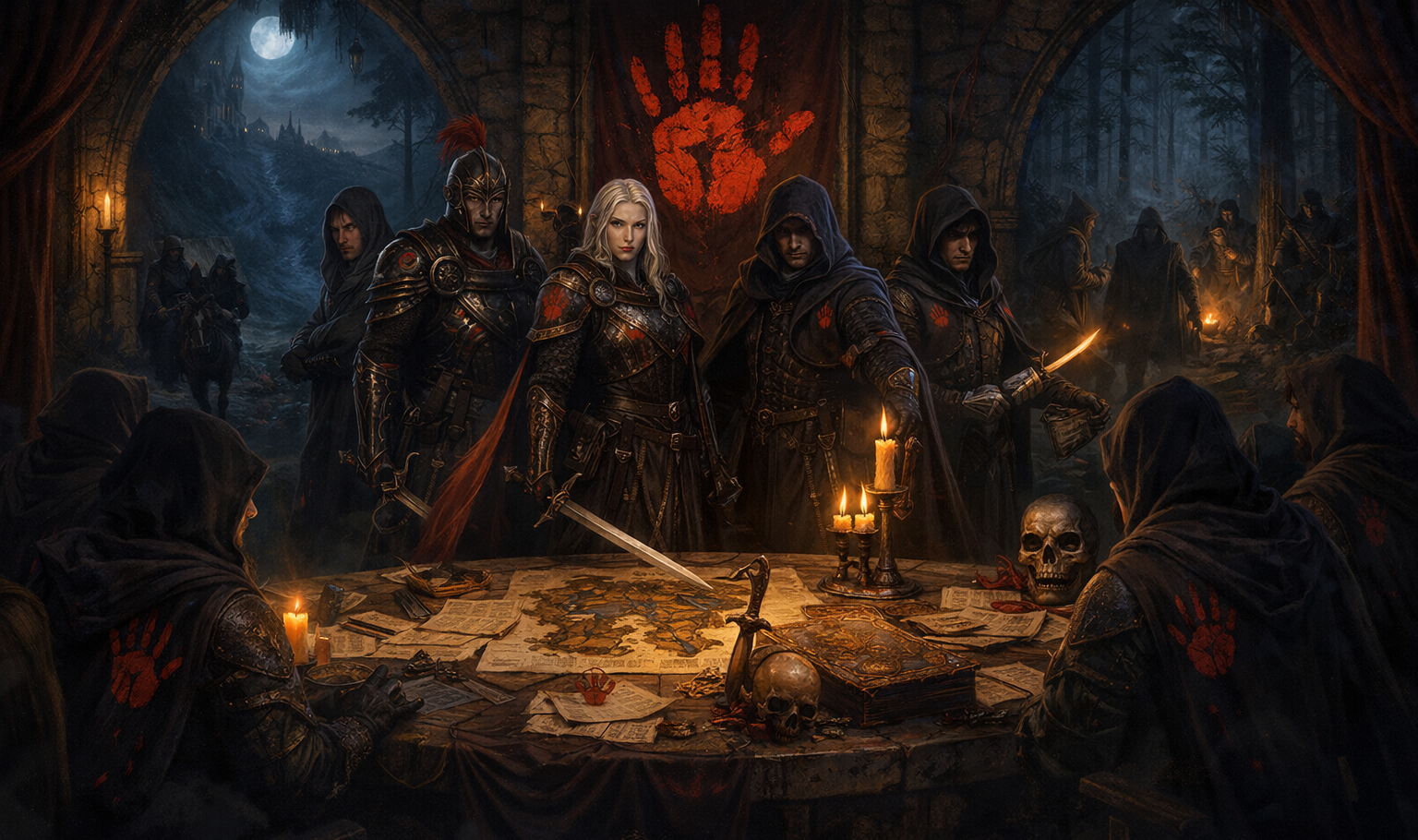
The Order of the Red Hand is a covert military and intelligence organization within the Elven Kingdom of Arethane. Originally founded as a mercenary group, it has evolved into a highly effective clandestine unit specializing in covert operations, espionage, and the protection of Arethane from hidden threats. Despite its public facade as a mercenary band, the order operates in the shadows to safeguard the kingdom's stability.
Structure and Leadership
- Captain Delphine Gwydian
- Role: Commander of the Order
- Description: The highest ranking officer, responsible for overseeing the entire organization, setting strategic goals, and coordinating with other intelligence and military units. Captain Gwydian ensures that the order's operations align with the kingdom's broader objectives.
- 1st Lieutenant Cavalry Darath Hawksong
- Role: Leader of Cavalry Units
- Description: Oversees the mounted troops, specializing in cavalry tactics and rapid deployment.
- 1st Lieutenant Shandoss Elestraelian
- Role: Special Operations and Intelligence
- Description: Manages covert operations and intelligence gathering missions, handling complex and sensitive assignments.
Beliefs and Missions
The Order of the Red Hand is driven by a commitment to protecting Arethane from internal and external threats. Their beliefs are rooted in loyalty, secrecy, and the preservation of the kingdom's stability. The order's missions include:
- Espionage: Gathering critical intelligence on potential threats.
- Covert Operations: Executing secretive missions to address hidden dangers.
- Protection: Safeguarding the kingdom from destabilizing forces.
Rituals and Practices
- Code of Silence: Members adhere to a strict code of silence, forbidding them from speaking ill of fellow members and ensuring loyalty.
- Initiation Rituals: New recruits undergo initiation ceremonies that emphasize secrecy, loyalty, and the order's values.
- Shadow Meetings: High level strategic meetings are conducted in concealed locations to maintain secrecy.
Role in Elven Society
The Order of the Red Hand functions as an unseen guardian of Arethane. While their activities are hidden from the public eye, they play a crucial role in maintaining the kingdom's security and stability. Their covert nature allows them to address threats that conventional forces cannot.
Symbols and Garb
- Symbol: The order's emblem is a red handprint, symbolizing both their covert nature and their commitment to protecting the kingdom.
- Garb: Members typically wear dark, practical clothing suited for stealth and combat. Their attire often includes red accents or insignia reflecting their affiliation with the Order of the Red Hand.
Relations with Other Orders
- Order of the Shadow Walkers: The Order of the Red Hand collaborates with the Shadow Walkers on certain covert operations, especially those involving espionage and intelligence gathering.
- Order of the Black Scorpion: They maintain a cautious alliance with the Black Scorpion, exchanging information and coordinating on missions that impact the security of Arethane.
Notable Achievements
- Neutralization of Threats: The order has successfully neutralized several significant threats to Arethane, including uncovering and thwarting espionage attempts and covert invasions.
- Intelligence Successes: They have gathered crucial intelligence that has prevented potential crises and ensured the stability of the kingdom.
- The Order of the Red Hand remains a critical component of Arethane's defense apparatus, operating discreetly to protect and preserve the kingdom's safety and security.
| |
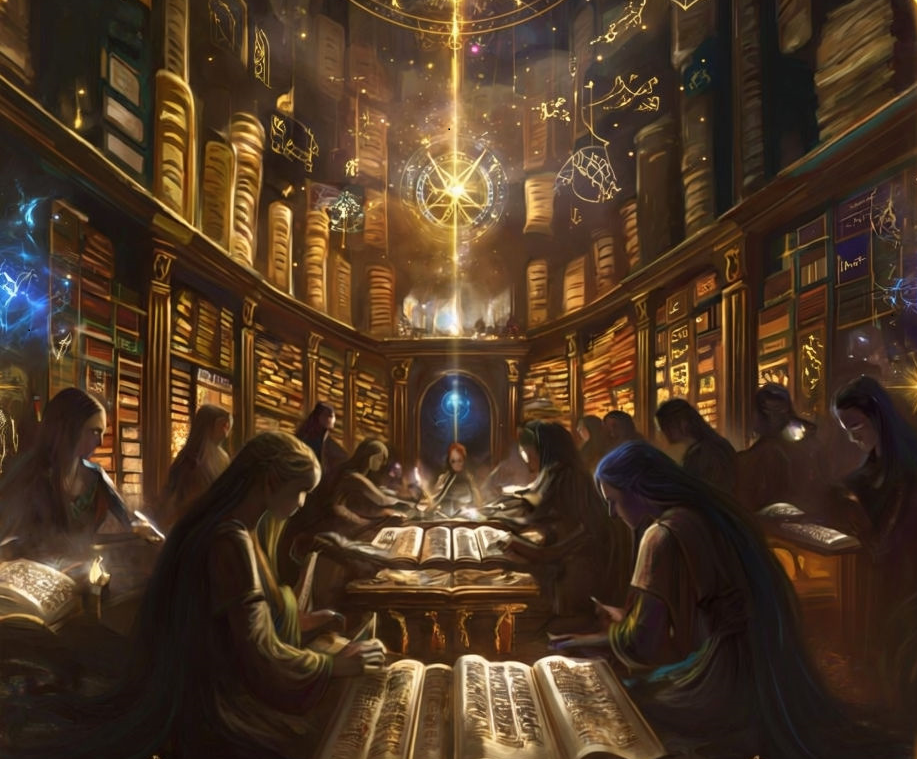
Arethane Wizards Council and Magic Guilds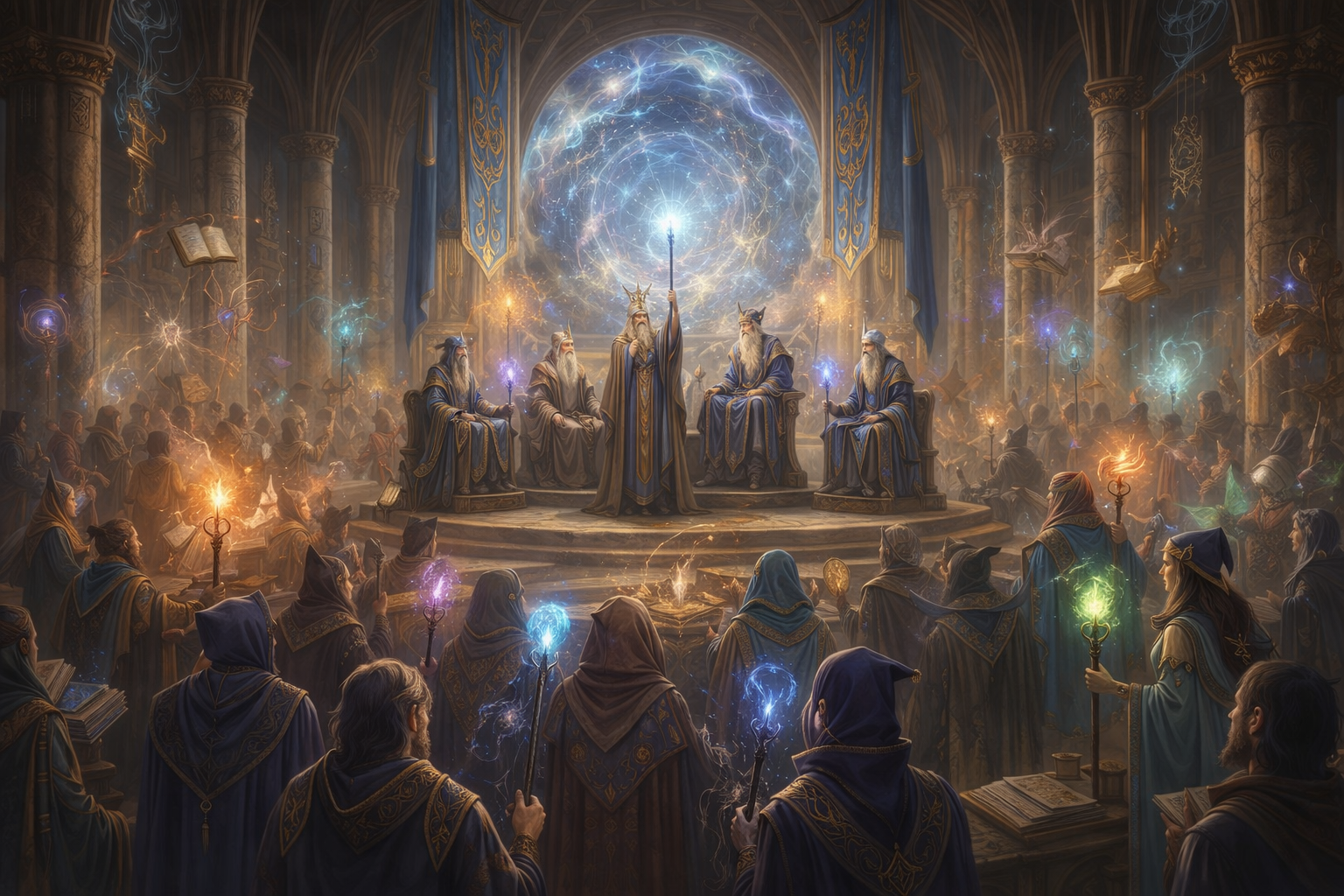
The overarching governing body for magic guilds in Arethane. The most influential guilds operating under the Council's umbrella, including:
- The Circle of Eternal Mysteries
- The Scriptorium of Luminous Secrets
- The Arcane Society of the Sovereign Stars
- The Order of the Celestial Conclave
The Arethane Wizards Council is a prestigious governing body that oversees numerous magic guilds within the Elven Kingdom of Arethane. It is responsible for coordinating the activities, research, and influence of these guilds, ensuring that their pursuits align with the broader goals of the Council. Major Magic Guilds are powerful and influential organizations dedicated to the study and advancement of magic. They each have their own unique focus and approach to magic, but all work to increase their power and influence.
Structure and Leadership
Arethane Wizards Council:
- High Councilors: The top leadership, comprising the most powerful and influential mages from various guilds. They set overarching policies and strategic goals.
- Council Members: Senior mages representing different guilds who implement decisions and oversee Specific areas of magical research and influence.
- Support Staff: Administrative and logistical personnel assisting in the daily operations of the Council.
Major Magic Guilds:
- Guild Master: The highest ranking mage within a guild, responsible for overall direction and strategy.
- Councilors: Senior members who advise the Guild Master and manage key operations.
- Enchanters and Scholars: Core members engaged in research, spellcasting, and guild activities.
Beliefs and Missions
Arethane Wizards Council:
- Beliefs: The Council believes in the pursuit of ultimate magical knowledge and the enhancement of Elven society through the mastery of arcane arts. They see themselves as the custodians of magical wisdom and guardians of the realm's mystical balance.
- Missions: To foster magical research, influence political and social structures, and maintain the status and power of the guilds. They aim to ensure the progress of magic and its integration into every aspect of Elven life.
Major Magic Guilds:
- Beliefs: Each guild has Specific philosophies, but they all value the advancement of magical knowledge, personal power, and the influence that comes with magical mastery.
- Missions: To conduct research, uncover lost magical knowledge, and wield influence within the Elven Kingdom. Guilds often have specialized goals, such as mastering particular types of magic or gaining political power.
Rituals and Practices
Arethane Wizards Council:
- Rituals: Regular convocations of the Council for decision making and planning. Ceremonial gatherings to honor achievements and mark significant magical events.
- Practices: Coordinating research efforts, managing guild relations, and overseeing major magical projects.
Major Magic Guilds:
- Rituals: Initiations and promotions within the guild, ceremonial casting of spells, and rituals to enhance magical abilities or solidify alliances.
- Practices: Daily magical training, research experiments, and participation in public and private magical events.
Role in Elven Society
Arethane Wizards Council:
- Role: The Council is a central authority in the magical community, influencing the direction of magical research and the integration of magic into society. It also plays a key role in political and social matters through its member guilds.
Major Magic Guilds:
- Role: Guilds are influential entities within Arethane, shaping the magical landscape and contributing to societal development through their research and public projects. They also serve as advisors to nobles and participate in political and social events.
Symbols and Garb
Arethane Wizards Council:
- Symbols: The Council's emblem often features a stylized representation of an arcane sigil or rune, symbolizing unity and mystical authority.
- Garb: Members of the Council wear elaborate robes adorned with magical symbols and sigils, reflecting their status and connection to the arcane.
Major Magic Guilds:
- Symbols: Each guild has its own unique symbol, such as a Specific rune or magical glyph, displayed on banners, clothing, and artifacts.
- Garb: Members typically wear distinctive robes or attire that reflect their guild's colors and symbols. Garb may include magical accessories, such as amulets or rings.
Relations with Other Orders
Arethane Wizards Council:
- Relations: The Council maintains diplomatic and often competitive relationships with magical orders from other regions. They engage in knowledge exchange and occasionally collaborate on major magical endeavors, but they are also vigilant of potential rivals.
Major Magic Guilds:
- Relations: Guilds may have both cooperative and rivalrous relationships with other guilds and magical organizations. They often compete for resources and prestige but also collaborate on projects and share information when beneficial.
Notable Achievements
Arethane Wizards Council:
- Achievements: Successfully orchestrated the unification of magical knowledge under a centralized body, facilitated major advancements in arcane research, and played a key role in resolving magical crises affecting Arethane.
Major Magic Guilds:
- Achievements:
- The Circle of Eternal Mysteries: Discovered and harnessed the lost art of Elder Magic.
- The Scriptorium of Luminous Secrets: Authored a comprehensive tome on interplanar travel.
- The Arcane Society of the Sovereign Stars: Developed a powerful warding system to protect the Kingdom.
- The Order of the Celestial Conclave: Forged alliances with other magical organizations to stabilize magical ley lines.
- The Arethane Wizards Council and its guilds are central to the magical and political life of the Elven Kingdom, shaping its future through their research, influence, and strategic interactions with other powerful entities.
While the majority of the world sees magic and its practitioners as mysterious, dangerous, and not to be trusted, the Elves have had a long love affair with mysticism. The study and use of magic in Arethane is commonplace, with mages being an accepted part of Elven life. As with many other large group of like persons, the mages have numerous guilds to further their goals. Mage guilds of Arethane are the most powerful and influential in the entire world.
Goals:
The goals of individual guilds can vary greatly from guild to guild. Each one will have numerous plots, schemes, or other machinations running concurrently. However, all of them will undoubtedly be designed to increase the power of the guild. The reason most men of magic study the arcane arts is for power. The men who rise through the ranks of the council will be more concerned with power, which is why they had the diligence and desire to attain that position in the guild. These men (and women) will drive the guild to seek out power in its many forms.
1. Arcane knowledge: The most important charter for magic guilds is the study and advancement of mystic knowledge. Studies and experiments are constantly being conducted to discover new or forgotten arcane secrets. Most of these are conducted out of the public's sight, within the safe confines of the heavily protected guildhalls. Research is conducted on all forms of magic: spell, scroll, wards, circles, items, etc. Whenever a test subject is required, the poor are usually enlisted for a small fee. Any mage who discovers something that is genuinely new will be regarded highly among the guild and will be quickly promoted.
Guilds also finance expeditions to garner information or to check out any persistent or promising rumors. This leads to many members of the guild hiring adventurers, almost always men-at-arms, to accompany them into the Old Kingdoms, and other unexplored sections of the world. Most of these trips are financed privately by the wealthier of members who are trying to gain more clout within the guild by making a new discovery. Guilds will also organize groups of their own members and staff to sally forth and explore the unknown in hopes of unearthing some forgotten relic or information.
Guilds are also known to pay top coin to anyone with something of an unexplained magical nature or possibility. This irks the government to an extent but since the government and the guilds are mostly on good terms it is not a major issue. On occasion, they will trade knowledge with other guilds or with powerful organizations. They will always try to come out the better in the deal and are usually excellent negotiators. Often, two guilds will trade knowledge and both feel as if they cheated the other.
2.Status: One of the benefits of being a wizard, especially in the magic friendly Arèthane is the status that comes along with being a mage. The guilds endeavor to make themselves as upscale as possible in order to project the proper image. They will often make their headquarters as ostentatious as possible to show their wealth and influence. They will attach themselves to the powerful nobles and can often be active in the political arena. This is a strong recruiting incentive for the guild. If a young sorcerer wants to be part of the in crowd, moving up in the guild hierarchy can be an excellent vehicle to run with the "in crowd". Wizards of high standing in their guild can be very well known in their region. People know their faces, have heard of their exploits, knowledge, courtesy, etc. before ever meeting the person. Most mages love this form of adulation and it is great face for a guild.
To this end, the guild will attempt to place trusted members in influential positions. This often lands a council member of the guild as advisor to the particular noble house, or ruling body. In some areas, the noble house is always supplied with an advisor by the guild. This gives the guild a foothold in the court and allows their members to attend parties, social gatherings, and other events thrown by the well to do. Nobles love to hobnob with mages and the feeling is usually mutual. Guild members have been known to marry into noble families and any noble who shows an interest in the arcane will be aggressively recruited by the guilds.
Guilds will also offer to help in any project that stands to garner them acclaim. They will donate members and/or money to public works and monuments. This allows them some free advertising as every time someone sees one of their monuments, they will think of those who made it possible- the magic guild. Often, there will be a plaque or engraving giving the credit of the monument to the one who funded it and the mage guilds are quick to take advantage of this. By allowing the public to see how great and benevolent they are, they gain in status.
Members of the guild seldom abuse their status, but they certainly enjoy it. Aside from the amenities offered by the headquarters, members of powerful guilds receive a number of other benefits. If the mage guild has any deals with other guilds in town, its members can receive all sorts of discounts on a variety of things. They are also welcomed at most of the up-scale establishments in a city and delight in being recognized as a member of their guild. To this end, most guilds have some sort of clothing identifier or visible tattoo like some thieves' guilds.
3.Influence: It is only to be expected that any person who can force his will upon his environment to the extent that spell casters can would want to continue to exert his will on other things. Wizard guilds are notorious for dabbling in things that are not necessarily their business. This can include local politics, legislation, business, protection, crime, anything. Guilds can be very open about their involvement in issues, manipulate them from behind the scenes, or do both simultaneously.
Political involvement is the most common for magic guilds. If there is a ruling house, the guild will try to arrange to have an advisor assigned to the ruler. Some, more power-hungry guilds will try to turn the ruler into a puppet through which they can affect local law. Typically, they will send someone who is devious enough to make the ruler totally trusting and dependent upon the advisor. Once this is done the advisor will continue the sham of being his aide while making most of the decisions (or relaying those of the guild council) and having them enacted by the lord. This can be a problem in larger families where there are a great many voices to distract the lord from the advisor. Another method is to introduce a ruler to a strongly addictive drug and to supply him with it. This creates a besotted fool who is less and less concerned with governing and will gladly surrender power to someone else so that he or she can continue with escaping reality. In the Arèthane, the noble families commonly take this step without any influence from the guilds. There have been cases of more drastic measures taken. Mages have used spell magic like Love Charm, circles, wards, and other mystic means of altering the noble's thinking processes to their liking, but these are rare.
In more representative forms of government, the guild will take different measures. If there is a chief decision making diet for a municipality you can place a safe bet that there will be at least one member of the mage guild on it. If possible, they will try to have as many people on it as they can but there will always be one. The representative will be carefully chosen for his speaking abilities and might even resort to incantations or other magic during sessions. This is also very rare, but has happened.
What's more insidious is when the magic guild takes a quieter hand in matters. Some guilds choose to appear aloof from the political scene. This is a common stance taken in areas with less political stability. The guild will not want to be seen as taking part in petty squabbles of men. Rather, they will present the image of holding themselves above such infighting in their scholarly pursuit of the ways of magic. Some guilds actually take this stance in practice, but most use it as a front. A guild, which appears not to be involved in politics, can be totally tangled in it. Any guild worth its salt will have the wealth and power (mainly from its members) to offer aide and favors to political factions. The guild will not forget these favors it does for others nor will it allow them to forget. If there is more than one faction involved, the guild will likely help all of them to assure the winner be in their debt. Once it becomes obvious which will prevail, the guild can throw its support behind that faction wholeheartedly. A guild will also help the underdog, knowing that they will be tied to the guild for a long time.
What the magic guild does best, however, is intimidate and blackmail. Powerful guilds will have a proficient network of spies and informants to keep tabs on all-important figures of the area. These spies can keep track of trends in the city or region, track down rumors, observe others and plant misinformation of their own. Still, as competent as these men and women might be they pale in comparison to the mystic forces upon which the guild can call. There are no secrets from a guild when they start having you followed by familiars, summoned creatures, invisible members, or by scrying on you. The guild can use these means to gather all manner of dirt on important players in the political scene and use them in ensure these people work in favor of the guild. It is most disconcerting to take all possible pains to conceal your actions only to have a member of the local magic guild give you details of what you did, when you did it, where you did it, and with whom. Last, there is nothing to compare to the threat of mystic violence. The only thing more frightening than a mage are its servants - "Vote yes on the new tax, or your daughter will be rent asunder by a Shadow Beast."
4.Wealth: This is sort of a necessity for guilds. All of the above goals require money. While some members of guilds, or even entire guilds might be consumed by avarice, the normal guild member sees gold as a means to an end. To fund projects takes funds. To send expeditions requires supplies and money. Upkeeping of the guildhall requires a certain amount of currency.
The primary source of income for the guild is the members. To join the guild, you must make a donation of some sorts, to show the guild that you are a valuable member. In order to keep your membership and remain in good standing with the guild, you have to continue to make contributions to the guild. The more you contribute to the guild, the more respected you will be and the more power you will have. Contributions usually take the form of monetary donations but there are other things that are offered by members: spell knowledge (rare), magic items, information, and other non-monetary gifts are also appreciated.
The guilds make money on their own in a number of ways. Most guilds have an expansive library and while non-members are not allowed to see it, they can request to look at a book for a fee. A member will retrieve the book for the customer and there is normally an hourly rate for reading. Guilds will also sell minor magic items to adventurers or whoever needs them. These are always going to be small, non-powerful things like scrolls and potions. Guilds will seldom, if ever, sell magic to a non-member. They also sell information to others. As stated above, the information network of a mage guild is unparalleled and they know a great deal about what is going on in an area. Guilds are often silent partners in local business. If a guild sees a venture that seems likely to turn a profit, it will likely become a financial backer. This is normally done through a front man so that the business does not know it is being funded by the guild and so that others do not know of the guilds business ventures.
Last, guilds will hire their members out for various tasks. Guild mages can be seen guarding caravans, compounds, or other interests of employers paying exorbitant fees for the services of the spell casters. Local nobles often hire guild members to bolster their forces for combat. They act as mystic artillery in combat situations and can be devastating when working in unison. Important personages can request and pay for a member to act as a bodyguard. The member will most likely not have to act in defense of his charge since his presence shows that the person is under the protection of the guild.
Image:
Magic guilds take great pains to maintain their public image. Few people trust magic and its practitioners, especially summoners and diabolists. While magic is more accepted in the Arèthane, the dangers it presents have been seen more by the populous. Westerners may not be as superstitiously afraid of magic as other civilizations but they have distrust that comes from experience. The Mage guilds combat this distrust by making themselves out to be trusted and valuable members of society.
This is done primarily by taking part in all public affairs that will offer a positive spin on the Mage guild's activities. Any action taken against an enemy, pest, or other public hindrance will be supported openly by the guild. Many people will feel better about their city just because they know that the guild is "on their side". This is not entirely false. The guild knows that it must have a stable base of operations to flourish and they will work with all officials to keep their realm of influence relatively calm. At least, they will unless they desire chaos. However, the guild's contributions are usually only decorative. Strong magic guilds could wipe out thieves' guilds if they put their full resources to it. They could also destroy the Ratling problems in the lager, older cities by clearing out the sewers. The mage guilds in the older cities also could take on the vampire problem, and could rid the cities of these foul monsters in a relatively short period of time. The problem is that such endeavors would be costly and potentially dangerous. The guild is not in the business of making the world a better place for all mankind. They are in the business of furthering their own goals and putting yourself in unnecessary danger is not a good way to do so.
Magic guilds will also sponsor acts and civic events to increase their image. Many guilds have been known to create fireworks displays for celebration, erect public buildings (often libraries), fund renovation, and to help organize festivals. Guilds will go as far as feeding the needy, providing temporary shelter for people who need it and performing other philanthropic actions. These actions will be enacted shrewdly and will seem to be coming at great expense to the guild. These ploys are extremely effective in winning over the support of the population. The guild is not exactly in the business of being adored, but it keeps people from being suspicious and demanding the local government to take action against the masters of magic.
Benefits:
Magic guilds normally are not hurting for members. They actively recruit young spell casters who seem to have promise. Young wizards with a great amount of PPE or who have shown aptitude of some sort in learning magic will be approached by a member of the guild offering probational membership. Aspiring wizards will also entreat the guild to grant them membership. The guild requires some sort of show of allegiance or good faith, normally in the form of a monetary sum, spells, or magic item. The guilds will rarely accept a member who is above 3rd level. The guild council doesn't want too many powerful wizards with their own ideas undermining the guild. After a year of participating in the guild as a probationary member, where they show their worth, the new mage is inducted into the guild. Once the initiate becomes as full member, he/she receives all the benefits of a guild wizard.
These benefits are most obvious in the spell knowledge. While the guild council is loath to mete out any of their best spells, they can be rather generous with lower level spells. The usual is for one spell to be taught per year. This may not be the fastest way to power, but it is consistent and safe. Members are also rewarded with spell knowledge for exemplary service to the guild. Surprisingly, the guild council will trade evenly with a member for spell knowledge (i.e. 5th level for 5th level). This is an excellent source of knowledge for the reclusive members who do not like to go out into the world often or for members who are not keen on risking their lives for knowledge.
Most guilds will have a large supply of nominal magic items; charms, talismans, scrolls, potions, etc. and will loan these out or bequeath them to deserving members. If a member is in good standing, it is very likely that they can requisition such an item, as long as they can prove the need for it. These are also handed out as rewards for service to the guild. Service above and beyond the call of duty can result in any number of useful items for the member, and often they are offered a choice of items.
The guild offers more mundane amenities as well. Guild members can always stay at the guild headquarters for free or a nominal fee. There is also a crude form of chivalry between guilds where they will be cordial to members of other guilds and offer them sanctuary, albeit for a much greater price. These visitors will not be allowed anything other than sanctuary, but it is better than having to rough it in a strange city. In addition, they offer use of their real library and meeting places where they can discuss matters of magic with their peers.
The majority of mages feel that being among their peers is the greatest benefit of the entire guild system. Since the ways of magic are mysterious and dangerous, many people harbor fearful, superstitious beliefs about it. These beliefs lead to all manner of prejudices in spite of the best efforts of the guilds spin-doctors. For a mage to feel free to discuss his favorite subject, he has to be in the company of other mages. Only they will feel comfortable around a wizard and understand what he is saying. This feeling of belonging, finally, is what drives most of the wizards to the guild. They are tired of being the dangerous freak and wish for some sense of brotherhood. The guild offers that to them. For this reason, most of the guild members are loyal and can be a very tightly knit group.
Interactions
The Magic guilds are often involved in many matters and thus will be forced to interact with numerous other organizations. While most of these interactions are most cordial on the surface, there can be a much deeper sentiment that runs through the guild members.
Clergy: This is one of the greatest threats to any magic guild. Most guild members will hold members of the clergy in contempt. After all, the wizard can command the forces of magic by sheer force of will. The priests require the favor of their gods to help them perform their feats of magic. They also see the priests as acting as pawns for their supernatural masters. All mages are going to possess a certain amount of self-confidence and as such do not take orders well. They feel that the priests have devoted their lives to an indifferent master who offers little more than the crumbs off their table. Mages would rather take matters into their own hands and affect their environment rather than supplicate themselves and hope that a higher power can intervene on their behalf. Very few spell casters worship gods and those that do often worship gods of magic or knowledge (i.e. Thoth, Kym-nark-mar).
Few churches will be very accepting of magic guilds. Churches that offer peace, kindness, and help will be very suspicious of a group of people who wish to uncover the power that devastated the land so long ago. While not all faiths consider magic as obscene as the ones in the Middle Kingdoms, there is a general mistrust of mages in churches. Churches that seek power and influence will find themselves in direct conflict with powerful guilds. They end up competing for the same resources and struggling to grasp the limited power of a region before the other does. Churches fear the guild's recruitment of people towards the dangerous old ways and magic guilds fear the churches' turning people against the ways of magic.
Other Magic: Guilds are often composed of wizards, summoners, and diabolists. They all use their own power to create their effects. Their elemental lords bequeath warlocks their power and this places them in much the same light as priests. However, they do not compete with the mage guilds too often so relations between guild members and warlocks is much better. There is a certain level of mistrust and respect that keeps the two sides civil.
Witches and Necromancers are abhorred by the guilds. It is bad enough that they so casually perform hideous and unspeakable magic acts, but they often lumped together with other mages. No mage will be happy to be compared to a witch or a necromancer and will gladly point out all the differences between them. Any report of a witch or necromancer that reaches the guild will be investigated. Should the report turn up a real witch or necromancer, the guild will act swiftly and with force. They will also make it known that they were taking steps to protect the good people of the region against the "evil" forms of magic, used by evil men.
Government: As outlined above, most mage guilds will try to exert as much influence as possible over any governing body. If they can't they will most definitely work with them as much as possible. They loathe any negative publicity and as such rarely run afoul of the law. They will aide whenever it is a high reward for them and will generally stay out of the government's way as long as things are working well for them.
Normal Folk: This is entirely dependent on the individual member. There are no regulations regarding interacting with the normal populous. It is impossible to operate in a large city without being among its citizenry. Some members can be very amiable and kind to all men. These will most often be respected members of their neighborhood and will have many connections with vendors, merchants, etc. Others can be insufferable snobs who feel their position raises them above the common rabble. These are the kind of men and women who will rarely deal with a peasant and will ride in carriages every where. Again, since image is important to the guild the members will usually be at least respectful of the person's right to live in peace. They will not cause trouble, and the guild council deals those who do with swiftly and harshly. Guilds routinely do business with banks, merchants, etc and those who do not mind dealing with the "normals" will handle these activities. Some guild members will operate business on the side as well as being backers of other ventures. It depends entirely on the disposition of the guild member.
Adventurers: So, how guilds fit into your campaign? This will differ from guild to guild and should be used as a powerful plot device. Your average guild member will be disdainful of adventurers. The men-at-arms will be seen as brutes, the mages as wild and uncontrollable, priests as fools following a fool's path, etc. However, not all members are average. Here are a few ideas as to how a guild could influence your campaign.
- Simply hiring them for a job. The job is dangerous and requires someone to do it. The guild does not want to risk any members, but will pay handsomely. This is trite, I know, but it can lead to a pre-packaged adventure or dungeon-crawl with an adequate segues.
- Helping a member. One member needs help. They are on the run, or are operating outside of the guild. They need the group to protect them from the guild and to aid in escape. This member will have holdings and can pay them. This will run them up against the guild's forces.
- Helping someone else against the guild. Maybe one of the nobles in the guild's pocket wants out. He hires the group to kill a few members of the guild, maybe his advisor. Or, he can hire them to destroy evidence that the guild might have.
- Running into the guild by accident. The guild and the PC's are going on the same quest. They are looking for the same treasure, artifact, person, book, whatever. The guild will have employed a group to find it and this group will compete with the players for it. Then again, maybe they will work with them.
There are as many possibilities for the magic guilds in your campaign as you want. They will make great friends and allies for the group. They can provide support, information, etc although it will always come at a price. They can also be a constant enemy. They have the power and influence to cause the players problem after problem. This will carry on in revenge scenarios if the group cheats, foils, or otherwise becomes a thorn in the guild's side. The guild can strike from many directions and can hide their touch if they want to. It could be an adventure in itself just trying to solve the riddle of who is attacking them. Have fun with the guilds and use them to their fullest!
| |
a href="http://www.arethane.com/arethanehome.html">Return to Arethane |