Province of Peldara

History of Peldara
Long ago, before the kingdoms of today bore their names, before the sundering, there was the Eaepeldar Empire .
Eaepeldar rose from the fertile plains and gentle rivers of the land that would one day be called Peldara, a place so abundant with grain, fruit, and timber that the ancients named it the Garden of the Gods. Here, the Eaepeldar Emperors carved out dominion, and from here their roads, laws, and armies spread until the empire's shadow touched every horizon.
For millennia, Eaepeldar stood as a beacon of order. Its temples blazed with sacred fire, its markets bustled with goods from far-off lands, and its scholars bound magic to stone and bronze. In those days, Peldara was not merely a kingdom, it was the heart of the world, and all others bent knee or paid tribute to its throne. The Voioshan Empire rivaled it, Eryndor sought to outmatch it, and the sea-kings of distant isles vied for its favor, but none could truly eclipse Eaepeldar.
Yet greatness is never eternal. As the ages passed, cracks formed in the foundations of empire. Wars with Voiosha drained its strength, and famine stalked the plains when trade faltered. The smaller states, Bal`Lordorron, Terren, even Kos and Turzel, once bound by treaties of loyalty, grew bold and defiant. The enemies of Eaepeldar circled like wolves, and at last the empire that had endured ten thousand years began to splinter.
From its ashes rose a broken patchwork of city-states, each claiming the mantle of the old ways but none able to command the loyalty of all. It was an age of chaos and ambition, when noble houses schemed, warlords carved domains from the bones of provinces, and priests quarreled over which gods still held dominion. The land bled, yet it endured, for Peldara has always been too rich, too fertile, to ever fall into true ruin. Its rivers still flowed, its fields still yielded harvest, and so men fought ceaselessly for the right to rule them.
In time, amidst the wreckage of a thousand failed thrones, a remnant endured, the Peldarian Enclave. It was born not from conquest but from memory, for its lords claimed descent from the Imperial Court itself, guardians of Eaepeldar's legacy. They gathered what fragments remained: laws carved into marble tablets, rituals whispered by aging priests, even the ruins of aqueducts and citadels. With these they wove a tapestry of continuity, saying to the people, "We are still Eaepeldar. We are the thread unbroken."
For centuries the Enclave stood, never as mighty as the empire, yet never broken like the city-states around it. Its banners became a symbol of stability, its priests keepers of the old gods. Slowly, through diplomacy, marriage, and war, the Enclave grew stronger until it was no longer a memory but a kingdom reborn. Thus was forged the Kingdom of Peldara, proud and unyielding, claiming not only its land but the very spirit of the continent's past.
But history has never been kind to Peldara for long. Its nobles bicker and feud as their ancestors once did, and foreign powers, Voiosha reborn as Yeaoshan, the seafaring kingdoms, and the restless isles, eye its wealth with envy. Some say the cycle is unbreakable, that Peldara will always rise, always fall, and always rise again. Others say that this kingdom, forged from both ruin and memory, will be the one to endure where the empire did not.
Thus, the tale of Peldara is one of memory and rebirth, of soil that forgets no seed, of a people who will not surrender their inheritance. The empire is gone, but the kingdom endures, and in the words of its sages.
They call it the Heart of the Continent, and not without reason. Peldara lies cradled between rivers and plains, its fields so wide and fertile that even in times of famine elsewhere, its granaries remain full. To approach its borders is to enter a land where the earth seems endlessly generous: golden waves of wheat, vineyards climbing rolling hills, orchards bursting with fruit. Farmers here boast that the land does not simply feed them, it spoils them.
But Peldara is not only earth and harvest. Its cities gleam with the weight of ages. Marble ruins of Eaepeldar temples stand beside bustling markets, their columns draped with ivy, their stones repurposed into homes and palaces. The people walk among these remnants with pride, for to be Peldaran is to live daily in the shadow of empire, heirs to a glory older than memory itself.
Society
The Peldarans themselves are a proud and restless folk. They prize eloquence as much as valor, for here the tongue is as mighty a weapon as the sword. A noble may duel his rival with steel at dawn and argue his cause in the council chamber by dusk, both acts held in equal esteem. Hospitality is sacred, to turn away a guest is considered a crime against the gods, yet so too is honor, and insults are remembered for generations.
At the kingdom's heart lies the capital, where the King of Peldara sits upon a throne carved from the very marble of Eaepeldar's ruins. His crown gleams not only with gold but with legitimacy, for he rules not merely by inheritance but by the blessing of the High Priesthood. The priests are guardians of the old gods, deities of harvest, justice, war, and wisdom, whose temples remain the pillars of society. To a Peldaran, to worship is not merely ritual; it is the daily proof that the line from empire to kingdom remains unbroken.
Peldara's society is steeped in hierarchy, but it is not without opportunity. The nobility still hold vast estates, lords of villages and valleys, but merchants have carved out their own influence in the great river-markets, their caravans stretching as far as Kos and Yeaoshan. Scholars, too, are highly regarded, for knowledge of law, history, and magic binds the realm together as firmly as any army.
Ah, but the armies of Peldara are no small thing. Born from the discipline of empire, drilled in the arts of both sword and formation, they march in gleaming ranks, though their commanders are often as ambitious as the kings they serve. To ride beneath the banner of Peldara is to carry the weight of centuries, for every soldier is told that he marches in the footsteps of Eaepeldar's legions.
Peldara is not without its shadows. Its nobles feud endlessly, their rivalries older than the kingdom itself. Corruption seeps into its courts; bandits haunt its forests, some claiming descent from fallen houses. And though its people speak of unity, old divisions remain, between noble and common, city and countryside, priest and merchant. Yet despite these flaws, the kingdom endures, as it always has, because the land itself seems to insist upon survival.
To outsiders, Peldara is a land of contradictions: ancient yet thriving, noble yet quarrelsome, devout yet worldly. To its own people, however, there is no contradiction at all. They are heirs to an eternal legacy, guardians of a torch that has burned since the days when Eaepeldar ruled the world.
Races:
- Humans (Dark-skinned Peldarans): The majority population. They are farmers, soldiers, priests, and merchants, deeply tied to the land. Peldarans are considered the archetype of the Enclave's people: eloquent, proud, and devout.
- Dwarves: Living in fortified river-hill towns and within the older Eaepeldar ruins. They provide craftsmanship, masonry, and smithing, especially for temples and military arms.
- Halflings: Thriving in rural river valleys and trading towns. Halflings are trusted merchants, innkeepers, and caravan leaders, often acting as neutral parties between human noble houses.
Religion in Peldara
The Church of Light and Dark
In Peldara, religion is not just faith, it is identity. The Church of Light and Dark holds supreme influence, shaping law, culture, and even war. Every child grows up knowing that the Sacred Cycle, the eternal balance between Light and Dark, life and death, order and chaos, is the heartbeat of the world. To live without honoring both sides is to invite ruin, for Light without Dark stagnates, and Dark without Light consumes.
Temples dominate both countryside and city skylines. In villages, they are modest shrines where farmers leave grain, fruit, or wine to ensure good harvests. In cities, they rise as grand marble sanctuaries, blending Eaepeldar ruins with newer construction, their walls covered in frescoes of gods walking among mortals.
The Pantheon of Light
Worshippers of Light focus on order, protection, fertility, and justice. These gods are beloved by farmers, mothers, and kings.
- Ra, Lord of Light: God of justice, truth, and the sun. His priests are judges and magistrates, keepers of law and ritual purity.
- Isis, the All-Mother: Goddess of magic, healing, and fertility. Her temples are filled with priestesses, healers, and midwives.
- Osiris, the Lawgiver: God of resurrection and the afterlife. His priests preside over burials, embalming, and funerary rites.
- Horus, the Great Sphinx: God of war and divine protection. Soldiers dedicate their blades to him before marching to battle.
- Bennu, the Phoenix: God of rebirth and renewal. His followers focus on cleansing, festivals, and the eternal turning of the Sacred Cycle.
The Pantheon of Darkness
The gods of Darkness are not shunned but respected, for without destruction, nothing can be reborn. They are feared, but their role in the Sacred Cycle is vital. Their temples are quieter, filled with incense and shadows, where priests murmur prayers for safe passage into death.
- Set, Lord of Chaos: God of storms, fire, and upheaval. His priests bless warriors, rebels, and those who seek change.
- Anubis, Guide of Souls: Psychopomp and protector of the dead. His priests wear jackal masks during rites of passing.
- Apepi, the Serpent of Chaos: God of corruption and entropy. His worship is controlled tightly, but offerings are made to keep his wrath at bay.
- Ammit, the Devourer: Judge of the unworthy. Her priests oversee trials of oath-breakers and criminals, their sentences often final and bloody.
Priestly Orders (Himsa & Serks)
The clergy is divided into Himsa of Light and Himsa of Darkness, each with their own hierarchies, but both under the authority of the Caliph.
- Himsa of Light act as healers, protectors, judges, and teachers.
- Himsa of Darkness tend the dead, guide souls, and oversee destruction and renewal rituals.
- Serks are senior priests, advisors to nobles and the Shahanshah, mediating between Light and Dark factions.
Sacred Practices in Peldara
- The Balance Offering: Every worshipper must make offerings to both Light and Dark deities, even if they favor one side. A farmer might leave grain for Isis but also pour a libation to Anubis to honor the dead.
- Funerary Rites: The dead are embalmed and interred with prayers to Osiris and Anubis. Nobles are entombed in elaborate crypts, peasants in communal necropolises.
- The Feast of Cycles: A grand seasonal festival marking harvest and renewal, where priests of Light and Dark perform rituals side by side to honor both growth and decay.
- Zebra-Blessing Rituals: Sacred Warriors' zebras are anointed with oils and blessed by both Light and Dark priests before battle, symbolizing swiftness, strength, and balance.
Regional and Local Beliefs
- Farmers whisper to river-spirits before planting.
- Villages honor local ancestor-heroes alongside the gods.
- Old shrines to forgotten Eaepeldar demi-gods still receive offerings, blending imperial cults with the Sacred Cycle.
Population of Peldara
- Humans (Dark-skinned Peldarans): 80% (2,000,000)
- Dwarves: 8% (200,000)
- Halflings: 7% (175,000)
Cities of Peldara
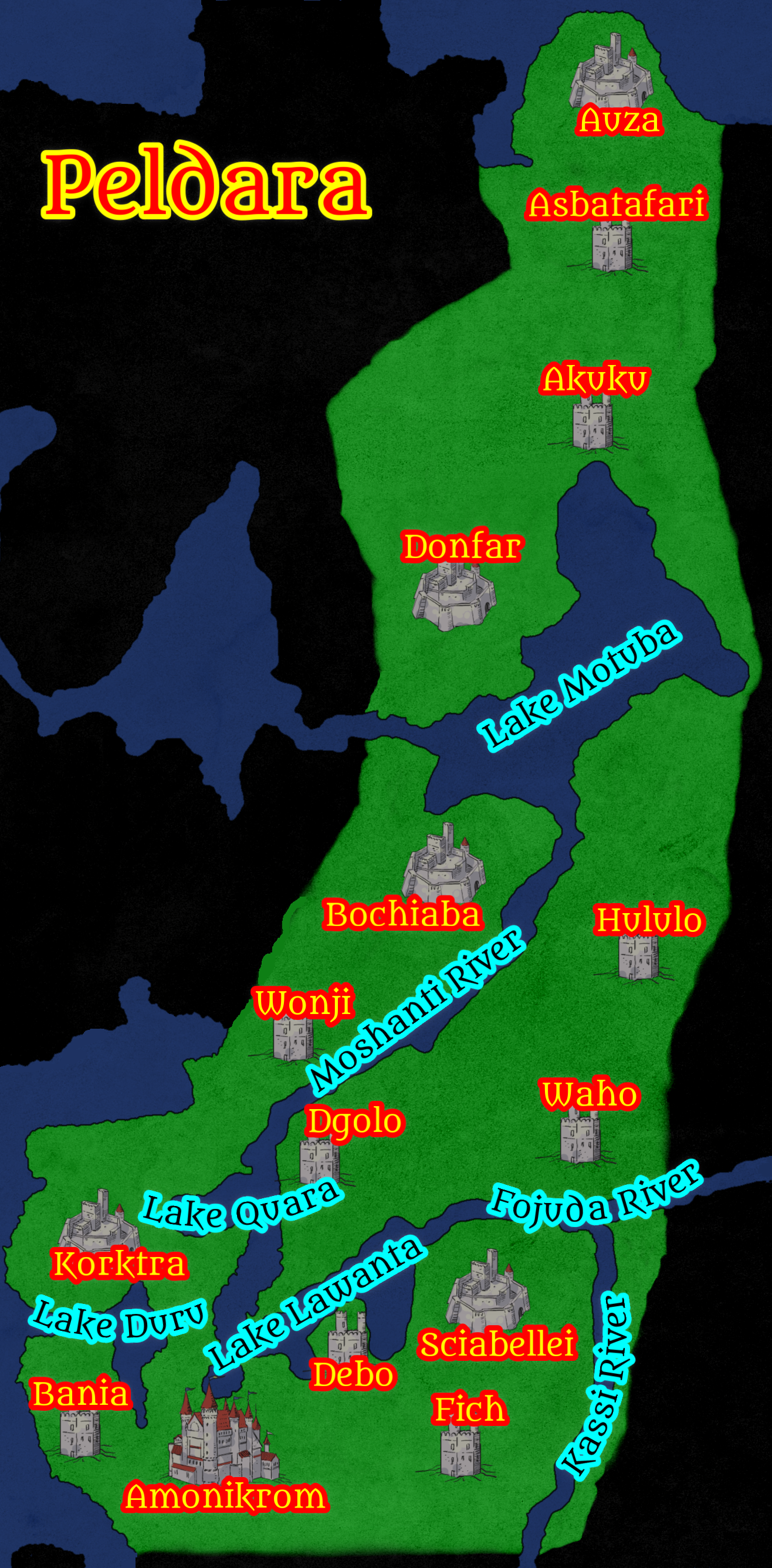
- Amonikrom, Capital of Peldara: Amonikrom, the grand capital of Peldara, rises in red stone fortifications on the southern frontier of the kingdom. This sprawling fortress-city is the seat of the High King and the beating heart of political and military power. Its towering walls, citadel, and vast parade grounds make it both an administrative hub and a stronghold of defense. The city's bustling marketplaces brim with merchants from across the seas, while its academies train the next generation of generals, diplomats, and scholars. Life in Amonikrom is vibrant but often tense, as politics, intrigue, and ambition run deep in its halls of power. The people here are cosmopolitan and ambitious, priding themselves on their role as guardians and rulers of the realm.
- Bania: Bania, a coastal trade city near the capital, is a lively port where foreign merchants bring spices, silks, and wonders from distant lands. Its docks teem with ships, sailors, and traders, while its streets bustle with music, gambling houses, and marketplaces that never sleep. Though prosperous, Bania is also infamous for smuggling, piracy, and shadow markets where anything can be bought for the right price. Its people are energetic, bold, and opportunistic, thriving on trade, risk, and adventure.
- Korktra: Korktra, a fortified city to the west, guards the kingdom's inland river routes and commands rich iron mines. It is a rugged industrial center where blacksmiths, armorers, and miners forge the steel that arms the kingdom's soldiers. The city is known for its hardy warriors and pragmatic culture, shaped by life on the frontier. Its walls are lined with war banners, and its people take pride in strength, endurance, and loyalty.
- Dgolo: Dgolo, surrounded by fertile fields, is Peldara's breadbasket. This agricultural town produces much of the kingdom's grains, fruits, and livestock, feeding both soldiers and civilians alike. Its people are deeply rooted in traditions tied to the land, with festivals celebrating planting and harvest cycles. The temples here honor earth and fertility gods, and the city is known for its strong community bonds, lively fairs, and devotion to simple but prosperous living.
- Wonji: Wonji lies along the great river, a city defined by fishing, river trade, and expert boat-making. Known for its navigators and bargemen, it is a hub of commerce flowing between north and south. Music, storytelling, and water festivals are central to its cultural life. The people of Wonji are cheerful, welcoming, and often seen as the best river pilots in the land, guiding travelers safely through winding waterways.
- Debo: Debo rests near the marshlands and wetlands of the southeast. Its people are reed workers, herbalists, and traders who thrive on what the swamps provide. Barges drift through its waterways, and mystics practice their craft in the misty lowlands. Known for its healers and potion-makers, Debo has a reputation for strange remedies and hidden wisdom, and travelers often come here seeking cures or charms.
- Sciabellei: Sciabellei is a fortress-city built at the crossroads of the kingdom's major routes. Its thick walls and disciplined garrisons make it one of the strongest military bastions of Peldara. Soldiers drill in its courtyards, and war councils are held in its stone halls. While it is first and foremost a martial city, it is also a hub for caravan traffic, keeping its markets bustling with goods from every corner of the land.
- Fich: Fich sits on the eastern coast, renowned for its deep harbors and shipyards. The city is home to master shipwrights, sailors, and naval warriors who form the backbone of Peldara's fleet. Though often compared to Bania, Fich is more disciplined and militarized, serving as the kingdom's naval arsenal. Its culture is defined by the sea, with festivals of sailors, long voyages, and daring tales of exploration.
- Waho: Waho stands upon the rolling eastern plains, famed for its horse-breeding and cavalry. The city thrives on ranching and riding, its people known as expert horsemen who make up the elite mounted forces of Peldara. Seasonal festivals feature races, contests of skill, and displays of horsemanship. Life in Waho is energetic, fast-paced, and bound to the rhythm of hooves.
- Hululo: Hululo is a city of scholars and priests, where temples and archives dominate the skyline. Known as Peldara's spiritual and intellectual heart, it is home to sages, oracles, and philosophers who preserve ancient wisdom. Pilgrims journey here to seek prophecy, healing, or enlightenment. The city's quiet courtyards and sacred halls make it a place of reflection and learning, revered across the kingdom.
- Bochiaba: Bochiaba, at the center of the kingdom, is a mighty fortress-city that acts as Peldara's military core. Second only to Amonikrom in power, Bochiaba serves as the strategic stronghold from which the armies of the kingdom are marshaled. Its stone walls rise high, its barracks are vast, and its laws are iron-clad. Justice and discipline rule here, and the people pride themselves on loyalty to king and kingdom.
- Donfar: Donfar guards the northern passes and mountain valleys, its fortress commanding the heights. Known for its elite garrisons and stonecutters, it produces both hardy soldiers and fine building materials. Its people are tough, disciplined, and accustomed to cold winds and rugged terrain. Donfar is the northern shield of Peldara, unyielding against invaders.
- Akuku: Akuku is a prosperous town in the northern midlands, thriving as a market and artisan hub. Farmers bring their goods to its bazaars, while craftsmen produce fine wares. Known for its lively trade fairs and its role as a link between north and south, Akuku's people are enterprising, industrious, and always ready to bargain.
- Asbatafari: Asbatafari lies near the great northern forests. It is a city of hunters, trappers, and woodcutters, where traditions of ancestor-worship and shamanism remain strong. Its people are resilient, skilled in survival, and deeply connected to the wild lands around them. Trade in furs, timber, and forest herbs sustains the city, while its shamans guard the old ways.
- Auza: Auza, the northernmost city of Peldara, is a frontier stronghold facing the unknown. Isolated and often threatened by raids from beyond the border, its people are hardened, vigilant, and fiercely independent. Scouts and militias keep constant watch, while its markets deal in hardy goods needed for survival in harsh lands. Auza is a city of resilience, pride, and the spirit of the frontier.