Province of Nelia

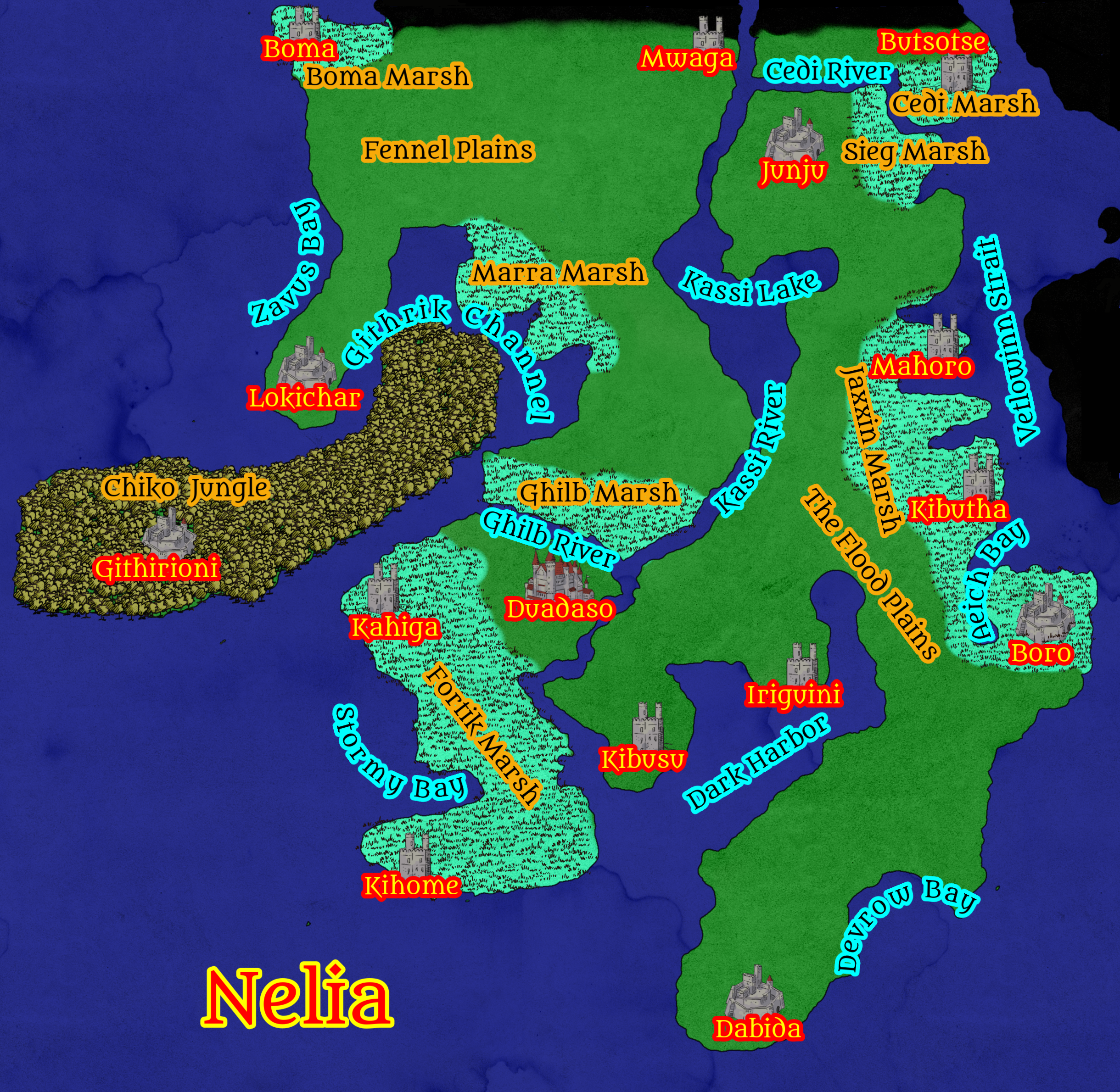
Nelia, The River Province
Nelia, known throughout the Enclave as the River Province, is a land shaped entirely by water. To outsiders it is "The Flooded Lands," a place where life rises and falls with the slow, swelling breath of the rivers. From the moment the spring floods begin their inexorable climb, Nelia's identity reveals itself, fertile plains turned to shining deltas, villages rising on stilts, and vast reed-choked marshes teeming with bird and beast alike. It is the lifeblood of the Enclave's economy, and yet it is as dangerous as it is bountiful.
History of Nelia
Nelia's history is written in silt, flood, and stone. For as long as memory reaches, its people have lived in negotiation with the river, worshipping it, fearing it, and bending its power to their survival.
In the age before the Enclave, when the world was divided into scattered tribes, the first settlers came to the delta. They built their huts upon the natural rises and fished the swollen marshes, learning that the waters which drowned their homes one season would fatten the soil the next. Their myths spoke of the river as a living serpent, a god whose coils could both feed and devour. To live along its banks was to live at the mercy of a divine beast, both protector and destroyer.
Around two and a half millennia ago began what later chronicles would call the Age of Canals. As villages swelled into towns, the people carved their first great dikes and channels to turn the floods aside. This mastery of water transformed Nelia from a loose collection of marsh-dwellers into a rising province. With control of the river came wealth and with wealth, power. Priests and lords who commanded the flow of water came to command the flow of grain, trade, and life itself. It was in this age that temples first rose to Osiris and Anubis, where rites of flood, harvest, and death were woven together into a single cycle of worship.
But no canal could tame the river forever. Nearly 2000 years ago came the disaster remembered as the Sundering. It tore down levees and washed whole towns into the depths. Survivors huddled on the few high places, ravaged by hunger and disease, convinced the gods themselves had turned against them. Out of this calamity came the Levee-Keeper Guilds, families who swore never again to let the river swallow their kin. They rebuilt the walls of earth and stone, and their descendants still hold sacred the charge of guarding Nelia from the river's fury. In the myths of the people, the Scar Flood became the punishment of the river-god, and its memory haunts every flood season that follows.
Eventually Nelia was drawn into the wider destiny of the Enclave through what is known as the Scribes' Accord. In exchange for protection and partnership, Nelian priest-scribes agreed to provide the Enclave with an annual bounty of rice and papyrus. Barges heavy with scrolls and rice sailed outward each season, and the province's wealth and importance grew as its waters became the arteries of an empire.
Yet unity was never the way of Nelia. Three centuries ago the people were riven by the Schism of Currents. A new priesthood rose among the marsh villages, teaching that the river's spirit was more than Osiris alone, that it flowed with a thousand living voices. Their vision of worship, part animism and part flood-cult, clashed with the orthodox priests, who preached a stricter Sacred Cycle. Though blood was rarely shed, the division left its mark upon every rite, festival, and funeral procession, and to this day Nelia remains divided between the two currents of faith.
Now, in the present age, Nelia remains both indispensable and precarious. Its canals, levees, and papyrus scriptoria feed and sustain the Enclave, yet each spring threatens to undo centuries of labor with one furious flood. Power drifts uneasily between priests, levee-keepers, and merchant captains, each vying to steer the destiny of the Flooded Lands. Just as the river winds and shifts, so too does Nelia's fate, never fixed, forever flowing.
The people of Nelia have long accepted that their survival depends on bending with the floods rather than fighting them. They have raised levees, dug canals, and built floating markets that drift from town to town. Entire fields of barley and emmer wheat vanish beneath brown waters for months, only to reemerge thick with new growth when the waters recede. The river provides not only food but also trade, carrying grain-laden barges down to the cities of the Enclave and bringing back wealth, spices, and knowledge in return. Fishing is both sustenance and craft, with riverfolk famed for their skill in netting the monstrous catfish and eels that lurk in the shadowy currents. From the papyrus swamps come the scrolls and inks that fill the libraries and temples of the wider world, giving Nelia a reputation as the scribe's province as much as the farmer's.
But the same waters that bless Nelia also curse it. Floods too high can drown entire villages, sweeping away cattle and fields alike, while stagnant pools invite swarms of insects carrying fever and wasting sickness. Disease spreads with alarming speed in the crowded reed-hamlets, and many a family measures its lineage by the years the floods were merciful rather than cruel.
Religion, Ritual, & Mysticism
Religion in Nelia is a living of the river. The two primary expressions are:
- The Cult of Osiris: celebrates the flood as a cycle of death and rebirth. Rituals include river-processions, the scattering of seed-offerings into the silt, and annual dramas that re-enact the god's descent and return. Osirian priests are often agricultural advisors and hold sway over planting rites.
- The Cult of Anubis: manages the care of the dead, embalming practices, and rites to prevent the dead from becoming restless. Anubian temples act as mortuary hospitals and necropolis administrators.
Himsa vs Amonikrom:
Himsa are local river-shamans and cultists who emphasize direct communion with water-spirits, personal offerings to the river, and practical flood rites that blend older animist methods with Osirian imagery.
Amonikrom is a temple-led faction, doctrinal and institutional, that insists on formal liturgies, strict funerary protocols, and centralized control of sacred texts. They interpret the Sacred Cycle as a structured path through which the Enclave's stability is maintained.
The dispute is not purely theological, it has practical consequences in how people treat the dead, who profits from funerary services, and who sets the calendar for irrigation rites.
Magical practices: protective river-wards, spell-inlaid papyrus charms, ritual mummification with wards against plague-spirits, and semi-secret water-binding rituals practiced by Himsa families.
The present is no less turbulent than the past. Nelia's barges still glide downriver with grain and papyrus, but unrest bubbles beneath the surface. Each flood season becomes a political reckoning as much as a natural one. If the waters bless the fields, one side claims divine favor; if they bring ruin, blame falls upon the other. And all the while, Nelia's people continue their ceaseless work, sowing, fishing, and praying that this year the flood will not be their undoing.
Military of Nelia
The Armed Forces of Nelia, known collectively as the Host of the Golden Plains, are a proud and seasoned military power. Though Nelia lacks the sheer size of Peldara or the naval dominance of Daral, its soldiers are among the most tactically refined and resilient on the continent.
Structure and Organization
- Royal Command: The Soveriegn of Nelia serves as Commander-in-Chief, advised by the Golden Council, a body of senior generals, mages, and priest-commanders representing the major provinces.
- Standing Army: The Legions of Nelia number roughly 12,000 full-time soldiers. These are divided into provincial regiments that each owe direct allegiance to the crown.
- Militia Forces: In wartime, Nelia can mobilize another 20,000 militia, local levies trained in spear, bow, and shield, drawn from its farming and pastoral communities.
- Auxiliaries and Allies: Halfling scouts, Peldaran horsemen, and Elven rangers from border enclaves often serve as specialized auxiliary forces.
Branches of Service
- The Golden Legions: Core infantry formations, heavily disciplined and trained in formation fighting. They wear polished lamellar or scale armor with golden accents and carry spears, shields, and short swords.
- The Plains Cavalry: Light and medium horsemen famed for mobility and endurance. Their tactics favor flanking, harassment, and lightning strikes across the open grasslands.
- The Order of the Sun: A holy knightly order bound to the Solar Church. They serve both as elite shock cavalry and as moral guardians, wielding radiant magic and sun-blessed weapons.
- The Mage-Corps of Nelia: A small but potent body of war-wizards, battle-scholars, and geomancers. They specialize in defensive wards, elemental manipulation, and strategic weather control.
- The River Guard: Nelia's modest naval force, composed of shallow-draft warboats that patrol its great rivers and lakes, defending trade routes and ferrying troops swiftly between provinces.
Training and Doctrine
Nelia's military doctrine emphasizes discipline, adaptability, and coordination between its various arms. Officers are trained in both strategy and governance, often serving as magistrates in peacetime. Every soldier is expected to understand basic field engineering and survival, reflecting the kingdom's pragmatic traditions.
Equipment and Armament
- Armor: Bronze or steel lamellar, with decorative gold filigree denoting rank. Officers wear crested helms styled after solar rays.
- Weapons: Spears, curved sabres, composite bows, and short swords are standard. Cavalry wield long lances and recurved bows.
- Siegecraft: Nelian engineers are skilled in constructing light catapults, mobile towers, and defensive earthworks.
Magic and Faith in Warfare
Priests of the Sun-God march with the army, blessing weapons, healing the wounded, and invoking radiant wards. Magic is tightly integrated into command strategy, with battle-mages serving directly under generals rather than as independent units.
Reputation and Campaigns
Nelia's soldiers are renowned across the continent for their honor and their ability to endure long campaigns in open terrain. Their discipline and mobility make them ideal for both offense and defense on the vast plains of central Peldara. Historically, they have served as mercenaries and peacekeepers, balancing power among their more aggressive neighbors.
Population of Nelia
- Total Population: 2,400,000
- Humans (Dark-skinned Peldarans): 90% (2,160,000)
- Halflings: 10% (240,000)
Cities of Nelia
- Duadaso (Capital): At the heart of Nelia, Duadaso sits at the meeting of multiple river branches, making it both the political and religious center of the province. The city is built on high artificial mounds reinforced by stone and wood, surrounded by canals and ceremonial docks. It houses the Great Temple of Osiris and Anubis, where the Himsa and Orthidox priesthoods contest their influence. Duadaso is also home to scriptoria where papyrus is pressed and ink prepared for shipment to the Enclave. The city thrives on bureaucracy, priestly processions, and the constant movement of grain barges.
- Boma: Located at the northern edge of Nelia, Boma is a fortified port town guarding traffic from northern incursions. It is known for its reed-armored militias and extensive fish markets. The people here are hardy marsh-dwellers, respected for their skill in crafting boats that can maneuver in both shallow waters and open lake-like expanses.
- Mwaga: A northern farming hub, Mwaga spreads across the floodplains, its wealth measured in granaries rather than temples. The settlement is a patchwork of fields, irrigation dikes, and family shrines, more rustic than grand. Mwaga is often described as Nelia's "bread-field," supplying much of the grain exported to the Enclave.
- Butsotse: This eastern port town is famed for its herbalists and healers, who gather plants and fungi from the marshes to produce medicines, inks, and sometimes poisons. Pilgrims visit its shrines to Anubis, seeking cures for illnesses believed to be carried by the river.
- Junju: A strategic city on a major river, Junju controls tolls on barge traffic. Its people are shrewd traders, and its docks bustle with merchants and mercenary guards. Junju is often called “The Gate of the Floods,” as all river traffic moving between northern Nelia and Duadaso must pass its watchtowers.
- Mahoro: Perched along the eastern coast, Mahoro is a fishing port. It is here that barges are launched toward the sacred waters. The scent of incense and resin clings to the air. The Himsa priests consider Mahoro one of their holiest sites.
- Kibutha: This riverside settlement is a market town specializing in papyrus harvesting and the crafting of scrolls. Kibutha is also known for its vibrant festivals, where river dances and boat races celebrate the cycles of flood and harvest. It is a lively, almost boisterous place, where scholars and laborers mingle freely.
- Boro: Located in the southeastern delta, Boro is a city of stone-cutters. Its masons carve monumental chambers for Nelia's priesthood and nobility.
- Iriguini: Iriguini is a merchant's haven, with bazaars spilling across bridges and causeways. It is famous for its river pilots, guides who know the safest channels and shifting sandbanks of the delta. Without them, barge captains risk ruin in the marshy labyrinth.
- Kibusu: This southern town is heavily tied to the Levee-Keeper Guilds. Its people are renowned engineers who oversee massive earthen walls protecting Nelia's heartland. Their knowledge of dikes and flood control makes Kibusu indispensable, though the town itself often smells of wet clay and tar from its endless works.
- Kahiga: A smaller but wealthy settlement west of Duadaso, Kahiga is known for cattle and goat herding on the rare drylands that border Nelia's marshes. Its people are independent-minded, proud of their upland herds, and sometimes at odds with the priests who favor crop farmers.
- Lokichar: Guarding a key waterway to the west, Lokichar is a fortress-city, bristling with stone towers and levee-gates. It is a militarized place, responsible for defending Nelia's river trade from pirates and incursions. Lokichar is sometimes called the “Shield of the Delta.”
- Githirioni: Set on an isolated rocky island, Githirioni is Nelia's prison and place of exile. Surrounded by treacherous waters, it is said that no one escapes. The Himsa view it as cursed ground, while the Orthodox priests see it as divine justice, where those who anger the river are cast into its eternal embrace.
- Kihome: Far to the southwest, Kihome is a fishing town that thrives on coastal and river trade. Known for its pearl divers and net-weavers, it supplies both food and luxury goods. Its distance from Duadaso makes it somewhat autonomous, and its people prize their independence.
- Dabida: At Nelia's southernmost edge, Dabida is a major port town where river meets sea. It serves as the entry point for foreign merchants, and its harbors are filled with strange sails. Dabida is cosmopolitan by Nelian standards, blending local traditions with the influences of distant lands.