Province of Sudran

History of Sudran
Sudran began as a small, agriculturally rich city-state located in a fertile region that produced an abundance of grains, fruits, and vegetables. Early settlers, primarily humans and halflings, cultivated the land in harmony with nature, making Sudran an important agricultural center in the continent.
The early years saw Sudran as a place of relative isolation, prosperous yet peaceful, with little interest in military expansion. The people were content with their egalitarian society, where class distinctions were minimal, and everyone played a role in the agricultural economy. The ruling family of Sudran served as spiritual leaders, guiding the populace through divine law and maintaining the delicate balance between the gods, nature, and human life.
The Age of Wisdom and Agricultural Prosperity
By the time of the Golden Age of Sudran, the city-state had become a cultural and intellectual beacon. Sudran was renowned for its agricultural techniques, many of which were developed by the halfling population, and for its philosophical schools that explored the connection between nature, humanity, and the divine. The ruling family continued to serve as spiritual guides, ensuring that divine law governed all aspects of life, but their role was largely symbolic in political terms.
Delgwenth Empire's Expansion: The Growing Threat
As the Delgwenth Empire began its expansion, Sudran, with its agricultural wealth and cultural influence, found itself in the crosshairs of imperial ambition. The empire's military might was unmatched, and the rapid conquest of nearby territories created a growing pressure on Sudran to either submit or face the threat of destruction.
Initially, Sudran sought to maintain its independence through diplomatic means, using its cultural influence and philosophical connections to negotiate favorable terms with the empire. Sudran's spiritual leaders and philosophers reached out to the empire's ruling elite, hoping to maintain their autonomy through diplomatic agreements and the promise of continued agricultural support.
The Great Decision: Sudran's Diplomatic Overture
As the empire's military power began to encircle Sudran, it became clear that resistance was futile. Sudran's lack of a military and reliance on agriculture made it ill-prepared to withstand an imperial assault. The ruling family faced an existential crisis: they could either resist and risk the annihilation of their way of life, or submit to the empire and ensure the survival of their people and culture, albeit under the shadow of imperial rule.
In a moment of pragmatic diplomacy, Sudran's leaders chose the latter. They sent an official delegation to the Delgwenth Empire, offering a peaceful submission in exchange for continued religious freedom and the right to govern their internal affairs. The ruling family proposed that they would remain spiritual leaders and maintain their egalitarian society, with no military obligation to the empire, if Sudran's agriculture continued to feed the empire and its growing populace.
The Treaty of Harmony: Sudran's Submission
The Treaty of Harmony was signed between Sudran and the Delgwenth Empire, marking a pivotal moment in the city-state's history. Sudran agreed to submit to the empire's political control but was granted the right to remain independent in cultural, spiritual, and agricultural matters. The treaty allowed Sudran to continue its peaceful existence, free from military conscription or imperial intervention in its internal affairs.
Sudran's ruling family retained their position as spiritual guides, but their political power became secondary to the authority of the empire. While Sudran's intellectual and agricultural contributions were celebrated, the city-state was now part of the Delgwenth Empire's sphere of influence. It was a diplomatic victory for Sudran, one where survival was achieved through compromise rather than military conflict.
Sudran in the Modern Era: A Resilient Symbol of Harmony
In the modern age, Sudran's role in the empire is one of spiritual influence and agricultural abundance. The city-state remains a symbol of peaceful coexistence between empire and tradition, where intellectual thought and agricultural productivity are valued above military might. While Sudran's ruling family no longer holds political power in the empire, they are still respected as divine intermediaries and moral guides for both the people of Sudran and the wider empire.
Sudran's agriculture continues to be vital to the Delgwenth Empire, and its philosophers, priests, and spiritual leaders play an important role in shaping the cultural fabric of the empire. Sudran has found a unique position: a prosperous, agricultural state under the Delgwenth Empire that retains its cultural and spiritual heritage, while also recognizing the empire's need for military strength and political unity.
Sudran: Total Population Breakdown
Total Population: 545,000
Humans: 400,000
Halflings: 145,000
Society Overview
Sudran has an egalitarian society with minimal class distinctions. The ruling family holds spiritual authority, but there are no significant class divisions among the common people. Most citizens work in agriculture and spiritual practices. Halflings are especially known for their agricultural expertise.
Cities & Settlements of Sudran
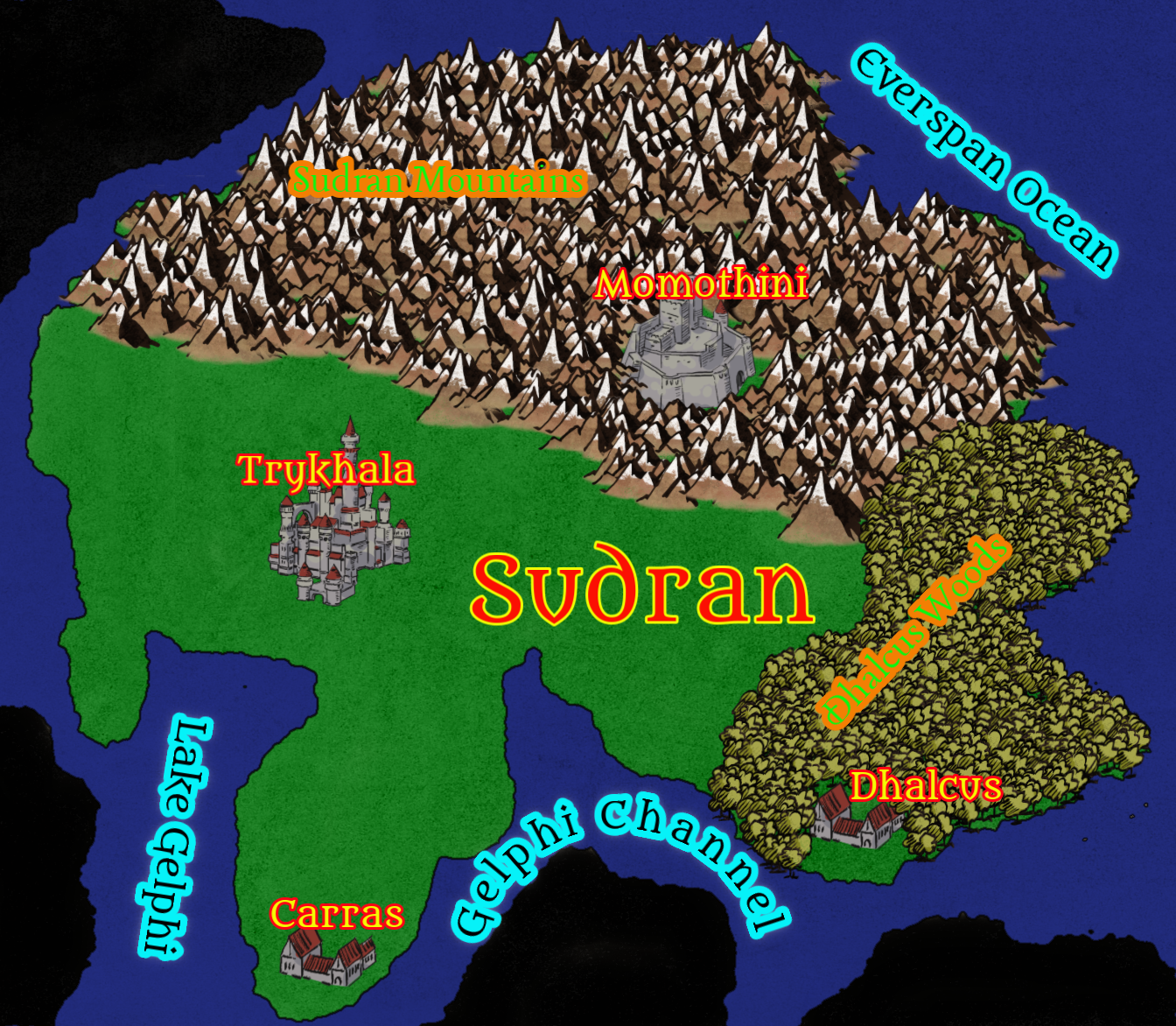
- Trykhala: The capital city of Sudran, Trykhala is the cultural and spiritual center of the city-state. It is home to the ruling family, the Divine Monarch, and various religious schools. Trykhala is known for its philosophical academies, where citizens gather to discuss matters of divine will and the mysteries of life. The city plays a central role in Sudran's spiritual leadership.
- Momothini: Coastal city that serves as the gateway for Sudran's trade and naval expeditions. It is an important economic hub, known for its bustling markets and connection to foreign lands. Despite its naval importance, Momothini focuses on peaceful trade and spiritual rituals at sea.
- Dhalcus: Located in the southern part of Sudran, Dhalcus serves as a vital agricultural settlement. The city is known for its granaries, fertile fields, and large-scale crop production. Dhalcus plays a key role in supplying food not only to Sudran but also to the wider region. It also holds spiritual significance with temples dedicated to harvest gods.
- Carras: A small, inland city primarily focused on craftsmanship and small-scale trade. Carras is known for its artisan workshops where tools, pottery, and textiles are made. Though not as large or influential as Trykhala, Carras plays an important role in Sudran's economy as a center for local craftsmanship.
Social Structure of Sudran
The social structure of Sudran is relatively egalitarian, with humans and halflings sharing similar status in the community. The ruling family remains at the top, holding spiritual leadership, but without any military or political authority. Sudran's population is primarily engaged in agriculture, spiritual practices, and craftsmanship.
Key Social Groups
- Ruling Family: Spiritual guides and leaders, with no military power.
- Farmers & Halflings: The backbone of Sudran's agricultural wealth.
- Artisans: Crafting tools, pottery, and textiles, contributing to local trade.