Province of Marwyath
Origins and Geography
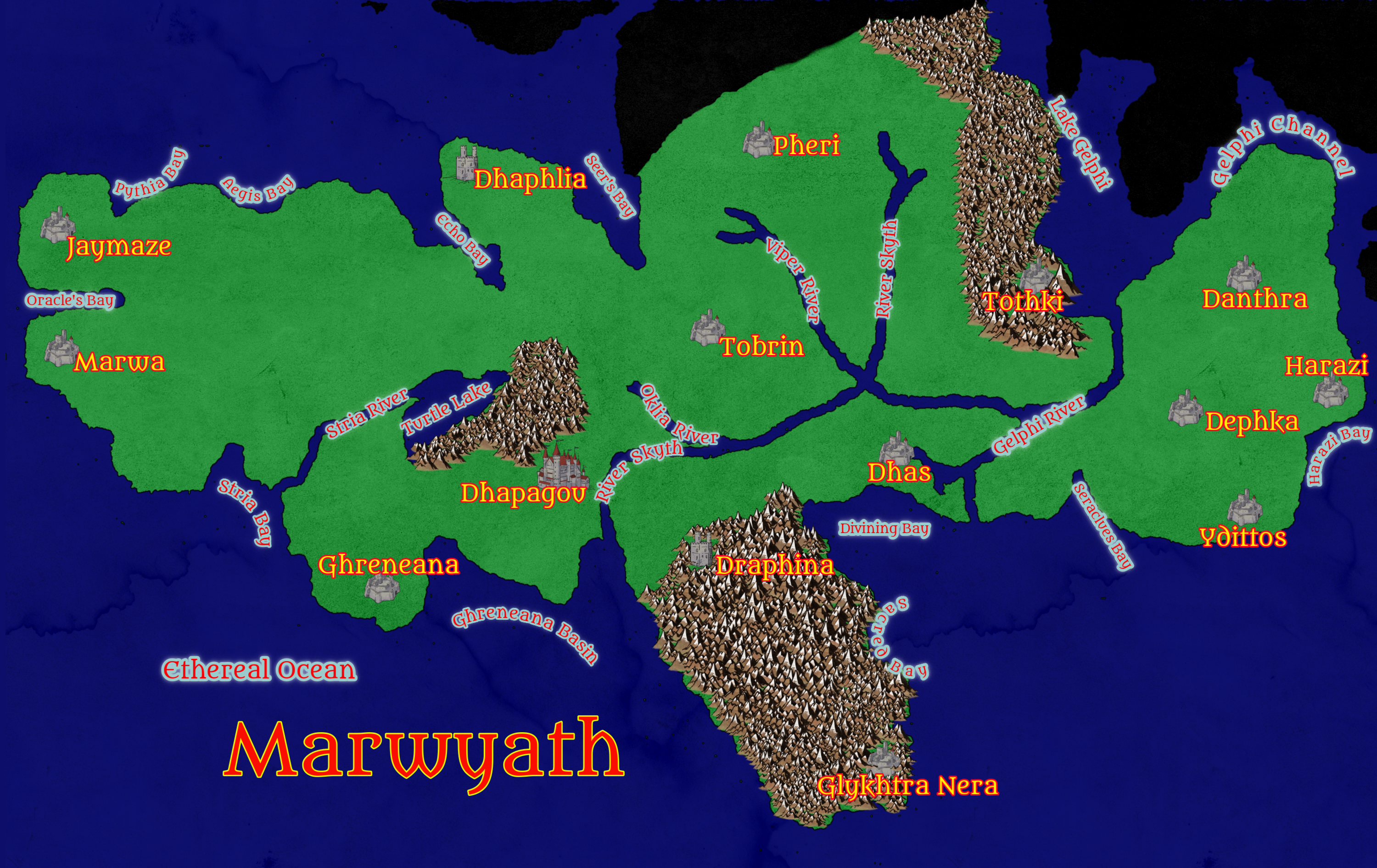
Marwyath was once part of the greater kingdom of Gyath, but after the Gyathian Civil War, the southern half of Gyath, which was deeply affected by internal conflict, was carved out and became the birthplace of what would become Marwyath.
Gyath: The Kingdom Divided
At the time of its formation, Marwyath was a new kingdom born from the south of the old Gyathian Kingdom. The original Gyath was a militaristic, hierarchical society, deeply entrenched in warrior traditions and ruled by a monarchy. However, following Ferrisco Oricci's death and the collapse of the Gyathian monarchy after the Gyathian Civil War, the kingdom fractured into multiple regions, with the north falling under the rule of the Empire and the south carving out a new destiny.
Marwyath took root in the southern half of Gyath, an area historically known for its fertile lands, rivers, and strategic military importance. This region had long been a key agricultural zone, providing the kingdom with food and resources. While Gyath continued to fight for its survival in the northern territories, the southern half embraced a new vision, led by Lady Selara Marwyath.
The Rise of Marwyath: A New Kingdom
The southern territories that formed Marwyath had long been tied to the spiritual roots of Gyath, but after the civil war, it adopted Lady Selara's vision for a spiritual and progressive society. She rejected the old militaristic and oppressive warrior traditions and replaced them with a kingdom focused on divine law, trade, and a balance of power between the elite and common folk.
Formation of Marwyath:
Lady Selara Marwyath founded the new kingdom after the fall of the Gyathian monarchy, and she claimed the southern half of the kingdom as Marwyath. Her vision of a spiritual monarchy and the establishment of the Divine Council redefined the political structure, placing divine law at the forefront.
The capital city of Dhapogou was established in the heart of the southern half, serving as the spiritual and political center of the new kingdom.
The Divine Council:
The Divine Council was formed to serve as the governing body of Marwyath, interpreting the will of the gods through oracles and religious rituals. This represented a shift from the militaristic traditions of Gyath, which had been dominated by warrior kings and military generals.
The Duality of Identity:
Although Marwyath was born from the southern half of Gyath, it quickly developed its own distinct identity based on spirituality and divine rule. The southern half was seen as the more progressive, while the northern half, still under Imperial rule, clung to the old traditions of Gyath.
Marwyath's Relationship with the Empire
Though Marwyath enjoyed a century of independence, its fate was ultimately tied to the Empire's expansionist ambitions.
The Empire's Encroachment:
For much of its early history, Marwyath remained an independent kingdom, standing firm against the Empire's encroaching influence. It was a spiritual stronghold, both a beacon of resilience and divine authority.
However, as the Empire expanded and grew more powerful, it began to set its sights on the southern half of Gyath, primarily for its strategic location, rich resources, and spiritual influence. The Empire sought to bring Marwyath under its control, both for its spiritual authority and its trade routes, which were integral to the Empire's expansion.
The Fall of Marwyath:
100 years ago, the Empire launched a military campaign to bring Marwyath under its control. After a series of battles and sieges, the capital city of Dhapogou fell to the Empire's forces.
Despite the surrender of Marwyath, the Empire allowed the Divine Council to remain, though their role was significantly diminished. The spiritual leadership was reduced to being advisors to the Imperial administration.
The Struggle for Identity:
Even under Imperial rule, Marwyath held onto its spiritual traditions and cultural identity. While Dhapogou remained a significant spiritual center, its status was diminished as Imperial influence grew, and the Divine Monarch became a figurehead in the new system.
Marwyath today exists as a province of the Empire, but its legacy as the southern half of Gyath is still felt in its cultural identity and spiritual significance.
Dhapogou remains a center of spiritual authority, and though it is under Imperial control, it still acts as the spiritual heart of the kingdom. The Divine Council continues to hold sway in matters of faith and cultural preservation, though its power is limited by the Empire's control.
Marwyath's identity as the southern half of Gyath continues to influence its people, and many still hold onto the old ideals of independence and spiritual governance that Selara Marwyath fought for. The resistance against Imperial rule remains, with occasional uprisings that seek to restore Marwyath's independence or at least preserve its cultural heritage. Total population: 1,200,000Marwyath: Total Population Breakdown
Class / Tier Race Population % of Total Notes Noble Class Humans 50,000 4.17% The ruling elite, consisting of families that control the region's military, economy, and politics. Freemen (Soldiers, Traders, Artisans) Humans 300,000 25% Independent citizens, mainly soldiers, traders, and artisans. Highly involved in Marwyath's commerce and military. Dwarves 50,500 4.17% MAinly Miners and Weaponsmiths Helots (Bound laborers) Humans 500,000 41.67% Laborers bound to the land, working on farms and in various industries. Heavily taxed and bound to servitude. Orcs / Half-Orcs 300,000 25% Enslaved or bound workers, often used in military or manual labor tasks. Resentful and oppressed. Cities & Settlements of Marwyath
Cities & Settlements of Marwyath