Province of Gyath
Origins and Geography
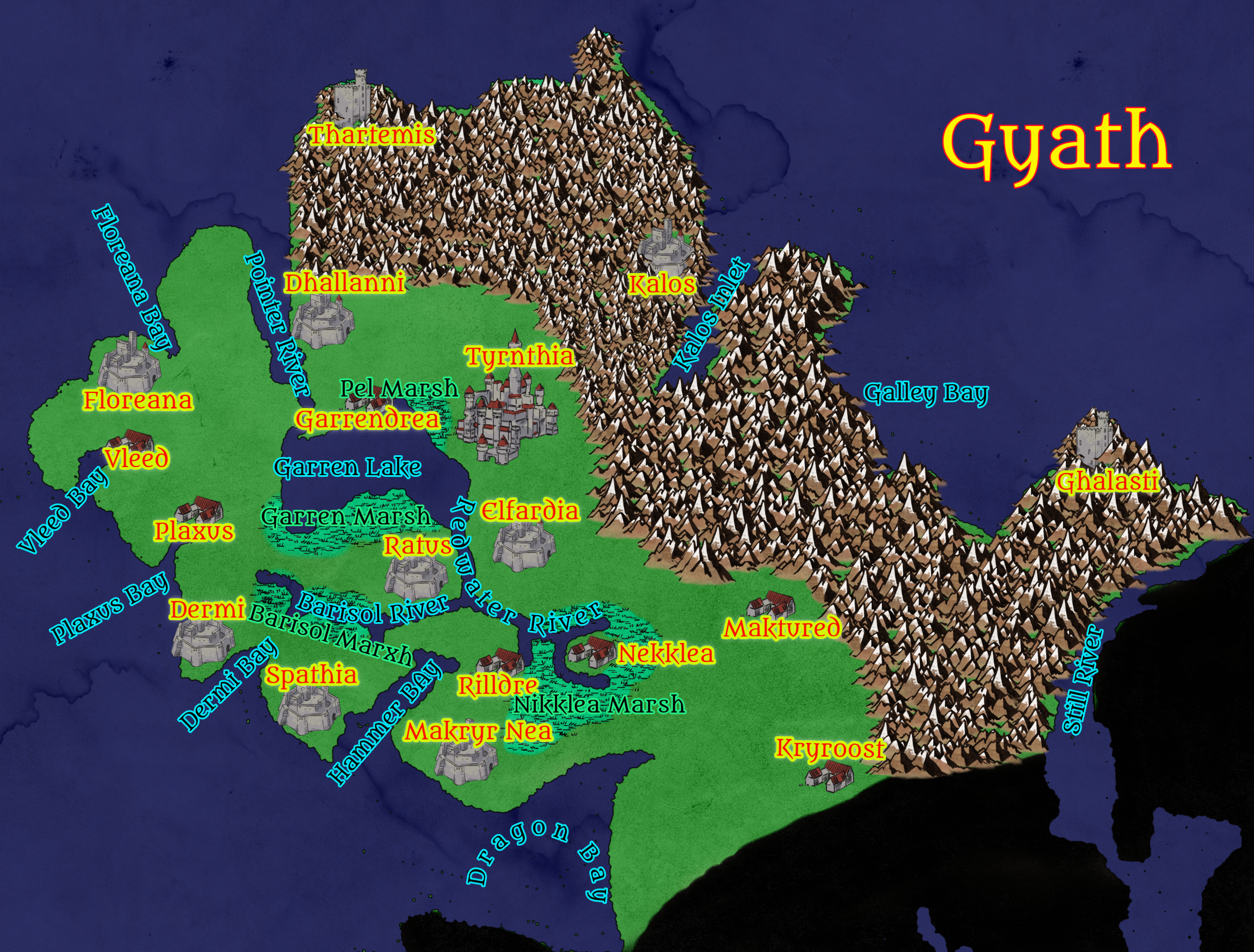
Gyath lies on the empire's North Central marches, a land of harsh contrasts, fertile plains edged by mountain ridges, plains, swamps and storm-battered coasts that open toward foreign seas. Unlike Delgwynth, whose waterways bind it inward, Gyath's geography has always pushed outward, toward war, rebellion, and expansion.
The people of Gyath were born in contested lands, their spirit tempered by strife and hardened by the shifting tides of conquest. In this rugged country, every hill could be turned into a fortress and every river into a defensive line. Its cities rose not as mere centers of commerce, but as bastions of defiance, ever watchful, ever prepared. Gyath was the empire's frontier shield, unyielding against outside threats, yet it was also the empire's greatest internal challenger, for its people were never content with submission.
Of all the Empire's settled islands, Gyath was the first and the oldest, holding that distinction for nearly half a century before any others followed. It was here that the traditions of independence and sovereignty ran deepest, where rulers governed by the strength of their arms as much as the will of their people. Long before Thalor Halkries of Delgwynth proclaimed himself Emperor, Gyath had stood as the strongest of the island realms, proud of its autonomy and jealous of its influence.
At the height of this era ruled Ferrisco Oricci, a warrior-king whose name is still spoken with equal measures of reverence and lament. Oricci was no tyrant, but a hardened commander forged in endless skirmishes along Gyath's borders. He united fractious clans beneath one banner and commanded loyalty through valor and discipline. His soldiers marched as if their land itself was watching, and in battle they fought with a tenacity that made even hardened foes think twice.
Yet when Thalor Halkries rose in Delgwynth, bearing both the ambition of an emperor and the armies to realize it, Gyath could not remain untouched. Oricci resisted, rallying his warriors to defend Gyath's sovereignty against Thalor's imperial vision. Their struggle was bitter and unrelenting, a clash between two titanic wills; one seeking unity, the other defending freedom.
In the end, Ferrisco Oricci was defeated, though not without leaving deep scars upon Thalor's cause. His downfall marked the end of an era, the collapse of Gyath's once-unshakable supremacy, but it was not the death of Gyath's spirit. Oricci's defiant stand, though ultimately in vain, became etched into the heart of the Gyathian legacy, an enduring symbol of resilience. His struggle was a testament to a people who would rather fight and fall with honor than kneel in submission. The legend of Oricci would echo through the centuries, a tale of defiance, of sacrifice, and of a collective will to resist oppression, no matter the cost. His last words, whispered in the face of overwhelming odds, would become a battle cry for generations to come: "We will not bow. We will not break."
Gyath, though shattered by Oricci's defeat, did not crumble. For the people of Gyath, defeat was not the end, it was only another trial to be endured, another story to be told. In the wake of the fall of Oricci, Gyath bent under the weight of the Empire's iron rule, its lands claimed, its people subjugated, but the fire of defiance still burned in the hearts of the Gyathians. It would take more than the heavy hand of an empire to erase their identity. The seeds of rebellion were sown, and in time, Gyath's struggle would give rise to something new, something unexpected, a civil war that would tear the kingdom apart and lead to the birth of a new realm, Marwyath. The true break would come not through conquest, but through the fractures within its own people, as loyalty and bloodlines fractured along lines of ideals and power.
The Gyathian Civil War: The Breaking of a Kingdom
The Gyathian Civil War was a brutal and transformative conflict that tore the heart of the Gyathian Kingdom asunder, giving birth to the new realm of Marwyath. It was a war not fought purely for land or power, but over the very soul of Gyath, its identity, its future, and its ideals. <
Origins of the Conflict
Following the fall of Ferrisco Oricci and the eventual subjugation of Gyath under the rule of the Imperial Empire, there simmered a growing discontent among the Gyathian people. Oricci's death left a void, one that was filled by his loyalists, who sought to avenge his defeat and continue his struggle. Yet, with Gyath's power waning and its society fracturing, the heart of the Gyathian kingdom struggled to hold together.
At the core of the tension were two conflicting visions:
- The Loyalists of the Old Guard, who sought to restore Gyath to its former glory, clinging to its militaristic traditions and the memory of Oricci's defiance.
- The Reformists, who saw the future of Gyath as one that could no longer rely on the harsh warrior traditions of the past. They advocated for a more inclusive and progressive society, one that might embrace the changing tides of the world, including more equitable systems of governance and a challenge to the rigid class structures that had dominated the kingdom.
As the Imperial influence tightened its grip on Gyath, these factions began to clash openly. The Empire, seeing the fractures in the kingdom, encouraged and even manipulated these divisions to weaken Gyath further.
Key Factions and Leaders
- The Loyalists of Oricci's Line: Led by the charismatic Duke Farros Draketh, a former warlord who had fought beside Oricci in his final stand, this faction held on to the ideals of the old Gyath. They sought to reclaim their land through force, calling for the expulsion of the Imperial influence and the restoration of the old military hierarchy. Farros was a stern and battle-hardened leader, respected by many for his unwavering loyalty to Oricci's cause.
- The Reformists of the New Dawn: A growing movement led by the enigmatic Lady Selara Marwyath, a former noblewoman who had lost much of her family in the war with the Empire. Selara argued that Gyath's military might was a relic of a bygone era and that the future lay in trade, diplomacy, and a new political structure that could balance the power between the warrior elite and the common folk. She rallied those who had suffered under the old system, many of the lower classes, the Therioi, and those who had endured the harshness of the Helot system.
- The Imperial Loyalists: A faction of Gyathians who had, over time, become loyal to the Imperial throne. This group, led by the ambitious General Orlan Kethar, sought to solidify Gyath's place under Imperial rule, believing that only by aligning themselves fully with the Empire could Gyath survive. Though initially a small faction, their numbers swelled as the war progressed, and many of the Empire's legions were stationed in Gyath to ensure their success.
The War Unfolds
The war erupted in full force when Duke Farros Draketh declared open rebellion against the Empire, seizing the eastern region of Gyath in a surprise assault. The initial battles were marked by swift victories on both sides, with the Loyalists reclaiming key territories in the east, while the Reformists held firm in the western provinces, rallying the common folk and many of the minor races to their cause.
For years, the conflict raged, with cities such as Tyrnthia and Thartemis becoming battlegrounds, their streets filled with the clashing of armies. The capital, Tyrnthia, once a symbol of Gyath's supremacy, became a focal point for the war. The reformist faction, gaining momentum from victories in key battles and growing popular support, laid siege to Tyrnthia, but the Imperial Loyalists within the city, bolstered by reinforcements from the Empire, fought fiercely to hold it.
The war reached its height when Lady Selara Marwyath, having gained significant ground in the west, marched her forces northward, intent on liberating the northern territories and forcing the hand of the Empire. However, the Loyalist forces under Duke Farros Draketh, once united in their love of Gyath's traditions, began to splinter. A key battle at the Elfardia proved to be the tipping point. Both factions suffered massive casualties, and Farros was critically wounded in the fighting. His death fractured the Loyalists, and many of his followers, disillusioned, turned to Selara's cause.
The Rise of Marwyath
With Farros Draketh dead and the Loyalist forces in disarray, Lady Selara Marwyath and her Reformists marched on the remnants of Gyath, which lay in ruins. The Empire began pulling its forces forward and a massive battle was faught. In the final days of the war, Selara's forces were forced to withdreaw, Gyath remained a part of the empire and there was a reluctant peace. But Gyath as a unified kingdom was no more. Instead, the Kingdom of Marwyath was born out of the ashes, with Lady Selara Marwyath crowned its first monarch. Marwyath, named after the Lady Selara, stood as a new realm, one that rejected the old martial traditions of Gyath and embraced the vision of a more balanced and diverse society.
However, the scars of the war remained. Bitter divisions lingered between the warrior class, who felt betrayed by the abandonment of the old ways, and the common folk, who resented the old system that had kept them subjugated for so long. Tensions remained high, and many who had fought for Gyath's old ideals continued to dream of reclaiming their former kingdom.
The civil war left Gyath in ruins, its cities burned, its armies scattered, and its people divided. Yet, the spirit of defiance and the memory of Ferrisco Oricci's stand lived on, especially in the hearts of those who resisted the reform.
Gyath slowly pulled itself back together.
The Gyathic System
Gyathic society was forged in rivalry, with neighbors, with the empire, even with itself. Its cities are semi-independent strongholds, each boasting its own proud lineage, yet united by necessity when facing external foes. The empire tamed them through conquest, but never truly subdued their spirit.
Military service is not just an obligation but a birthright. Boys and girls alike are drilled from youth, not with the communal austerity of Delgwynth, but with the ferocious pride of clan and city. Their training emphasizes adaptability: mountain ambushes, river crossings, and brutal open-field clashes.
Government and Society
Gyath's governance is unstable, swinging between unity and fracture:
- Thason Halkries the Arcon of Tyrnthia, cousin of the Emporer: Nominal ruler of Gyath, enthroned in the citadel at the empire's insistence, but often resisted by proud regional lords.
- The Fortress-Lords: Hereditary rulers of cities like Elfardia, Rentus, and Kalos, who command private armies and jealously guard their autonomy.
- The People's Assemblies: Fiercely independent councils, especially in coastal cities, where free citizens demand a voice in war and tribute.
Society is less rigid than in Delgwynth, but far more turbulent. Noble families lead warrior-clans, peasants till fertile river-valleys, and mercenaries hire themselves to whoever promises coin or plunder. Yet all are bound by the same creed: never to be slaves, always to fight.
Culture and Values
The Gyathic spirit is one of defiance, rivalry, and glory. Their poets praise rebellion as much as loyalty, their festivals celebrate both local heroes and divine patrons of war. Where Delgwynth values silence and obedience, Gyath prizes bold speech, fierce debate, and displays of strength.
The Dragonwright faith is embraced with a uniquely Gyathic twist: Moranthus is not only the flame of order but also the fire of rebellion. Temples in Tyrnthia preach loyalty to the empire, but shrines in Floreana or Ghalast might invoke Moranthus as the liberator who will one day free Gyath from imperial chains.
Military Might
Gyath's armies are renowned for their ferocity and versatility:
- Masters of fortress defense: stone citadels like Kalos and Rentus held out against sieges that would have broken lesser cities.
- Skilled in guerrilla warfare: mountain clans ambushed invading armies, striking and vanishing into the highlands.
- Capable of open-field shock tactics: the Gyathic phalanx, less disciplined than Delgwynth's, but stronger in numbers and ferocity.
Decline and Strain
Gyath's strength is also its weakness:
- Fractured Loyalties: Cities feud with one another as often as they resist the empire.
- Imperial Distrust: Emperors stationed legions in Tyrnthia and Kalos to keep Gyath under control, draining its autonomy.
- Rebellious Reputation: Gyath's repeated revolts earned it brutal reprisals, leaving scars of burned towns and slain clans.
- Over time, Gyath has become both indispensable and dangerous: a sword always at the empire's side, yet one that might turn against its wielder.
Legacy
Gyath remains the empire's troubled frontier, a land of warriors and rebels, guardians and traitors. It is celebrated for its bravery, feared for its pride, and never fully trusted by the throne. To this day, imperial chroniclers write: “To rule Gyath is to hold fire in the hand: bright, burning, and never safe.”
Gyath: Total Population Breakdown
Total population: 2,500,000
Class / Tier Race Population % of Total Notes Citizens (Warrior Class) Humans 125,000 5% Full citizens of Gyath, trained as warriors from youth, control politics and land. Therioi (Free folk, auxiliary soldiers, boatmen) Humans 325,000 13% Free folk, skilled in river operations, trade, and auxiliary military support. Dwarves 12,500 0.5% Marginalized, often work as miners or blacksmiths. Halflings 75,000 3% Participate in trade, crafts, and river work. Helots (Bound laborers) Humans 1,000,000 40% Serve the fields and fisheries; heavily taxed and bound. Orcs / Half-Orcs 962,500 38.5% Entirely in Helots tier, work in fields, labor camps, or river work.