 |
|||||
|
|
| |||
Habitats for Monsters & Animals
Most animals occupy a particular geographic region, climate and/or terrain. They rarely, if ever, leave their natural habitat unless forced out by humanoid settlers, disease, changes in climate, the lack of an abundant food source, drought, etc. If the animal cannot adapt to the changes in his environment, it must find a new, suitable habitat or perish. All of these conditions will restrict where a specific creature will be found or where it may migrate to in times of environmental upheaval. Likewise, certain animals are found only in certain regions. This usually has to do with climate, food, predators (or lack thereof), and environment. For example, one would hardly expect to find a frog or a deer in a desert.
Wild animals. even exceptional or monstrous animals, are rarely found in or near large cities or towns because the habitats of humanoids are too inhospitable and dangerous for even the largest and most ferocious predators. Of course, some creatures, especially small scavengers like rodents, squirrels, raccoons, foxes. owls, hawks and similar animals, may flourish among the dwelling places of intelligent beings, especially in and around rural villages and farmlands. Exotic or rare creatures are most often found in the wild. far from the hub of civilization. However, while this is the general rule, the occasional monstrosity will invade the habitat of men or wander far from its normal haunts.
Intelligent beings are much more versatile and motivated by needs, desires and curiosity not shared by animals. Thus, while a particular intelligent race may dominate a specific region, they are NOT restricted to any one area of the world and may pe found anywhere. Note that most of the intelligent creatures described in this book, with the exception of the Coyles and Wolfen, are not dominant forces in the world. Consequently, their numbers are small compared to humans, elves, dwarves. orcs. goblins, ogres and other races. For example, while a person may encounter an Eandroth Rogue anywhere in the world, he will be one among many hundreds or thousands of humans. However, the Eandroth are numerous in their homeland, the only place where an adventurer will encounter entire tribes of them. Note: Most of the monstrous races are considered enemies of humans and the other dominant races. Thus, they tend to avoid direct or frequent contact with them. The world maps and habitat listings indicate the region(s) where a creature is most abundant and/or its natural habitat.
A Brief Definition of Some Common Terms
Alignments: The moral orientation of the creature; good (principled and scrupulous), selfish (unprincipled or anarchist), and evil (miscreant, diabolic or aberrant). Most animals are considered anarchist alignment, while predators may be considered anarchist/self-serving or evil because they prey on humanoids.
Allies: Known comrades and associates; usually applicable only to intelligent beings.
A.R. (Armor Rating) or Natural A.R.: This is the creature's natural Armor Rating (A.R.), if any. Any rolls to strike that fall under the creature's natural A.R. means that the blow may strike and sting, but does not penetrate the creature's natural armor and does NOT inflict damage. Any roll above the A.R. number means the attack penetrates the tough hide and inflicts normal damage.
Attacks Per Melee: Indicates the number of attack(s) or melee actions (run, leap, etc.) the creature can perform per melee round (15 seconds). Most animals attack with claws, teeth/bite or stinger.
Attributes: Most monsters are provided with the eight attributes and the number of six-sided dice (plus bonuses or modifiers) to be rolled to deter-nine each one. Technically, any of the monster races can be used as player characters, provided the Game Master allows it (their inclusion is completely up to the G.M.). Many others make great Non-Player Character (NPC) villains. Animals, even exceptional animals, are not usually provided with an attribute listing. The physical and mental attributes of most animals are much more consistent and unchanging than an intelligent, humanoid creature. Animal stats include average attacks per melee round, bonuses, natural abilities, speed. habitat, behavior and other basic data. Note that in many cases, these "stats" reflect an average or general range of that particular type of animal and are not intended to be all inclusive.
Average Life Span: Typical years of natural life in the wild (often increased by as much as 25% in captivity).
Bonuses: These are modifiers added to a specific action, often combat related, such as strike, parry, dodge and damage. ALL bonuses are in addition to any possible O.C.C., R.C.C., skill and/or attribute bonuses. If the character or creature gets a full set of attributes, then the bonuses listed are in addition to any possible attribute bonus. Most animals don't get attributes listed so the bonuses listed take into account all bonuses available to it.
Damage: The damage listing indicates the type of natural attacks or means of defense, such as claws, bite, etc., as well as the amount of damage inflicted by that particular attack. Unless otherwise noted, the creature may use any combination of attacks; i.e., Three attacks per melee by an Adram could be three bites, or three claws, or a combination of clawing and biting attacks.
Dice: Hit points and S.D.C. are indicated by ID6, 2D6, etc. Some may indicate a modifier like 2D6+12, and so on. 2D6+12 means roll two six-sided dice and add 12 to it for the total.
Enemies: Natural hostilities/antipathies toward other races or animals; usually applicable only to intelligent beings.
Habitat: Type of terrain and regions of the world where the creature is commonly found; i.e. jungle, forest, grassland, swamp, mountain, etc.
Hit Points: Hit points and S.D.C. indicate the amount of physical damage a character/creature can withstand before it dies. A typical listing for monsters will appear as: Hit Points: P.E. attribute plus ID6 per level of experience or a dice listing like 3D6.
Horror Factor: Creatures that are particularly frightening, ugly, repugnant or aggressive predators have been assigned a horror factor (H.F.) rating. These are generally limited to monsters, monstrous animals, snakes, reptiles, bats and rats which are repulsive and frightening to humans even when they are relatively harmless. The G.M. should feel free to use the animals assigned with a horror factor as a guideline for determining the H.F. for others, when appropriate. Animals that are normally considered cute, gentle and/or beautiful, such as most birds, horses, squirrels, monkeys, dogs, etc., do not have a horror factor.
Languages: The type(s) and numbers of languages known to the creature; usually applicable only to intelligent beings, not animals.
Magic: Indicates natural or learned magic abilities or O.C.C. possibilities. Druids, Shamans, and some magic spells, circles and artifacts, as well as psionics, can influence or control animals.
Natural Abilities: These are abilities common to all creatures under that particular race, breed or category. These typically include abilities and features such as prehensile tail, the ability to fly, swim, climb, as well as nightvision, prowl, etc.
Notes: Special or important notes of interest.
O.C.C.: Occupational Character Classes, such as soldier, mercenary, priest, wizard and so on, are specific areas of training, knowledge and skills. This listing indicates which O.C.C.s, if any, are available to that particular creature. Animals do not usually get an O.C.C., although some may have equivalent skills listed under natural abilities. like swim, climb, and prowl.
P.P.E.: The amount of Potential Psychic Energy (P.P.E.) possessed by the creature — all living beings have some measure of P.P.E. — see general list for animals. Also some specific animals are given a specific P.P.E. level.
Psionics: Indicates any natural psionic abilities.
Range: Specific locations where the creature is normally. found.
R.C.C.: Racial Character Classes are typically intelligent beings who have a set of basic skills (learned or instinctive) due to the creatures' orientation/nature, instincts, and powers or abilities.
S.D.C.: Structural Damage Capacity (S.D.C.) is endurance and tolerance to stress and injury in addition to hit points.
Sensitivity to Magic & the Supernatural: Many animals are sensitive to the emanation of magic energy (P.P.E.) and the presence of the supernatural, particularly supernatural evil. Dogs and horses are among the most sensitive in the world. Both animals can actually sense and smell supernatural beings, from entities to demons and alien intelligences. Cats, pigs, and primates (chimpanzee and other apes) are also reasonably sensitive to these magic and psychic energies, but are not as sensitive as dogs and horses (about 30-50% less).
Size: Average size of the creature in feet and meters (m).
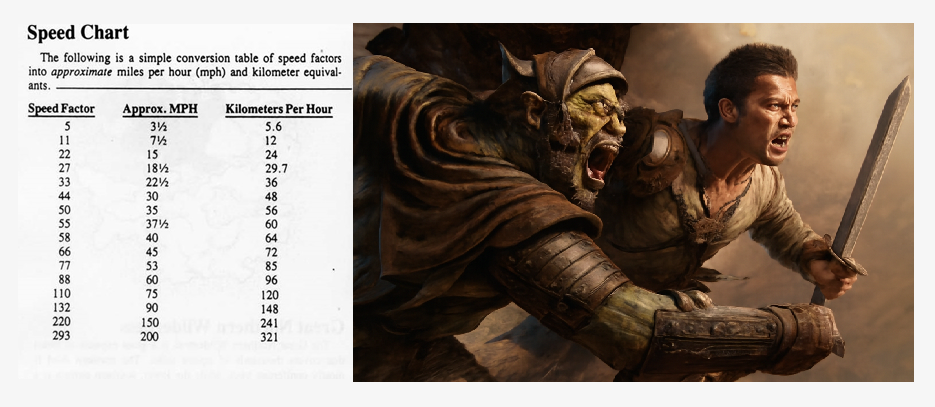
Speed: Average speed by "speed factor" (see speed chart), miles (mph) and kilometers (km). Most animals have an average rate of speed, but can run or fly faster (often double) for a short time (one to a few minutes) in a burst of speed.
Value: Lists any known value for the creature.
Weight: Average weight in pounds and kilograms (kg).
Horror Factor
All supernatural creatures, dragons, most monsters and some animals (usually predators) have a horror factor (this may be more like an awe factor when it comes to gods and Faerie Folk). The horror factor represents either the hideous or frightening appearance of the monster or its overwhelming aura of evil and power (or a combination of the two). Whenever a human/mortal encounters one of these monstrosities, the character must roll a 20-sided die to see whether or not he or she is momentarily stunned by the sheer horror of the thing. This horror factor roll might be thought of as a saving throw or mental parry. Fortunately, the character only needs to roll for the first melee round of each encounter, not every melee of combat.
To save vs horror factor (H.F), the player must roll a 20sided die. Just like a parry, the roll must be equal or higher than the horror factor. For example: A slobbering creature, with a horror factor of 10, emerges from a crypt. All characters who see it must roll to save against horror. In this case, a succesSfuI save is 10 or higher. Everybody but poor Tom rolls above a 10 and saves. Tom rolls a six, so his character is momentarily stunned with horror.
A failed roll means the character is so overwhelmed that he or she is temporarily stunned. In game terms, this means the character loses initiative (don't even roll for it), loses one attack/melee action, and cannot defend himself (no parry or dodge) against the creature's first attack of that melee round. Fortunately, the character snaps out of the shocked stupor quickly and can join in the combat that same melee. By the second melee round, the character has completely recovered his senses and is functioning as normal; roll for initiative and combat as usual.
P.P.E. & H F Animal Reference Table
The following is a general list of P.P.E. and horror factor (H.F.; when applicable) by general animal type. Specific animal descriptions may differ from this general animal list.
- Alligator/CrocodiIe: 2D6 P.P.E. and H.F. 11-14
- Arthropods (spiders/scorpions): I P.P.E. and H.F. 10-15
- Bear: 2D6 P.P.E. and H.F. 11-16
- Birds (small): ID4 P.P.E. and no H.F.
- Birds of Prey: 2D6 P.P.E. and H.F. 7-10
- Cattle/Deer: 2D6 to 3D6 P.P.E. and generally no H.F.
- Cat (small: lynx, wild): 2D6 P.P.E. and H.F. 10-13 cat (large: lion, tiger): 4D6 P.P.E. and H.F. 10-14 Domestic Cat: 3D4 P.P.E. and no H.F.
- Domestic Dog (small): 2D6 P.P.E. and no H.F.
- Domestic Dog (large): 3D6 P.P.E. and H.F. 8-10 if attacking.
- Dog: Wild (small: fox): 2D6 P.P.E. and no H.F.
- Dog: Wild (large: coyote, wolD: 4D6 P.P.E. and H.F. 10-14 if attacking.
- Fish: ID4 P.P.E. and no H.F.
- Horse: 4D6 P.P.E. and no H.F.
- Mouse/Bat: ID4 P.P.E. and H.F. 10-12
- Mustelid (badger, weasel): 2D6 P.P.E. and no H.F.
- Primates: 2D6 to 4D6 P.P.E. and usually little or no H.F.
- Rat: 2D4 P.P.E. and H.F. 10-12
- Reptile (lizard, turtle): ID4 to ID6 P.P.E. and no H.F.
- Rodents: ID4 to ID6 P.P.E. and little or no H.F.
- Snakes: ID6 P.P.E. and H.F. 10-15